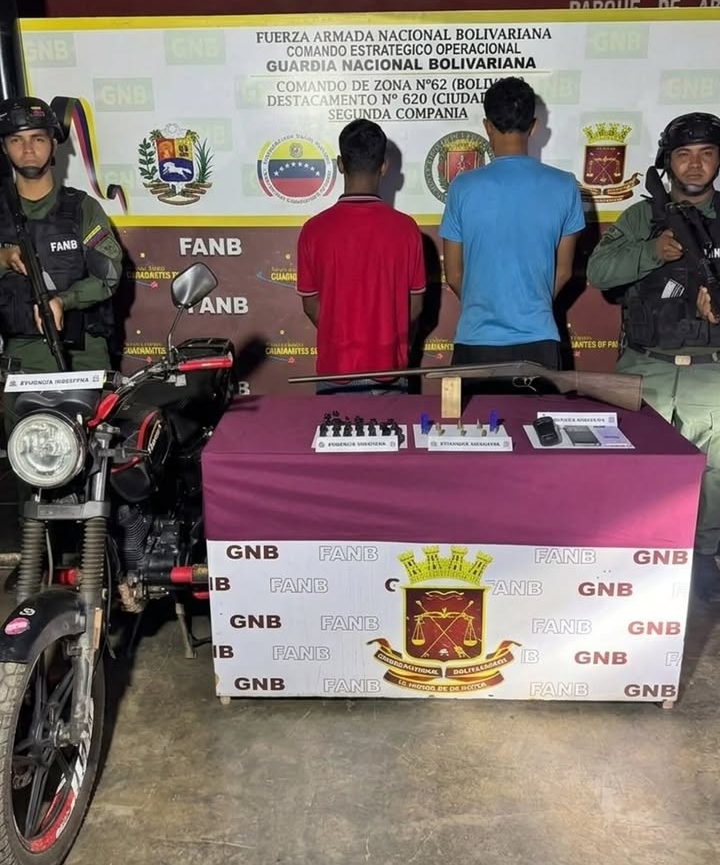
Drug and Firearm Arrest in Ciudad Piar
Venezuelan security forces arrested several individuals in Ciudad Piar, Bolívar State, following the seizure of narcotics and a firearm. This operation, conducted by the National Guard and police, targets the regional narcotics pipeline and the proliferation of illegal weaponry in the strategically sensitive mining corridors of southern Venezuela.
This isn’t just another police blotter entry. When you look at the geography of Ciudad Piar, you are looking at the heart of the “Arco Minero” (Mining Arc). The intersection of illegal gold mining and narcotics trafficking creates a volatile ecosystem where firearms are the primary currency of power. The seizure of weapons and drugs in this specific jurisdiction signals a continuing struggle between state authority and the “sindicatos” (informal mining syndicates) that often control the local economy.
The problem is systemic. In regions where the formal economy has been supplanted by illicit extraction, the vacuum is filled by organized crime. This creates a precarious environment for legitimate business owners and residents, who find themselves caught between military operations and gang enforcement.
The Geopolitical Weight of Bolívar State
Ciudad Piar serves as a critical node for the movement of goods and illicit materials across the state of Bolívar. Because of its proximity to the Brazilian border and the vast mineral deposits of the region, it has become a transit point for cocaine moving toward international markets. The presence of firearms in these arrests suggests a level of militarization among local trafficking cells that exceeds simple street-level dealing.

The United Nations Office on Drugs and Crime (UNODC) has frequently highlighted the nexus between illegal mining and drug trafficking in the Amazonian basin. In Venezuela, This represents amplified by hyperinflation and the collapse of traditional governance, making the “mining-drug complex” a dominant force in the regional economy.
“The challenge in Ciudad Piar is not simply arresting individuals. it is dismantling the financial infrastructure that makes the drug trade more profitable than legal employment. Without economic alternatives, the cycle of recidivism remains absolute.”
For those attempting to operate legal enterprises in these zones, the risk is not just theft, but extortion. Navigating the legalities of land use and mineral rights in a region plagued by instability requires more than just a permit; it requires a sophisticated understanding of regional law. Many operators are now seeking specialized corporate defense attorneys and compliance experts to ensure their operations don’t inadvertently intersect with illicit supply chains.
The Mechanics of the Seizure
The operation in Ciudad Piar focused on the interception of narcotics—likely cocaine or synthetic derivatives—and the recovery of a firearm. While the specific quantity of drugs is often downplayed in initial reports, the presence of a weapon indicates a “protection” element, suggesting these individuals were not merely users but distributors.
The legal ramifications for these suspects are severe under the Venezuelan Organic Law on Drugs, which carries heavy prison sentences for trafficking. However, the real-world impact is felt by the community. Every firearm recovered is one less gun capable of destabilizing a neighborhood, yet the sheer volume of illegal weapons in the Mining Arc means these seizures are often a drop in the bucket.
Security is the primary commodity here.
Local businesses are increasingly forced to invest in private security and risk management. When the state’s presence is inconsistent, the need for vetted private security consultants becomes a matter of survival rather than a luxury. The goal is to create “safe zones” for commerce in an otherwise unpredictable landscape.
Regional Impact Analysis
| Impact Area | Immediate Effect | Long-term Risk |
|---|---|---|
| Local Economy | Disruption of illicit cash flow | Potential for violent retaliation by syndicates |
| Public Safety | Temporary reduction in available firearms | Increased volatility during “power vacuums” |
| Infrastructure | Increased military checkpoints | Slowdown of legitimate commercial logistics |
The Human Cost of the Mining Arc
Beyond the arrests, there is a deeper sociological crisis. Ciudad Piar is a town defined by the “gold rush” mentality. The influx of migrant workers and the desperation born of economic collapse create the population susceptible to recruitment by cartels. The drug trade provides the liquidity that the formal banking system cannot.
This creates a public health crisis. The proliferation of narcotics leads to increased addiction rates within the mining camps, which in turn fuels the demand for more trafficking. This is a feedback loop of instability.
“We see a pattern where the drug trade funds the illegal mining equipment, and the mining profits are used to purchase higher-caliber weaponry. It is a symbiotic relationship that undermines the rule of law in Bolívar.”
Addressing this requires more than police raids. It requires a comprehensive social intervention. Community leaders are calling for the implementation of vocational training and health services. For families devastated by the drug epidemic, finding reputable addiction recovery specialists and mental health professionals is the only way to break the cycle of dependence.
The Road to Stability
The arrests in Ciudad Piar are a tactical victory, but the strategic war is far from over. The Human Rights Watch and other international monitors have noted that security operations in mining zones must be balanced with the protection of civilian rights to avoid further alienating the local population.
If the Venezuelan government can transition from sporadic raids to a permanent, transparent security presence, the “Arco Minero” could actually become a driver of legitimate economic growth. Until then, the region remains a high-risk environment where the line between the law and the lawless is razor-thin.
The volatility of southern Venezuela serves as a stark reminder that security is not a static achievement, but a constant process of maintenance. For the residents of Ciudad Piar, the removal of a few kilos of drugs and a single firearm is a momentary reprieve. The enduring solution lies in the professionalization of the region—replacing the shadow economy with verified legal frameworks and legitimate industry. Those navigating this complex terrain must rely on the highest caliber of professional guidance to survive and thrive. The World Today News Directory remains the definitive resource for connecting global citizens with the verified legal and security experts capable of operating in the world’s most challenging jurisdictions.