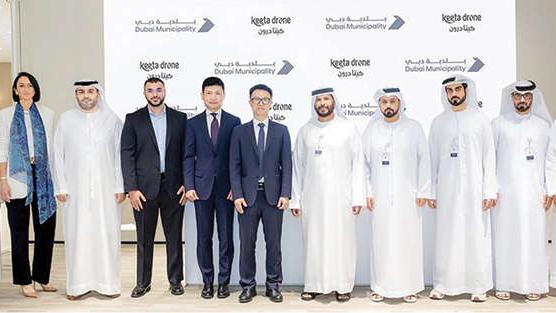
Drone Food Delivery Coming to Dubai Parks and Beaches
Dubai is deploying autonomous drone technology to deliver food directly to public parks and beaches, marking a significant evolution in urban logistics and smart-city infrastructure. This initiative aims to optimize last-mile delivery efficiency while cementing the United Arab Emirates’ position as a global leader in the integration of automated commercial services.
This is more than a convenience for tourists and residents; it is a calculated move in the global race for logistical supremacy. As metropolitan centers across the West grapple with crippling traffic congestion, rising labor costs, and the carbon footprint of traditional delivery fleets, Dubai is leveraging its unique regulatory environment to pilot a future where the sky becomes a primary artery for commerce.
The shift toward autonomous aerial delivery represents a fundamental restructuring of the “last-mile” problem—the most expensive and inefficient segment of the global supply chain. By bypassing ground-level congestion, the UAE is testing a model that could eventually be exported to every high-density urban environment on the planet. For multinational corporations, this signals a looming shift in how goods are distributed, requiring a rapid reassessment of existing logistics and supply chain specialists to prepare for an era of three-dimensional commerce.
The Last-Mile Economic Imperative
In the current global economic landscape, the efficiency of the last mile determines the profitability of the entire retail and food-service sector. Traditional ground-based delivery is increasingly hindered by urban density and the volatility of fuel prices. The deployment of drones in Dubai’s public spaces serves as a live laboratory for a high-margin, low-friction alternative.

The economic implications are twofold. First, there is the direct reduction in operational overhead. Autonomous systems do not require the same labor-intensive structures as traditional courier services, potentially decoupling delivery scalability from human labor shortages. Second, the speed of delivery creates a new tier of consumer expectation that can drive higher transaction volumes in the hospitality and food industries.

However, transitioning from pilot programs to city-wide integration is not merely a technical hurdle. It requires a massive overhaul of urban airspace management. As these systems scale, the demand for sophisticated, real-time coordination software will skyrocket. Firms operating in the Middle East and beyond are already looking toward supply chain optimization specialists to integrate these autonomous aerial nodes into their broader distribution networks.
The move is also a signal to global investors. By demonstrating a functional, high-tech ecosystem, the UAE is positioning itself as a primary destination for Foreign Direct Investment (FDI) in the autonomous technology sector. This is a strategic effort to diversify the national economy away from hydrocarbons and toward high-value, intellectual-property-driven industries.
Regulatory Agility as a Tool of Soft Power
While many nations remain bogged down in the bureaucratic inertia of traditional aviation laws, the UAE has demonstrated a capacity for “regulatory sandboxing”—creating controlled environments where new technologies can be tested without the immediate weight of legacy restrictions. This agility is a form of soft power, allowing the state to set the standards that other nations may eventually be forced to follow.
When a nation successfully establishes the framework for drone-based commerce, it becomes a “rule-maker” rather than a “rule-taker” in the international arena. This has profound implications for international trade and the standardization of Unmanned Aerial Vehicle (UAV) protocols. As these standards coalesce, the legal complexities of cross-border technology transfers and airspace rights will become central to international diplomacy.
Global enterprises must navigate this evolving landscape with precision. The intersection of sovereign law and emerging technology creates a complex web of compliance requirements. Multinational corporations are increasingly relying on aviation regulatory legal experts to ensure that their automated fleets meet both local mandates and international safety standards.
“The transition to autonomous urban delivery is not just a technological milestone; it is a geopolitical shift in how states project efficiency and control over their domestic infrastructure.”
The Security-Innovation Paradox
The integration of drones into public spaces like beaches and parks introduces a significant security dilemma. The same technology that delivers a meal with surgical precision can, if mismanaged, pose risks to privacy, noise pollution, and, most critically, airspace security. The dual-use nature of UAV technology—capable of both commercial utility and tactical application—means that every step toward automation must be met with equal steps in surveillance and defense.

Managing the “low-altitude” airspace requires a level of digital oversight that currently exceeds the capabilities of most municipal governments. We are seeing the emergence of a new requirement for “digital sovereignty,” where a state’s ability to monitor and secure its own skies becomes as vital as its ability to secure its land borders. This creates a massive market for advanced sensor networks, anti-drone technology, and encrypted communication protocols.
For the private sector, this creates a heightened risk profile. As drone density increases, so does the potential for cyber-physical attacks on delivery networks. This reality is driving a surge in demand for geopolitical risk consultants and cybersecurity firms that specialize in protecting automated physical assets from both state and non-state actors.
As the world watches Dubai’s skies, the lesson is clear: the future of global commerce is moving upward. The nations and corporations that master the management of this new dimension will hold the keys to the next era of economic growth. To navigate the complexities of this shifting landscape—whether through regulatory compliance, logistical restructuring, or risk mitigation—industry leaders must leverage the specialized expertise found within the World Today News Directory to secure the partners necessary for this transition.
- Russia Does Not Rule Out US-Mediated Peace Talks With Ukraine in October
- Florida Woman Charged With Attempted Murder After Setting Stranger on Fire at Gas Station
- Iraq Finds Drone Launchers Near Iran After East-West Pipeline Attack Firing (newsy-today.com)
- Russian Drone Attacks Leave Nine Dead and Dozens Injured Across Ukraine (newsdirectory3.com)