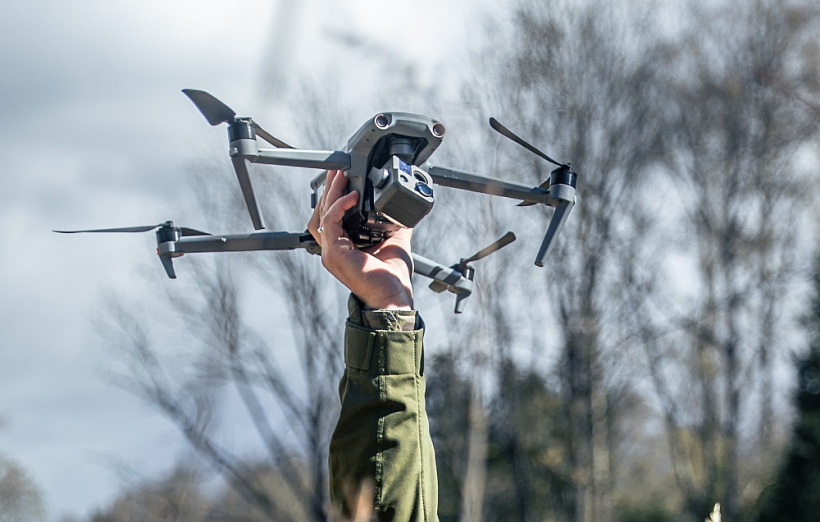
Dron Expert Ieviņš: Tech Obsolete in Months, Monitor Ukraine War
“The innovation cycle is short, but it is not that you have to reinvent the wheel every time,” said Uģis Ieviņš, a drone expert and head of Baltic Unmanned Solutions, according to Lasi.
Ieviņš said the core platform remains similar; the challenge lies in integrating new sensors, changing tactical use and combining drones with other technologies for greater effect. Manufacturers must continuously monitor the course of the war in Ukraine, the tactics used by the adversary and the development of technologies, because technologies can become obsolete in a few months.
Military and civilian drones differ little in construction or operating principle, with many platforms serving both domains, Ieviņš said. The main distinction is the level of autonomy. Simpler, manually piloted systems rely on operator skill for flight, altitude and position. Ukraine widely uses such systems because they are relatively cheap and deployed on one-way missions where the drone is not recovered.
More autonomous systems use sensors and navigation technology to perform functions independently. The operator defines the region and target type for the drone to locate.
A critical difference for military drones is a communications system more resilient to electronic warfare. Until recently, much drone autonomy depended on flying pre-set waypoints using global navigation satellite systems (GNSS), including GPS, Galileo, BeiDou and GLONASS. Military drones no longer rely solely on GPS because its signals are easily disrupted.
One widespread alternative is visual navigation, where a downward-facing camera compares captured images with a map, similar to consumer mapping applications. Other systems use ground-based radio beacons providing additional reference signals. Some drones employ precise inertial navigation, using gyroscopes and sensors to mechanically determine and remember position in space. These signals are harder to affect with jamming or spoofing.
“Signal jamming occurs when transmitters on the ground shout louder than the satellites and the drone can no longer receive navigation signals and determine its location,” said Maj. Modris Karišs, head of the Autonomous Systems Competence Center.
Karišs said Russian long-range drones equipped with alternative navigation systems cannot be neutralized by electronic warfare methods. If the alternative system simultaneously fails, the drone may fly in an unknown direction. In rare cases, when jamming succeeds — occurring in about one in a thousand instances — the system can freeze, lose the satellite signal and fail to restore the original navigation.
With close-range drones, the situation differs. In combat conditions, using such drones for object protection, both GNSS signals and communication between operator and unmanned aerial vehicle are jammed.