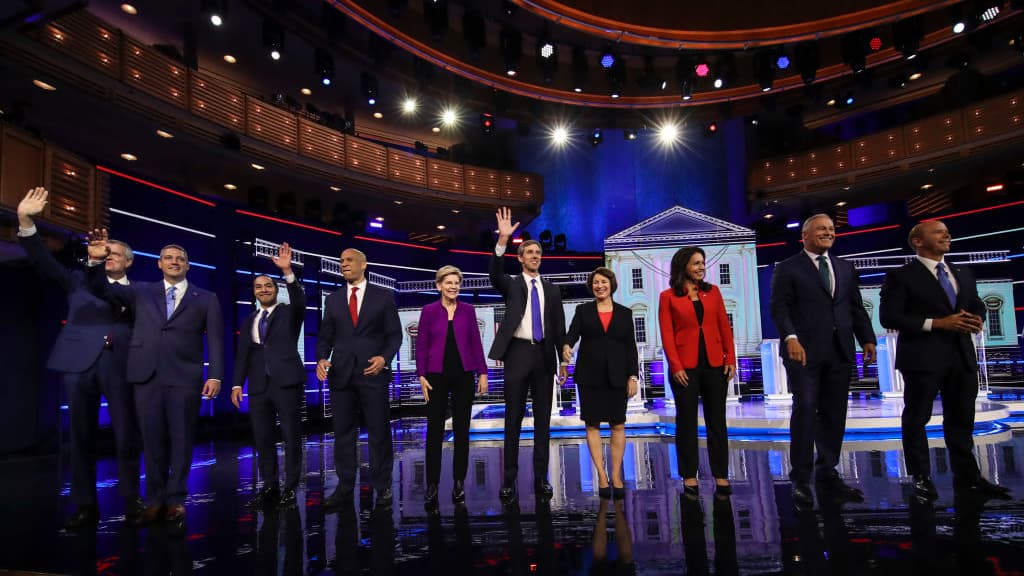
DNC Requires Dark Money Pledge for 2028 Primary Debates
Democratic presidential candidates must sign a pledge denouncing super PAC and dark money spending to qualify for the party’s 2028 primary debates, the Democratic National Committee announced Monday.
The rule applies to a dozen scheduled debates beginning in June 2027, the first time the DNC has made such a pledge a condition of participation.
DNC Chairman Ken Martin said the framework will “keep our party united, strengthen our eventual nominee, and put Democrats in position to take back the White House.”
The announcement follows November’s midterm elections, in which Democrats won 258 House seats and a Senate majority, their largest congressional majority since the early 1990s, TIME reported. The 2026 cycle also set a spending record: political advertisers spent $12.06 billion, the first midterm to outspend a presidential cycle, according to AdImpact data cited by TIME.
How the pledge works
Candidates who sign the Fair Campaign Practices Pledge must denounce spending by super PACs and by 501(c)(4) “dark money” groups that do not disclose donors. Each campaign will designate a representative to report outside spending to the DNC. If a candidate misses the deadline to denounce a group’s spending, they are disqualified from that debate and all subsequent debates until they do so.
The DNC will publish a tracker of complaints, their status, and candidates’ denunciations, TIME reported.
The requirement covers only the primary, not the general election. David Meyers, a spokesperson for OpenSecrets, said that dark-money spending in the 2020 Democratic primary totaled about $5 million — a “drop in the bucket” compared with roughly $52 million in total outside spending that cycle, per Issue One.
Enforcement questions
Experts say the rule’s impact depends on enforcement. Daniel Weiner, a campaign finance expert at the Brennan Center for Justice, told TIME the pledge is “not itself a huge accomplishment” without legislation to curb outside spending. He said enforcement will be clear in extreme cases of coordination, but “it’s too soon to tell” how it works in practice.
Robert Boatright, a political science professor at Clark University, called the “denounce” standard “slippery.” He told TIME a super PAC could attack a candidate without supporting anyone, letting rivals benefit while distancing themselves. The DNC requires every opponent to denounce spending that attacks any candidate. Boatright said a candidate caught colluding with outside groups after signing the pledge would take “a big hit in public opinion.”

Debate schedule set for June 2027 start
The DNC announced a calendar of 12 primary debates beginning in June 2027, with five debates in 2027 and seven in 2028, the Independent reported.
The DNC said criteria for making the stage will be similar to 2020, including polling and grassroots fundraising thresholds, with more details on times and locations coming in January.
Midterm momentum shapes early planning
The announcement follows Democrats’ November midterm performance in which the party flipped both chambers and secured its largest congressional majority in decades, the AP reported. Democrats will hold 258 House seats and a Senate majority when the new Congress convenes in January.

Enforcement questions and outside-spending dynamics
Daniel Weiner of the Brennan Center told TIME the pledge is “not itself a huge accomplishment” without legislation to curb outside spending, and said enforcement will be clear in extreme coordination cases but “it’s too soon to tell” how it works in practice. Robert Boatright of Clark University called the “denounce” standard “slippery,” noting a super PAC could attack a candidate without supporting anyone, letting rivals benefit while distancing themselves.
Boatright said a candidate caught colluding with outside groups after signing the pledge would take “a big hit in public opinion.”
The Democratic National Committee, as the principal executive leadership board of the Democratic Party, holds general responsibility for party affairs between National Conventions and specifically organizes and calls for the Democratic National Convention every four years, TIME noted.
This authority extends to establishing rules for the caucuses and primaries that choose convention delegates, including the power to set qualification criteria such as the new Fair Campaign Practices Pledge for the 2028 primary debates.
Chaired by Ken Martin and composed of state representatives, elected officials, and constituency group leaders elected by DNC members, the committee coordinates national campaign strategy and supervises the presidential nominating process, according to its charter.
Voter pressure and party divisions
The Independent reported that the debate schedule — five debates in 2027 and seven in 2028, capped at 20 candidates over two nights — anticipates a crowded field with no clear frontrunner. The DNC will announce locations in January, with the final debate planned for March 2028.
The party has narrowed convention-site finalists to Boston, Denver and Philadelphia.
“The DNC is keeping our foot on the gas as we head into the 2028 cycle,” Martin said in an emailed statement to the Associated Press.