
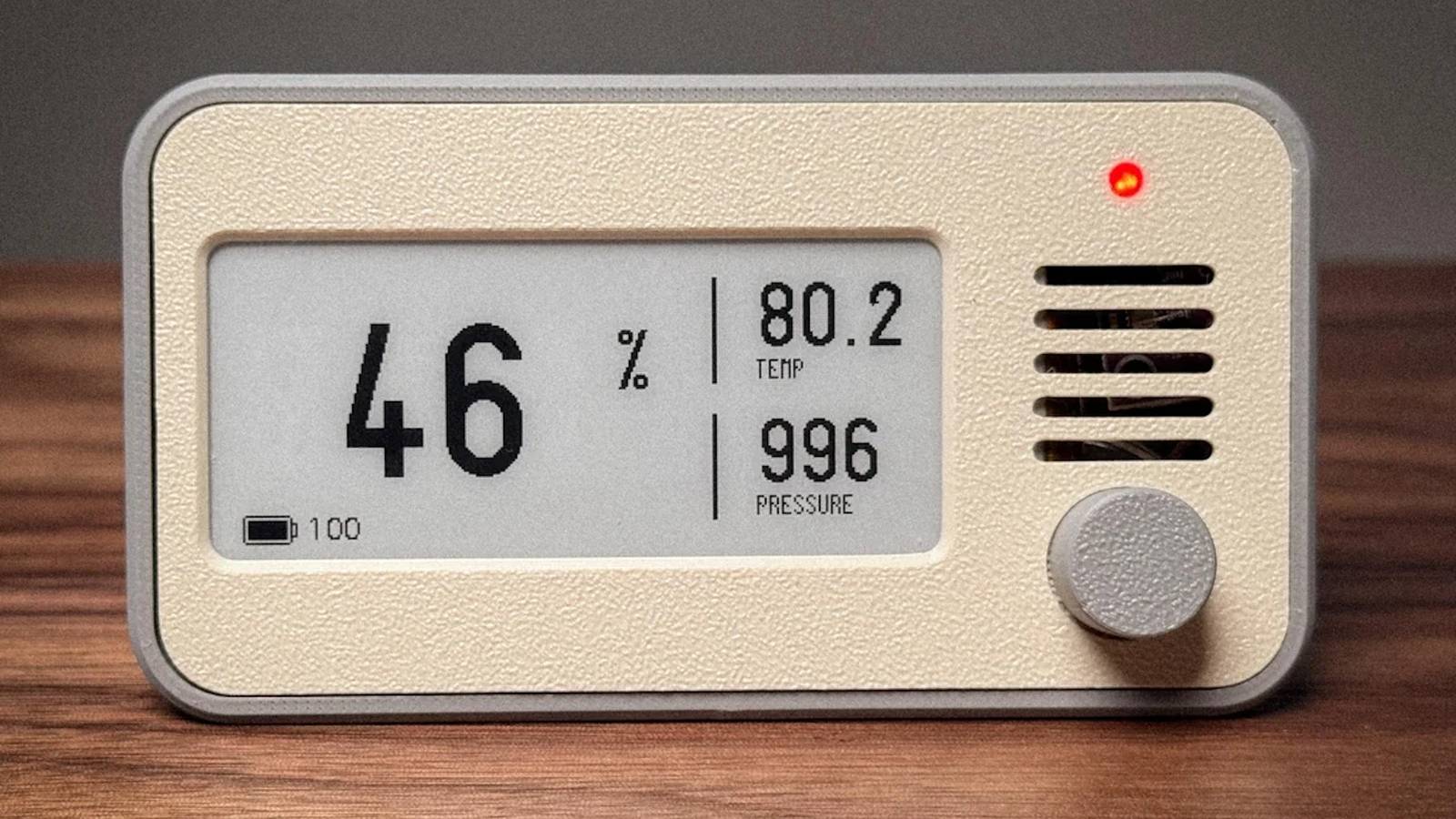
DIY ESP32 e-Ink Environmental Monitor: Temperature and Humidity Tracker
Architecting Low-Power IoT: The ESP32 E-Ink Environmental Monitor
The integration of ESP32 microcontrollers with e-Paper (e-Ink) displays offers a high-efficiency solution for environmental monitoring, specifically for long-term data logging where power consumption is the primary architectural constraint. By utilizing the ultra-low-power deep sleep modes inherent in the Espressif ESP32 SoC, developers can maintain temperature and humidity telemetry for months on a single LiPo battery charge, according to recent community-driven build documentation published on XDA Developers.
The Tech TL;DR:
- Energy Efficiency: The ESP32 utilizes a deep-sleep current draw of approximately 10µA, enabling multi-month operation on standard 18650 cells.
- Latency Management: E-Ink displays offer zero power draw for static images, making them ideal for telemetry that does not require real-time refresh rates.
- Deployment Reality: This hardware configuration is best suited for localized sensor nodes where high-bandwidth connectivity is unnecessary and local data logging is preferred.
Hardware Benchmarking and Thermal Performance
When evaluating the ESP32 for environmental sensing, the bottleneck is rarely the processor’s compute capability, but rather the efficiency of the power management integrated circuit (PMIC) and the sensor interface protocol. The ESP32-WROOM-32 module provides a dual-core Xtensa LX6 microprocessor, which is overkill for simple I2C sensor polling. However, its robust support for SPI makes it the industry standard for interfacing with Waveshare-style e-Ink panels.
| Metric | ESP32 (Deep Sleep) | Standard Arduino Nano |
|---|---|---|
| Current Draw | ~10µA | ~10mA – 20mA |
| Interface | SPI/I2C/Wi-Fi | I2C/UART |
| Display Support | E-Ink (Bistable) | OLED/LCD (Active) |
According to the official Espressif ESP-IDF documentation, the transition from active Wi-Fi transmission to deep sleep is the most critical phase for battery longevity. Developers must ensure that the Arduino-ESP32 core is configured to power down the radio and peripherals prior to entering the sleep state to avoid “vampire” power drain.
Implementation: Interfacing the BME280 Sensor
For high-precision temperature and humidity tracking, the BME280 sensor remains the preferred component for its stability and low noise floor. The following snippet illustrates how to initialize the sensor and trigger a refresh on a typical GDEW e-Ink display driver:
#include <Adafruit_BME280.h>

#include <GxEPD2_BW.h>
void setup() {
// Initialize I2C for BME280
bme.begin(0x76);
// Wake display and write telemetry
display.init();
display.setRotation(1);
display.firstPage();
do {
display.print(bme.readTemperature());
} while (display.nextPage());
// Enter deep sleep for 30 minutes
esp_deep_sleep_start(1800000000);
}
As noted by lead maintainers in the open-source community, the primary risk in this architecture is the “ghosting” effect on e-Ink panels if the refresh interval is too frequent. For enterprise-grade reliability, developers should implement a partial refresh cycle only when the delta between the current reading and the last logged value exceeds a predefined threshold.
Cybersecurity and Infrastructure Triage
Deploying ESP32-based devices across a facility introduces a unique attack surface. While these devices often lack the memory for complex containerization or full-scale Kubernetes orchestration, they remain vulnerable to man-in-the-middle (MITM) attacks if the firmware does not implement end-to-end encryption for the MQTT telemetry stream. If you are scaling these devices in a production environment, your firm should consult with a Cybersecurity Auditor to ensure that the firmware signing process is robust and that TLS 1.3 is enforced for all outbound traffic.
Furthermore, managing a fleet of these devices requires a centralized configuration management strategy. Organizations failing to update firmware remotely risk leaving devices exposed to known vulnerabilities in the underlying FreeRTOS kernel. In such cases, engaging a Managed Service Provider to manage the Over-the-Air (OTA) update pipeline is standard practice for maintaining SOC 2 compliance.
The Future of Low-Power Telemetry
The trajectory of environmental sensing is moving toward “Energy Harvesting” nodes—where the battery is replaced by small solar or piezoelectric cells. According to research published by IEEE, the combination of bistable displays and sub-microamp microcontrollers represents the most viable path toward truly autonomous, set-and-forget sensor networks. As these components continue to commoditize, the barrier to entry for enterprise-grade environmental monitoring will continue to drop, necessitating a shift in focus toward data integrity and secure cloud ingestion pipelines.
Disclaimer: The technical analyses and security protocols detailed in this article are for informational purposes only. Always consult with certified IT and cybersecurity professionals before altering enterprise networks or handling sensitive data.