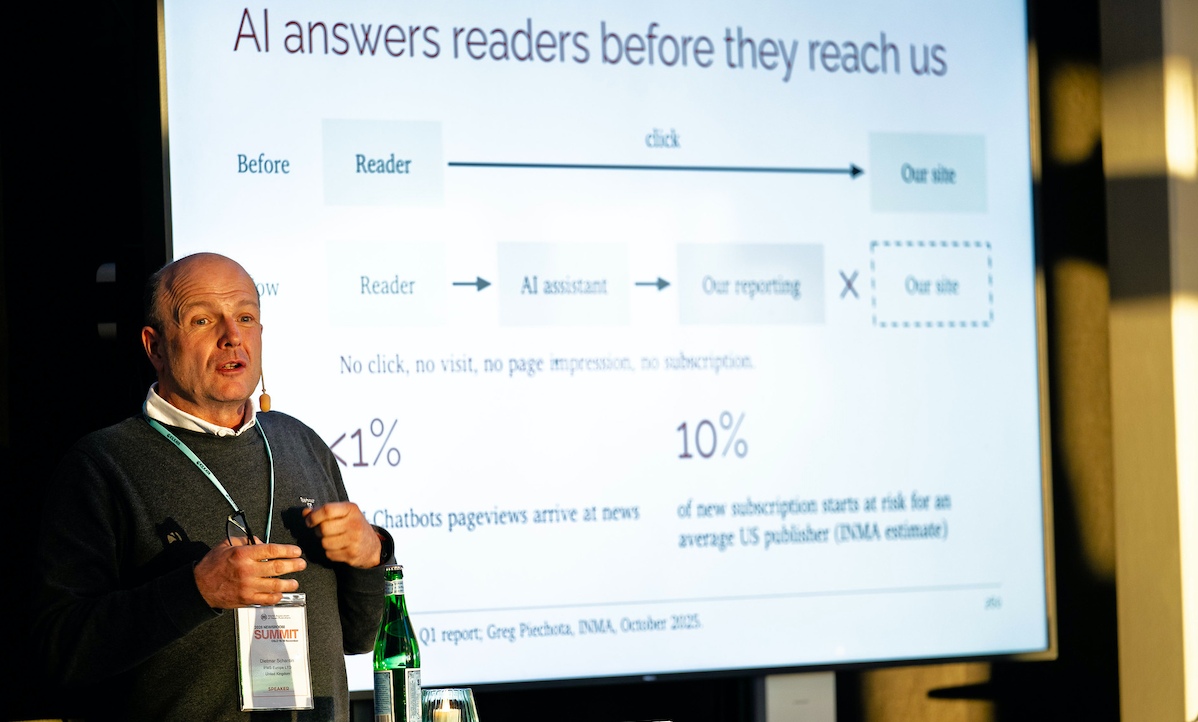
Dietmar Schantin: Keep Narrative Human, Use AI for Facts Only
Journalists must abandon the use of artificial intelligence for drafting news to preserve the integrity of human-led storytelling, according to strategist Dietmar Schantin.
Speaking at the WAN-IFRA Newsroom Summit in Oslo, Schantin argued that delegating the initial phase of reporting to software allows machines to dictate the vocabulary and angle of a story, effectively trapping the human reporter in a “finished and decorated” room, News – WAN-IFRA reported.
Gallup’s latest polling places American trust in mass media at 33%, an increase from the 28% cited in Schantin’s book, The Architecture of Journalism in the Age of AI, though he said that the rise originated from Republican respondents.
Concurrently, data from SparkToro indicates that 68% of Google searches in America resulted in no clicks during the first four months of this year, while Chartbeat data shows that chatbots return less than 1% of pageviews to publishers.
Schantin proposed a fifth layer in the editorial process, which he terms “narrative,” positioned between knowledge and wisdom. While he advocates for using AI to gather and organize facts, he maintains that the narrative layer—the decisions regarding what a story is, who it serves, and what to omit—must remain exclusively human.
He likened the process to music composition, noting that while software can arrange notes, a human composer makes deliberate choices that readers trust and can question.
Legal and accuracy failures are increasingly forcing publishers to reconsider their reliance on automated summaries. In May, the Munich regional court granted an injunction against Google after AI Overviews incorrectly linked two Munich publishers to scams, treating the summary as the company’s own statement.
In April, The New York Times published an AI-generated summary that misidentified a remark by Canadian Conservative leader Pierre Poilievre as a direct quotation, necessitating a correction that took more than two weeks to resolve.
Schantin urged newsrooms to audit their internal AI features by identifying who is accountable for the narrative choices made by the system. He warned that news organizations unable to name a responsible person for an editorial decision risk losing their value proposition to the audience.
As the global trade association representing more than 18,000 publications across 100 countries, WAN-IFRA convenes the annual Newsroom Summit to shape editorial strategy and defend press freedom.
At the 2024 event in Oslo, the organization provided the platform where strategist Dietmar Schantin argued that newsrooms must retain human control over the narrative layer of journalism—defining what a story is, who it serves, and what to omit—rather than delegating those choices to AI systems.
Through its World Editors Forum unit, WAN-IFRA translates summit discussions into ongoing guidance for editorial leaders navigating technological disruption. The 2024 summit’s focus on accountability—urging publishers to name a specific person responsible for every AI-influenced editorial decision—exemplifies how the association uses its convening authority to set practical standards that preserve audience trust and the industry’s value proposition.
“At least at the moment,” this human-led approach is where the business model has a chance, Schantin said.