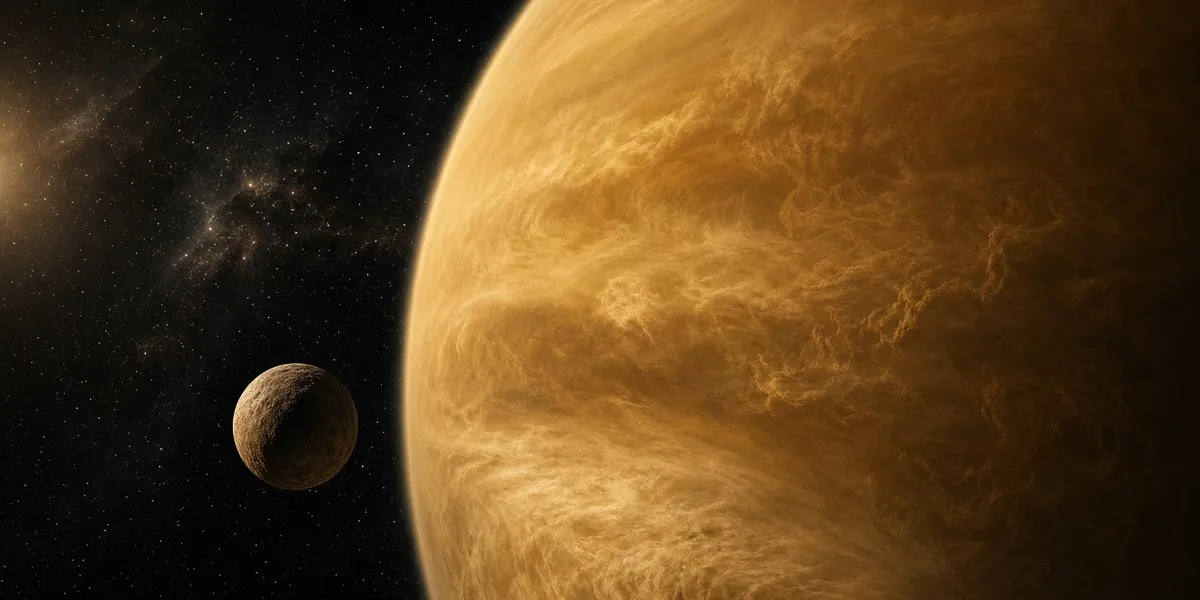
Did Venus Swallow Its Own Moon? New Study Suggests Slow Rotation Caused Lunar Crash
Venus May Have Swallowed Its Own Moon Due to Slow Rotation
Venus, despite sharing a comparable mass, structure, and radius with Earth, lacks a natural satellite—a long-standing mystery in planetary science. According to research published in The Astrophysical Journal and reported by ScienceDaily, new computational modeling led by University of California, Riverside astrophysicist Stephen Kane suggests that Venus may have once possessed a moon that was systematically pulled back into the planet by its own gravitational field combined with an unusually sluggish rotation rate.
The Tech TL;DR:
- Core Mechanism: Venus rotates once every 243 Earth days, a sluggish spin rate that causes a hypothetical moon to spiral inward rather than drift outward.
- Research Findings: Computer models built by UC Riverside astrophysicist Stephen Kane indicate that hypothetical moons ranging from half to ten times Earth’s lunar mass consistently crashed into Venus across simulations.
- Detection Hurdles: Approximately 80 percent of the Venusian surface underwent major global resurfacing roughly a billion years ago, meaning direct impact craters are likely wiped out, requiring deep seismic analysis instead.
Orbital Mechanics and the Slow-Spin Paradox
To understand why a Venusian moon would be doomed, planetary scientists contrast its dynamics against the Earth-Moon system. Precise measurements enabled by retroreflectors left on the lunar surface during the Apollo 11 mission show that Earth’s moon is currently receding from our planet at a rate of roughly four centimeters per year, as reported by ScienceDaily. That outward migration is driven by Earth’s rapid 24-hour rotation, which transfers angular momentum to the lunar orbit.

Venus operates under entirely different rotational constraints. A single rotation of Venus takes approximately 243 Earth days. Under these physical conditions, the tidal interaction flips entirely. Instead of transferring momentum outward, the combination of planetary gravity and a slow spin drags a satellite inward. To evaluate this hypothesis, Kane developed gravitational simulation models. After validating the framework against Earth and our moon, he tested multiple hypothetical moon masses—ranging from 50% of our moon’s mass up to ten times its mass—against varying rotation rates for Venus, noting in ScienceDaily that he was “shocked” when virtually all simulation parameters ended in a planetary collision.
Uncovering Sub-Surface Clues Beneath Venusian Crust
Proving that Venus swallowed a moon is exceptionally difficult due to the planet’s violent geological history. Consequently, looking at surface craters will not provide answers.

Instead, scientists look toward interior mapping. Early impacts on Earth left deep seismic anomalies in the mantle, a phenomenon discovered through terrestrial seismic studies. Similar deep-interior measurements and gravity mapping of Venus could uncover dense remnants or structural anomalies left behind by an ancient moon collision.
Energy Dissipation and Atmospheric Implications
A moon spiraling into Venus would not merely slip beneath the surface quietly. Understanding these historical energy inputs is vital for evaluating whether Venus was ever habitable before entering its current runaway greenhouse state.
Editorial Kicker
As planetary scientists refine interior modeling techniques in anticipation of upcoming missions to Venus, decoding the planet’s deep seismic profile will ultimately determine if its missing moon is buried deep within its mantle.