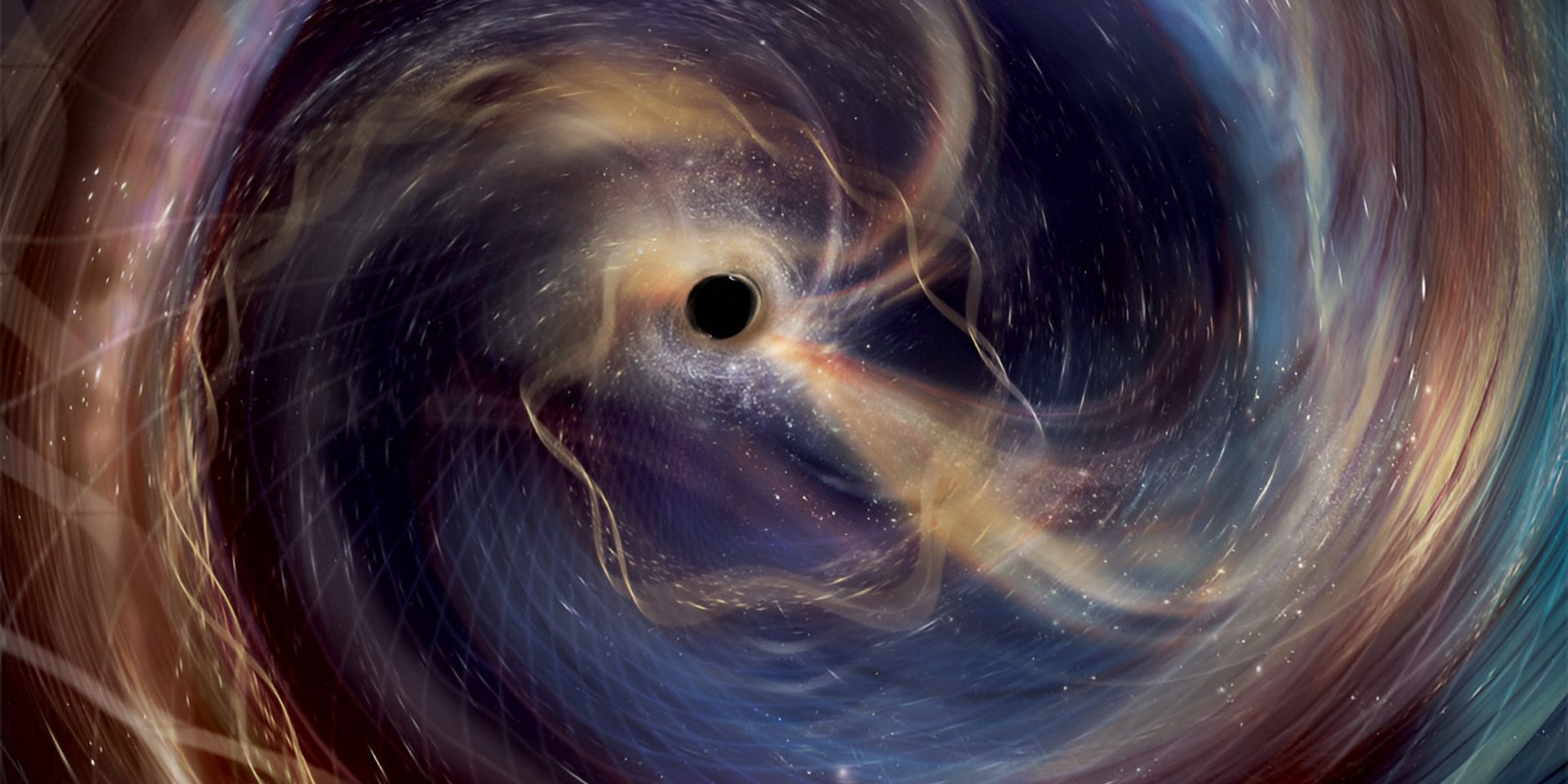
Did Black Hole Collisions Prove Einstein Wrong?
Gravitational wave detectors have confirmed that the final moments of black hole collisions provide a high-precision test of Albert Einstein’s General Theory of Relativity. Researchers analyzing data from the Laser Interferometer Gravitational-Wave Observatory (LIGO) and the Virgo interferometer have determined that the “ringdown” phase—the period immediately following the merger—aligns with Einstein’s predictions regarding the characteristics of the resulting single black hole.
## Verification of the No-Hair Theorem
The findings center on the “no-hair theorem,” a core tenet of general relativity which posits that a black hole is entirely defined by only three observable parameters: its mass, its electric charge, and its angular momentum (spin). According to this theorem, the specific gravitational waves emitted as a newly formed black hole stabilizes—the ringdown—should be dictated solely by these three properties.
Analysis of the signal GW150914, the first gravitational wave detection, and subsequent events has allowed physicists to calculate the mass and spin of the final black hole using both the initial inspiral phase and the subsequent ringdown. The data indicates that the properties derived from both phases are consistent, confirming that the black hole does not possess additional, unexplained characteristics or “hair” that would deviate from Einstein’s mathematical framework.
## Analyzing the Ringdown Signal
The ringdown phase occurs as the distorted, newly merged black hole sheds its irregularities to settle into a stable state. This process emits gravitational waves at specific, damped frequencies. By isolating these frequencies, scientists can effectively “hear” the geometry of the black hole.
If general relativity were incorrect, or if the merged object deviated from the expected Kerr black hole model, these frequencies would shift in ways that contradict the theory. Current observations show that the observed frequencies match the theoretical predictions within the limits of detector sensitivity. This consistency reinforces the reliability of the Kerr metric, the solution to the Einstein field equations that describes rotating, uncharged black holes.
## Technical Constraints and Future Sensitivity
While the results align with current physical models, researchers note that the precision of these tests is currently limited by the signal-to-noise ratio of existing detectors. Because the ringdown signal is relatively faint compared to the initial merger, distinguishing the specific harmonics requires high levels of instrumental accuracy.
The international scientific community is now looking toward next-generation detectors, such as the planned Einstein Telescope and Cosmic Explorer. These facilities are expected to provide significantly higher sensitivity, enabling more granular measurements of the ringdown phase. These future observations will determine whether smaller, subtler deviations from general relativity exist, or if Einstein’s century-old predictions remain robust under even more extreme conditions. The next phase of research remains focused on refining these signal-processing techniques to prepare for the increased data volume expected from future observation runs.