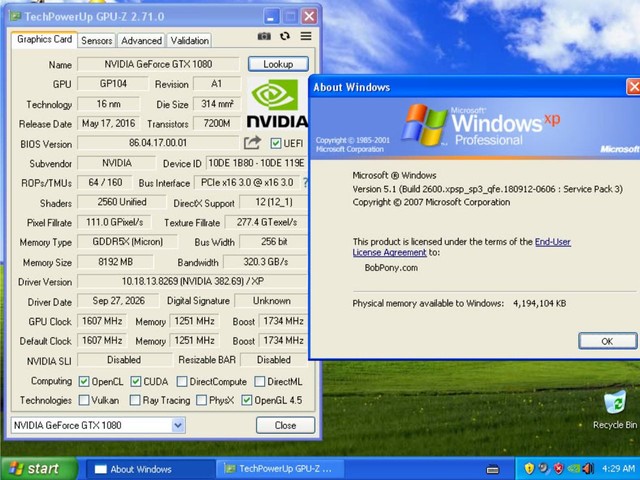
Developer builds custom ForceWare 382.69 driver for NVIDIA GTX 9 and 10
An independent developer has built a custom Forceware 382.69 driver for Windows XP, enabling NVIDIA GeForce GTX 9 and 10 series graphics cards to operate on the legacy operating system, HKEPC reported. The project bridges a hardware gap that forced many users to abandon the platform years ago, addressing missing support for Maxwell and Pascal architecture GPUs on the 32-bit system.
Custom INF Files Expand Hardware Recognition
The release is not a simple configuration file edit. Through customized INF files and source reconstruction, the developer generated a functional Forceware 382.69 driver that significantly expands hardware recognition.
The expanded support list covers multiple major GPU architectures and professional lines:

- Maxwell Architecture: Includes GeForce GTX 970, 980, 980 Ti, TITAN X (Maxwell), alongside select OEM editions of the GTX 950 and 960.
- Pascal Architecture: Encompasses GeForce GTX 1060 (3GB/5GB/6GB), 1070, 1070 Ti, 1080, 1080 Ti, TITAN X (Pascal), and TITAN Xp.
- Quadro Workstation Cards: Covers the Quadro M4000, M5000, and M6000 series, plus Pascal-based P2000, P4000, P5000, and P6000 models.
- Experimental GP107 Support: Introduces initial compatibility for the GTX 1050, GTX 1050 Ti, and Quadro P400, P600, P620, and P1000, though hardware verification for these chips remains in progress.
Custom Driver Resolves Software Limitations
Beyond hardware recognition, the custom driver addresses several deep-level software limitations inherent to running modern silicon on older operating systems. The developer stated that the package resolves OpenGL display class initialization failures, improves DisplayPort handling mechanisms, corrects HDMI 2.0 output capabilities, and unlocks EDID reading alongside system topology inspection.
Distributed under the GPL-3.0-only license with a narrow NVIDIA integration exception clause, the project is hosted on GitHub. The repository includes Python-based patchers, C and assembly routines, and installation templates, allowing technical users and retro-hardware enthusiasts to inspect and rebuild the driver independently.