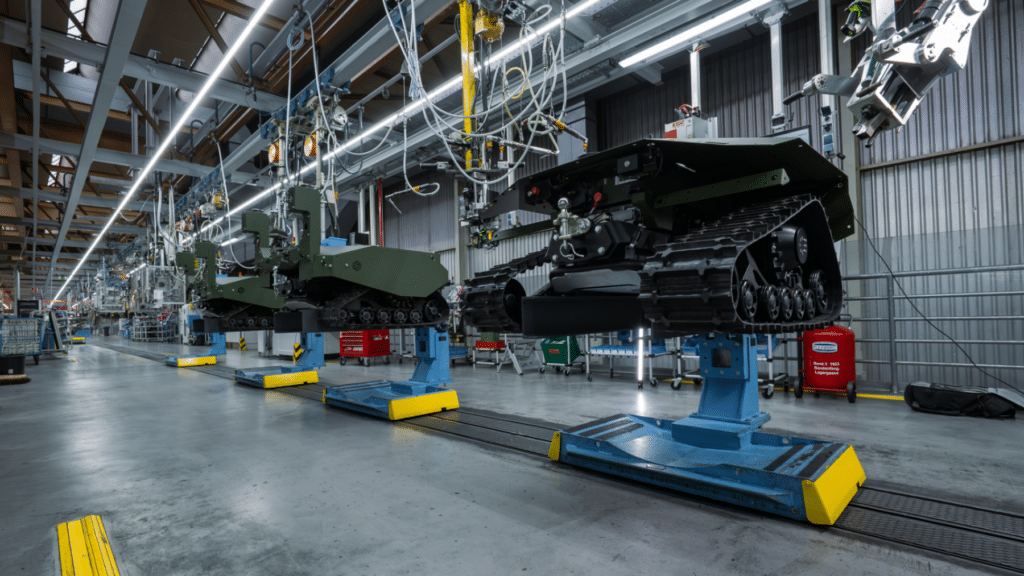
DEUTZ Opens First Industrial Plant for ARX Military Robots in Ulm
German tractor engine manufacturer DEUTZ has converted a production plant in Ulm into the first industrial series-assembly line for military ground robots, partnering with technology firm ARX Robotics to produce the GEREON unmanned ground vehicle, according to reporting by Autonoción.
Industrial Conversion at the Ulm Plant
For more than a century, DEUTZ built its business on internal combustion engines for agricultural tractors, construction machinery, and industrial vehicles. That manufacturing infrastructure now builds modular, tracked robotic systems designed for contested environments. The platform at the center of this shift, the GEREON, emerged from an ongoing strategic alliance between DEUTZ and Munich-based ARX Robotics.
Operations in Ulm move the tracked systems from prototype status to industrial scale.

Specifications and Operational Capabilities
The GEREON is a medium-sized, tracked unmanned ground vehicle built on a modular architecture designed to swap mission payloads without tools. According to Autonoción, the platform weighs roughly 450 kilograms in its baseline configuration and features a payload capacity of up to 500 kilograms. It travels at a maximum speed of 15 kilometers per hour in its current iteration, offering a travel range of up to 40 kilometers and a continuous operation window of 72 hours on a single battery charge, which takes 2.5 hours to replenish.
Remote operators control the vehicle at distances up to 4 kilometers using teleoperation or autonomous navigation modes. The platform integrates thermal imaging for nocturnal operations alongside ARX OmniConnect connectivity, supporting Bluetooth, Wi-Fi, 4G/5G, dual-band GNSS, and Starlink compatibility. An earlier prototype evaluated during 2023 autonomy trials in Estonia incorporated a LiDAR sensor, a stereo camera, and dual GPS receivers to execute follow-me tracking and obstacle avoidance.
Modular Deployments in Active Zones
Field flexibility dictates the vehicle’s deployment profile. The absence of required tools allows operators to reconfigure the platform within minutes for distinct operational demands. Current deployment configurations span several distinct categories:
- Last-mile logistics: Transporting water, ammunition, and provisions to advanced positions. This unarmed variant is already active in Ukraine.
- Medical evacuation (MedEvac): Extracting casualties from exposed zones without risking additional personnel.
- Surveillance and reconnaissance: Operating as a mobile sensor node with integrated tethered drones.
- Combat variants: Equipping the chassis with 5.56 mm weapons, grenade launchers, or 7.62 mm stabilized remote weapon stations.
- Anti-drone defense: Integrating the Dedrone Defender 2 electronic warfare system, a configuration displayed in 2025.
Underpinning these hardware configurations is Mithra OS, an artificial intelligence-driven software platform developed by ARX Robotics.
DEUTZ Propulsion Systems Will Extend Robotic Operating Range
The manufacturing agreement extends beyond chassis assembly to the integration of DEUTZ propulsion systems into ARX robotic platforms. Current models rely exclusively on electric battery power. Future iterations will introduce compact internal combustion engines or hybrid powertrains developed by DEUTZ, a step designed to extend the operating range of the tracked systems. Both companies plan to engineer a specialized software interface linking Mithra OS directly to the DEUTZ engine architecture, a development cycle expected to take several months.