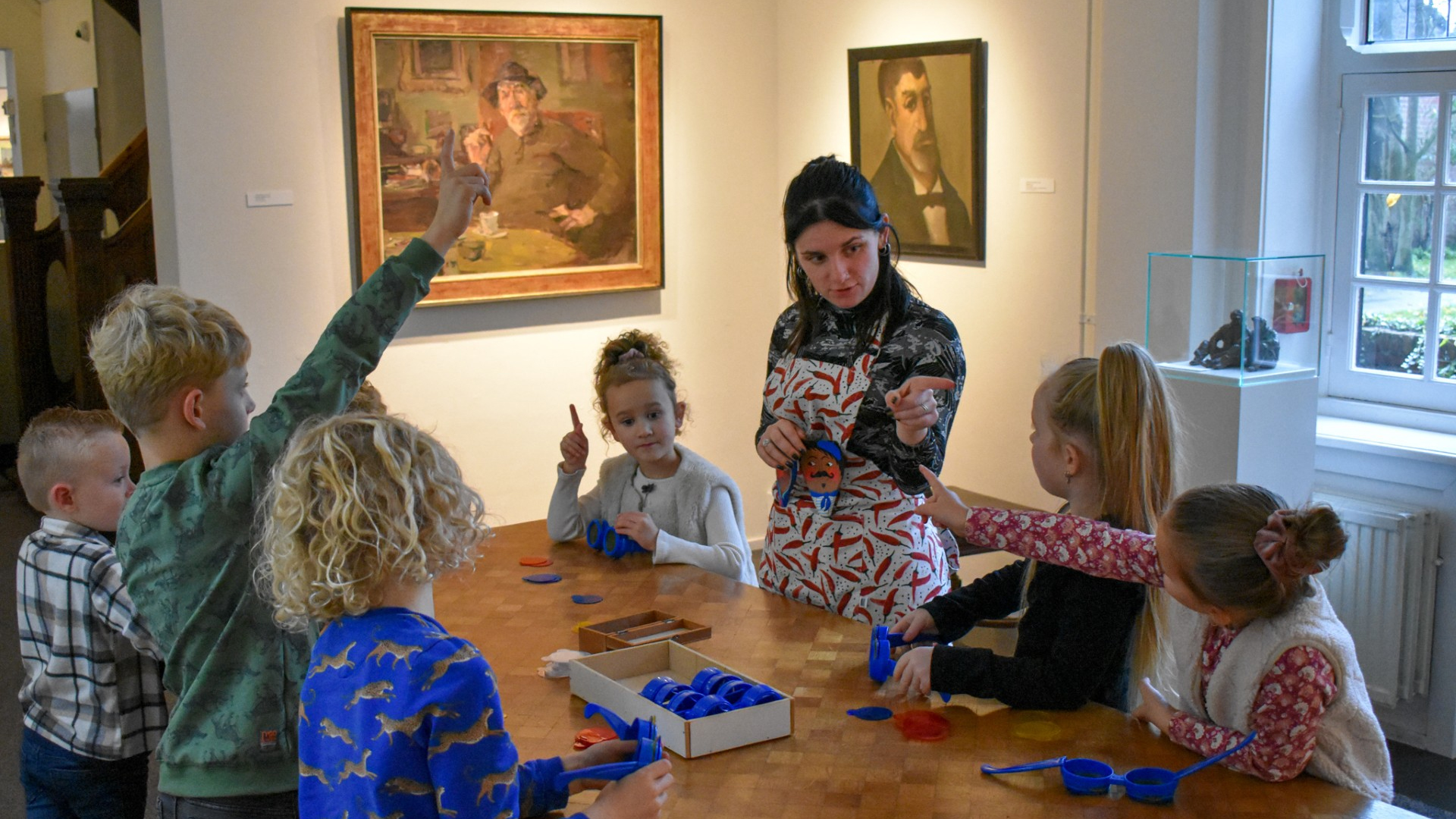
Deurne Pupils Cook Art at Museum De Wieger
Some 1,400 elementary school children from the municipality of Deurne are filing through Museum De Wieger this autumn — and most of them have never set foot in the building before.
Deurne Media Groep reported the numbers as the museum runs two fixed education programs for 55 lower-school classes, programs built to push pupils past simply looking at what hangs on the walls.
Museum docent Isa van Berlo of De Wieger told Deurne Media Groep that the youngest groups set out on a voyage of discovery when they arrive, because the museum itself is unfamiliar to most of them.
For groups 1 and 2, art-making turns into cooking. The children hunt for the right “ingredients” with help from four cheerful spoons — Klaartje Kleur, Pietje Potlood, Vicky Vorm and Kees Kunstenaar — characters built around color, pencil, shape and the artist himself. They search the galleries for different colors, shapes and materials, gathering everything needed for their artwork. Then everything goes into the pan.
What comes out in the end is left open, as the museum frames it. Can a work of art truly be “cooked”? The children decide.
Older pupils get a different brief. Groups 3 and 4 are asked to help the museum docents prepare for an important guided tour scheduled for the following day. Along the way, the team puts questions to them: what is a shape, and what is a blot? Where is the light, and where is the dark? Is this artwork happy or angry?
Deurne Media Groep sat in on one of the school visits this week to see the programs in action.
“It is wonderful to see what happens when children are given the space to look for themselves, ask questions and discover. It is precisely that curiosity that makes a museum visit so valuable,” the education team said.
Deurne itself lies in the province of North Brabant, a rural municipality of 33,596 inhabitants (2026) that also takes in the villages of Liessel, Vlierden, Neerkant and Helenaveen. The place was first recorded as Durninum — “near thorns” — in a deed of gift from the Frankish lord Herelaef to bishop Willibrord in 721.
For centuries it remained a cluster of farming hamlets west of the Peel peat moor, until the arrival of the Zuid-Willemsvaart canal in 1826 and the Eindhoven–Venlo railway in 1866 opened the moor up for commercial exploitation.
Photo: Museum De Wieger