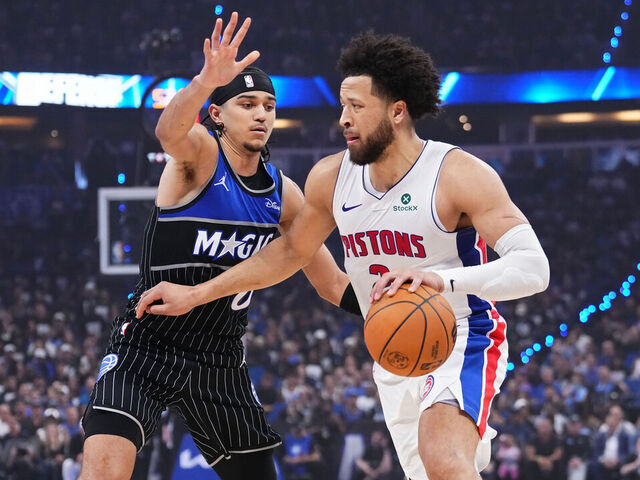
Detroit Pistons erase 24-point deficit to force Game 7 against Orlando Magic
The scoreboard in Orlando showed a 60-38 lead at the half, a margin that typically signals the end of a contest. For the Orlando Magic, the game represented a critical opportunity to advance toward the Eastern Conference semifinals. For the Detroit Pistons, this deficit served as the starting point for a gradual recovery of the lead, achieved through a consistent effort to reclaim the game one possession at a time.
The second-half shift demonstrated a significant change in momentum. While the Magic struggled offensively—shooting 4-for-37 in the second half—the Pistons adhered to a strategy of chipping away
, a phrase used by star Cade Cunningham to describe the process of reducing the lead from 24 points to 11, then six, before finally seizing control.
The Mechanics of the 42-10 Run
The shift in momentum was not instantaneous but cumulative. According to reporting from Yahoo Sports, the Pistons required 16 minutes and 24 seconds of game time after halftime to tie the score. This period saw the Pistons outscore the Magic 55-19 across the second half, a disparity that reflects one of the most severe offensive collapses in postseason history.
The volatility of the run was anchored by a defensive lockdown that reached a statistical extreme. The Magic missed 23 consecutive field goals during a stretch in the second half, a mark that set a playoff record in the play-by-play era. By the fourth quarter, the offensive struggle deepened significantly, as Orlando struggled to find any consistent scoring rhythm in the final frame. The Magic’s inability to convert shots during this period left them unable to stop the Pistons’ momentum.
This defensive pressure placed the Magic in a difficult position. As Orlando struggled to find a rhythm, Detroit leveraged the resulting turnovers and misses to fuel transition opportunities. The gametracker data from CBS Sports illustrates this steady climb in the final minutes. Between 11:47 and 7:36 of the fourth quarter, Cade Cunningham scored multiple times, including a driving layup and a bank hook shot, while the Magic’s offense remained stagnant.
Defensive Lock-In and the ‘Safety Blanket’
The Pistons’ resurgence was rooted in a halftime adjustment that prioritized defensive intensity over offensive desperation. Cunningham noted that the team’s goal was to remain poised and win through a commitment to their defensive scheme.
“Whenever we really lock in on our defense, it’s tough for them to score on us. That was the mentality at halftime.” Cade Cunningham, Detroit Pistons
Crucial to this effort was the presence of reserve big man Paul Reed. While the perimeter defense forced the Magic into difficult shots, Reed provided the interior stability necessary to prevent second-chance points and secure extra possessions. Cunningham described Reed’s physicality as a stabilizing force for the roster.
“He imposes himself on the game. He gets offensive rebounds, gives us extra possessions, he’s like a safety blanket for us.” Cade Cunningham, Detroit Pistons
The impact of this interior presence is visible in the play-by-play. Reed’s contributions included a block on a Tristan da Silva cutting layup and critical defensive rebounds that halted Orlando’s attempts to regain momentum. By controlling the glass and the paint, Detroit was able to dictate the tempo of the second half, transforming a lopsided first half into a 14-point victory.
Execution Under Pressure in the Final Minutes
The closing minutes of the game served as a validation of the Pistons’ tactical resolve. As the game entered the final stretch, the Pistons’ ability to execute under pressure contrasted sharply with Orlando’s inability to convert. Between the 11-minute and 7-minute marks of the fourth quarter, the Pistons’ offense became efficient, utilizing driving layups and pull-up jump shots to solidify the lead.
Cunningham’s performance in the closing window was a focal point of the rally. He recorded steals on turnovers by Tristan da Silva and Jalen Suggs, immediately converting those defensive stops into points. By the time Tobias Harris drew a foul and sank two free throws at the 7:02 mark to push the lead to 74-72, the psychological tide had completely turned.
The nature of the Magic’s collapse was highlighted by their overall ball security. Despite the Pistons’ surge, Yahoo Sports noted that the Magic committed only 10 turnovers in the game—their lowest of the series. This suggests that the loss was not a result of erratic play, but rather a total failure of shot execution, as the Pistons’ defense forced a series of misses that the Magic could not break.
For Detroit, the victory was not just about the final score of 93-79, but about the belief that they could survive a near-insurmountable deficit. According to Cade Cunningham, the team’s ability to stay in the moment and trust their identity allowed them to force a winner-take-all scenario.
The series now moves to Detroit for Game 7, scheduled for Sunday at 3:30 p.m. at Little Caesars Arena. While the Pistons hold the momentum, Cunningham remained focused on the necessity of the final result.
“It keeps us alive, allows us to fight another day. But none of this matters if we don’t go win Game 7.