
Deschutes county Redistricting Plan Favors Republicans, Experts Say
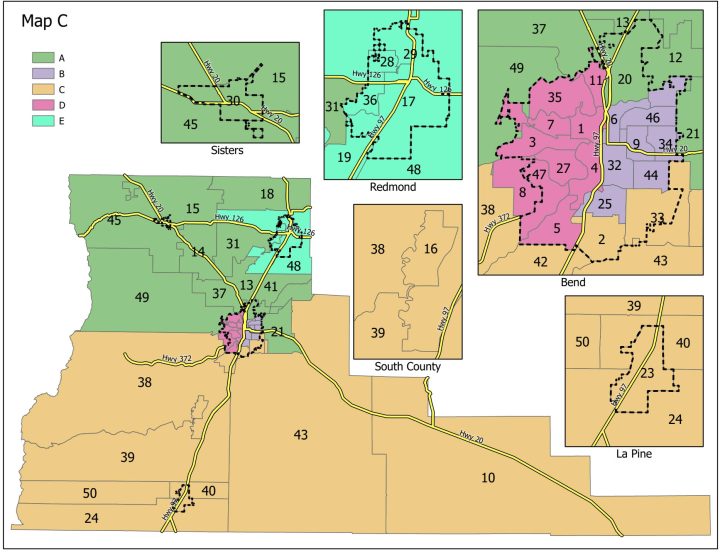
A proposed redistricting map for Deschutes County, Oregon, is drawing scrutiny for possibly giving an advantage to Republican candidates, despite the countyS overall lean towards Democrats. The map,developed by a citizen committee,will be presented to county commissioners on December 3rd,with approval likely sending it to voters on the May 2026 ballot for implementation in 2028.
The Bulletin newspaper analyzed precinct-level data from the 2024 presidential election, revealing a discrepancy between the county’s overall voting patterns and the proposed district breakdowns.While Democratic candidate Kamala Harris secured 53% of the vote county-wide, with 43% going to Republican candidate Donald Trump, trump would have won a majority in three of the five districts outlined in the proposed map.
Specifically, the map divides Bend into east and west districts where Harris would have won by critically important margins (27-48 percentage points). Tho, Trump would have carried the districts encompassing Sisters and northeast bend (by roughly 2%), south county and southeast Bend (by under 6%), and the greater Redmond area (by 18%).
The committee deliberately avoided considering party affiliation data during the mapping process, following a 4-3 vote and advice from the county attorney citing potential legal risks. Matt Cyrus, a Sisters rancher and committee member, explained the focus was on creating geographically cohesive districts based on shared communities and existing jurisdictional boundaries – demographic data, building permits, school districts, fire districts, and road districts were all considered. “We went with the cleanest lines that made the most sense,” Cyrus stated, emphasizing the goal of representing distinct portions of the county and allowing ”the chips fall where they may” regarding political affiliations. The committee held 11 meetings over several months, including a two-hour public listening session.
Experts from the Princeton Gerrymandering Project offered a nuanced assessment. Samuel Wang acknowledged the map provides “some advantage to Republicans, but it could have been worse,” suggesting further adjustments could achieve better balance in population and political affiliation. Jonathan Cervas agreed, noting that Democratic voters are “packed” into the Bend districts while others remain “pretty competitive.”
Deschutes County’s voter registration numbers reflect a concentration of Democrats in Bend (28,000 to 15,000 Republicans) and a Republican majority in the rest of the county (29,000 to 20,000 Democrats), with roughly one-third of voters identifying as non-affiliated.
County Commissioners DeBone and Adair have indicated they are unlikely to reopen the map for further changes, meaning the proposed districts could be in place for the 2028 election cycle.
