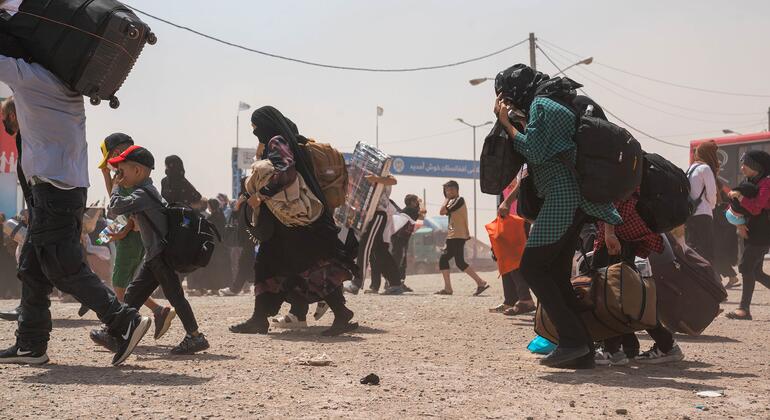
Deported Afghan Women Struggle to Rebuild Lives Amid Mass Returns, UNHCR Says
“I had a better life in Iran,” said Homa, a 44-year-old Afghan woman deported back to Herat, western Afghanistan.
“Unfortunately, we were deported.” Millions of Afghans have been forced home from Iran and Pakistan in recent years, with more than 6.5 million returning over the past three years alone, UNHCR reported on Sunday.
The returns have added more than 10 per cent to Afghanistan’s population, straining housing, jobs and public services, Charlie Goodlake of the UN refugee agency told UN News. Nearly 3 million people returned in 2025, according to figures cited by UNHCR. Women and girls make up more than half of those UNHCR assists, and women and children together account for nearly 82 per cent.
Educated women lose livelihoods
Zahra, 28, trained as a midwife but left Afghanistan because of the Taliban, the bad economy and her education. “It was because of the Taliban, and because of the bad economy, and because I was educated,” she said. In Iran she cared for an elderly woman for five years. “I had income,” she said. “I had a better life.” Now back in Herat, she is unemployed and lives with her parents and siblings, separated from her six-year-old son who lives with her ex-husband.
“Sometimes I can’t see him,” she said. “I only see him twice a month.” Her husband was addicted to drugs.
Her father is blind and her younger brother is the family’s only steady earner. Despite volunteering in clinics, Zahra said, “I don’t have opportunities to work.” She does not expect to win custody of her son. “The courts in Afghanistan always side with men,” she said.
Survival replaces stability
Homa spent six years in Iran cleaning apartments and collecting recyclable plastic. “It was a good income for my family,” she said. “We lived in a nice apartment building with a security guard. The neighbors helped me with food and sometimes with other things.” Today she shares a single room in her brother-in-law’s house with her husband, who has a disability and cannot work.
She is the family’s only breadwinner, cleaning houses and sewing clothes when she can find orders.
After surgery for appendicitis, Homa remains in significant pain and owes her brother-in-law money.
“I have no support for my medical needs,” she said. “I borrowed money for my surgery from my brother-in-law.” Relations with his wife are strained. “Some days,” Homa said, “I must beg in the street.” Some days the pressure is overwhelming.
The influx has added over 10 per cent to the national population, straining housing, jobs and public services in the western region where deportees like Zahra and Homa arrive.
In Herat city, the capital of the province and Afghanistan’s third-largest urban centre with an estimated 673,273 residents, the local economy relies heavily on cross-border trade that generates billions of dollars in customs revenue.
Cash assistance buys a sewing machine
UNHCR and partner organizations have provided cash assistance, legal support and mental health services. Homa used her payment to buy a sewing machine. “When I received the cash assistance, I was able to buy a sewing machine,” she said. “Now I have an income, and I help my family.” She works from home while recovering and bought rice and oil because “two months ago my family didn’t have any food to eat.”
Goodlake said the support aims to meet immediate needs and build longer-term livelihoods. UNHCR runs more than 150 vocational training projects across Afghanistan. “The primary needs of women and girls are, of course, immediate shelter or a place to live inside Afghanistan,” Mr. Goodlake said. “I am very worried about the future in Afghanistan,” Homa said. Zahra wants work, independence and more time with her son.