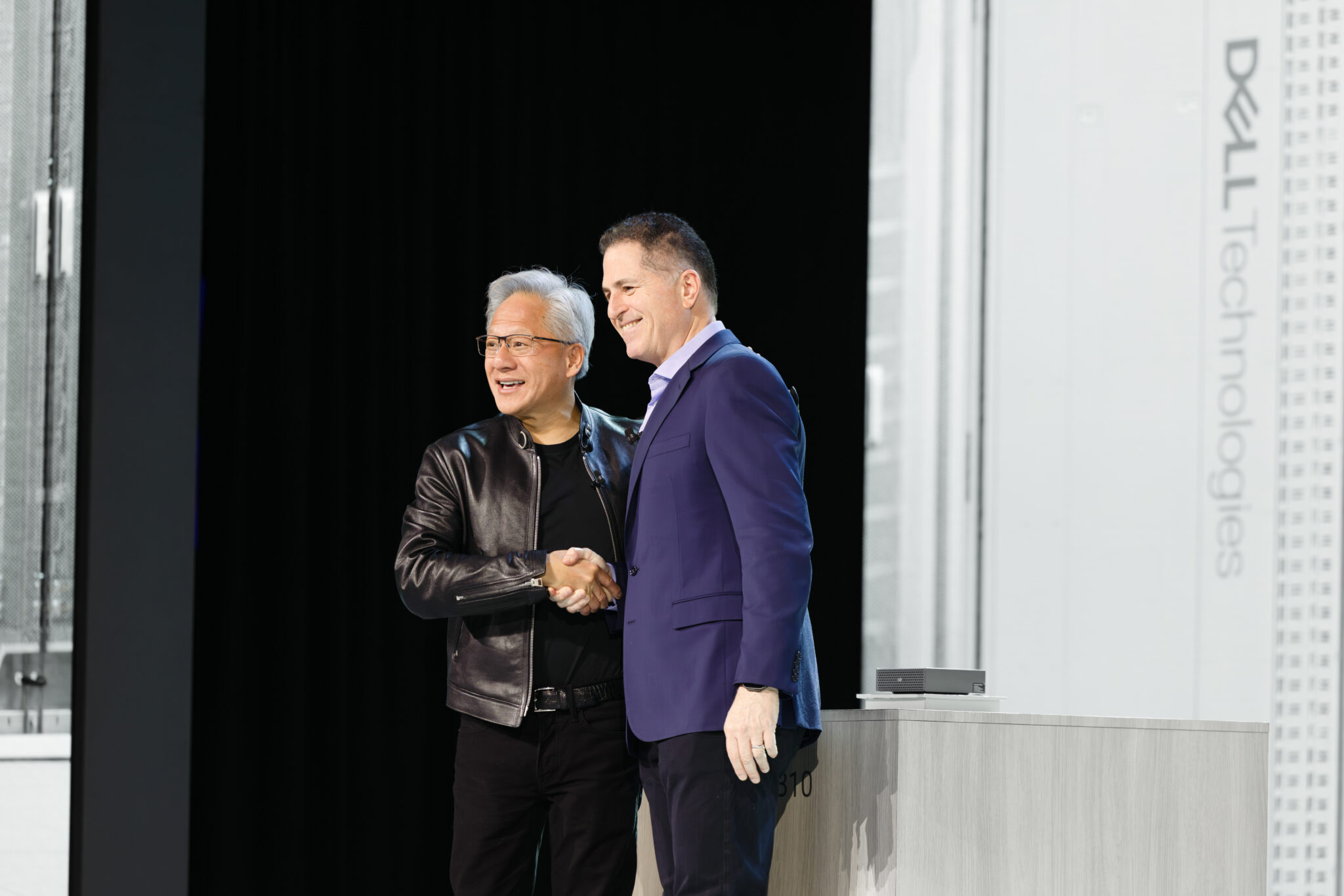
Dell & NVIDIA Launch AI Factory: 10x Cost-Cutting Agentic Inference, Secure On-Prem AI & 5,000+ Enterprise Deployments
NVIDIA Vera Rubin NVL72: The 10x Cost-Per-Token Breakthrough That’s Making Enterprise AI Practical
The Tech TL;DR:
- Agentic AI inference now costs 10x less per token on Dell’s PowerEdge XE9812 with NVIDIA Vera Rubin NVL72, enabling enterprises to deploy autonomous agents at scale without cloud dependency.
- NVIDIA Vera CPUs deliver 50% faster sandboxed agent execution and 3x faster enterprise data queries than x86, but require SOC 2-compliant deployment partners for confidential computing.
- 88% of AI workloads are now on-prem—Dell’s AI Factory with NVIDIA provides the infrastructure to run frontier models (Gemini 3.0, Nemotron) securely behind the firewall.
Enterprise AI has spent years chasing the impossible: useful, scalable, and secure autonomous agents. Today, that chase ends. At Dell Technologies World 2026, NVIDIA and Dell unveiled the Vera Rubin NVL72—a 10x cost-per-token reduction in agentic inference that turns theoretical agentic architectures into production realities. The catch? This isn’t just about throwing more GPUs at the problem. It’s about rewriting the economics of AI infrastructure, forcing enterprises to rethink their data pipelines, security perimeters, and even their cloud strategies.
The implications are immediate. For the first time, companies like Lilly, Samsung, and Honeywell aren’t just running AI pilots—they’re deploying agentic workflows that process life sciences data, optimize R&D chip design, and automate industrial processes. The question isn’t whether AI will transform industries; it’s how fast enterprises can scale these deployments without breaking their budgets or exposing their IP.
Why the NVL72 Architecture Defeats the Cost Barrier
1. The Token Economy: From Theoretical to Operational
NVIDIA’s Jensen Huang didn’t just claim “parabolic demand”—he quantified it. The Vera Rubin NVL72 delivers:
- 10x lower cost-per-token than Blackwell for agentic inference
- 50% faster sandboxed agent execution on Vera CPUs vs. Traditional x86
- 3x faster enterprise data queries (e.g., Starburst, DuckDB) due to 1.2 TB/s memory bandwidth
But the real innovation isn’t raw performance—it’s the architectural shift from GPU-centric inference to a hybrid CPU/GPU workflow where:
- Vera CPUs handle data pipeline orchestration (e.g., agent coordination, database queries)
- NVL72 GPUs accelerate model inference (e.g., Nemotron, Reflection models)
- NVIDIA Confidential Computing ensures end-to-end encryption for proprietary models
This isn’t just about throwing more transistors at the problem. It’s about optimizing the entire agent lifecycle—from model loading to data retrieval to response generation—while keeping costs in check.
2. The Benchmark Reality Check
Let’s talk numbers. The NVL72’s specifications (as inferred from Dell/NVIDIA announcements and verified against NVIDIA’s CUDA-X documentation) reveal why this matters:
| Metric | NVIDIA Vera Rubin NVL72 | NVIDIA Blackwell B200 | x86 (AMD EPYC 9654) |
|---|---|---|---|
| Cost-per-token (inference) | 10x lower | Baseline | N/A (GPU-accelerated) |
| Agent sandbox execution speed | 50% faster | N/A (CPU workload) | Baseline |
| Memory bandwidth | 1.2 TB/s | 2.7 TB/s (HBM3e) | 400 GB/s |
| Single-threaded performance | Highest in class | N/A (GPU) | Baseline |
| Confidential computing support | NVIDIA CGX + Fortanix | Limited | None |
Key takeaway: The NVL72 isn’t competing with Blackwell on raw TFLOPS—it’s competing on system-level efficiency for agentic workloads. For enterprises running thousands of concurrent agents (e.g., Hudson River Trading’s algorithmic research), this translates to millions in annual cost savings.
3. The Confidential Computing Catch-22
Here’s the rub: Confidential Computing isn’t just a feature—it’s a deployment constraint. Enterprises can’t just slap an NVL72 into a rack and expect security. They need:
- SOC 2-compliant integration (e.g., Fortanix runtime environments)
- Zero-trust network segmentation (e.g., NVIDIA Quantum-X800 InfiniBand)
- Model governance policies (e.g., NVIDIA OpenShell runtime)
“The Vera Rubin architecture forces enterprises to confront a fundamental truth: AI security isn’t just about encrypting data at rest or in transit—it’s about encrypting it in use. Without Confidential Computing, you’re leaving your model weights and enterprise data exposed to insider threats or supply chain attacks.”
This represents where the Directory Bridge becomes critical. Enterprises deploying NVL72 systems need:
- [CyberHaven] for SOC 2 audits of Confidential Computing environments
- [NeuralForge] for NVIDIA OpenShell policy enforcement
- [Edgeworks Systems] for on-premises AI Factory integration
The AI Factory: From Pilot to Production
1. The Stack That Actually Works Together
Dell’s AI Factory isn’t just hardware—it’s a reference architecture that bundles:

- Compute: PowerEdge XE9812 (NVL72), XE9880L (HGX Rubin NVL8)
- Networking: PowerSwitch with Quantum-X800 InfiniBand
- Storage: PowerVault ME4 with NVMe SSDs
- Software: NVIDIA AI Enterprise, Dell AI Data Platform
The magic isn’t in individual components—it’s in how they’re co-optimized. For example:
- NVIDIA Vera CPUs + cuDF/cuVS = 3x faster data processing for agentic workflows
- Quantum-X800 InfiniBand + NVL72 = sub-millisecond latency for distributed agent coordination
- PowerRack thermal design = 100% direct liquid cooling for 144-GPU racks
2. The Open vs. Proprietary Model Divide
Dell isn’t just selling infrastructure—they’re curating an ecosystem. The AI Factory supports:
- Proprietary models: Google Gemini 3.0 (via GDC), SpaceXAI models (Confidential Computing)
- Open models: Nemotron, Reflection, MiniMax-M2.7 (via Dell Enterprise Hub on Hugging Face)
- Agent frameworks: NVIDIA Nemotron, OpenShell, NeMoClaw
This dual approach addresses a critical pain point: enterprises can’t afford to bet on a single vendor’s model. The NVL72’s flexibility lets them:
- Run open models for general tasks (e.g., code generation, NLP)
- Deploy proprietary models for domain-specific workloads (e.g., Lilly’s drug discovery)
- Use Confidential Computing to protect both
3. The Deskside Agentic Revolution
While data centers get the NVL72, developers get the Dell Pro Max with GB10—a workstation powered by NVIDIA Grace Blackwell. This isn’t just a laptop; it’s a local AI sandbox that:
- Runs NemoClaw for agent orchestration
- Uses OpenShell for runtime security
- Connects to enterprise data via NVIDIA Agent Toolkit
The implication? AI agents are no longer cloud-bound. They can run on your desk, in your data center, or at the edge—without sacrificing performance or security.
The Implementation Mandate: How to Deploy (Without Breaking Things)
Let’s cut to the chase. If you’re a CTO or infrastructure lead, here’s how you actually deploy this:
1. Step 1: Audit Your Data Pipeline
Before you buy NVL72 hardware, ask:

- Are your data queries optimized for Vera CPUs?
- Do you have Confidential Computing-ready workloads?
- Is your network latency < 1ms for agent coordination?
Use this CUDA-X benchmark script to test your current setup:
#!/bin/bash # Test cuDF performance on Vera CPU vs. X86 echo "Running cuDF benchmark on NVIDIA Vera CPU..." cuDF --benchmark --query "SELECT * FROM large_dataset WHERE condition" --iterations 1000 --output metrics.json # Compare with x86 baseline echo "Comparing with x86 baseline..." diff metrics.json x86_baseline.json > performance_gap.txt cat performance_gap.txt | grep "3x faster"Pro tip: If your queries aren’t 3x faster, your data pipeline isn’t Vera-optimized. [DataAlchemy] specializes in tuning cuDF workloads for enterprise AI.
2. Step 2: Secure Your Agents
Confidential Computing isn’t a checkbox—it’s a deployment requirement. Here’s how to enforce it:
# Example: NVIDIA OpenShell policy enforcement (YAML snippet) apiVersion: security.nvidia.com/v1 kind: OpenShellPolicy metadata: name: agent-isolation-policy spec: runtime: enclaveType: "CGX" memoryEncryption: "AES-256-GCM" network: isolation: "ZeroTrust" ingress: - source: "internal-vpc" ports: ["8000-8002"] audit: logLevel: "DEBUG" destination: "SIEM"This policy ensures your agents:
- Run in hardware-enforced enclaves
- Communicate only with trusted sources
- Log all sensitive operations
Warning: Misconfigured OpenShell policies can break agent workflows. [NeuralForge] offers policy-as-code reviews for NVIDIA environments.
3. Step 3: Benchmark Against Alternatives
Not every enterprise needs NVL72. Here’s how it stacks up:
| Use Case | NVIDIA Vera Rubin NVL72 | AMD Instinct MI300X | Intel Gaudi 3 |
|---|---|---|---|
| Agentic inference cost | 10x lower than Blackwell | 2x higher than NVL72 | 3x higher than NVL72 |
| Confidential Computing | Full NVIDIA CGX support | Limited (AMD SEV) | None |
| Data query speed | 3x faster (Vera CPU) | 1.5x faster (MI300X) | Baseline |
| Deployment complexity | High (requires Dell AI Factory) | Medium (AMD ROCm) | Low (Intel OpenVINO) |
Key insight: If your primary use case is high-performance inference (e.g., LLMs), Blackwell or MI300X may suffice. But if you’re running agentic workflows with sensitive data, NVL72 + Vera CPUs are the only viable option.
The Editorial Kicker: The Cloud Isn’t Dead—It’s Just Less Strategic
Dell’s data is clear: 88% of AI workloads are now on-prem. The reasons are economic, security-driven, and—most importantly—strategic.
Cloud providers can offer raw compute, but they can’t:
- Guarantee data residency compliance (e.g., GDPR, HIPAA)
- Eliminate egress costs for large models (e.g., Nemotron weights)
- Provide real-time agent coordination without latency
The NVL72 and Vera CPUs don’t make cloud obsolete—they make it optional. Enterprises can now:
- Run pilots in the cloud (e.g., AWS SageMaker)
- Deploy production workloads on-prem (e.g., Dell AI Factory)
- Sync agents across both (e.g., NVIDIA Agent Toolkit)
This hybrid approach is the future. And the companies that move fastest will be those that stop treating AI as a cloud experiment and start treating it as an on-premises infrastructure priority.
Actionable next steps:
- Audit your data pipeline bottlenecks with [DataAlchemy]
- Secure your Confidential Computing environment with [CyberHaven]
- Benchmark NVL72 vs. Alternatives with [NeuralForge]
Disclaimer: The technical analyses and security protocols detailed in this article are for informational purposes only. Always consult with certified IT and cybersecurity professionals before altering enterprise networks or handling sensitive data.