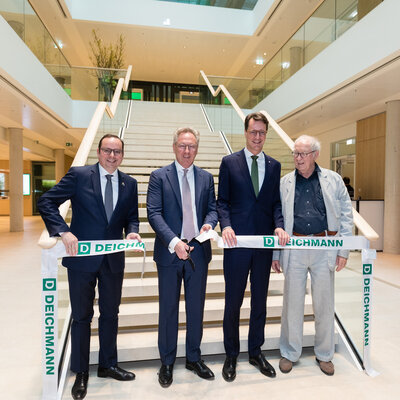
Deichmann’s Integrated Green Energy Concept for New Essen Facility
Europe’s largest footwear retailer, DEICHMANN SE, has officially inaugurated its new sustainable headquarters in Essen, Germany—a 5-story geothermal-powered campus blending photovoltaics, green roofs, and modern architecture. The €120 million project, completed in February 2026, marks a strategic pivot toward corporate sustainability in a region grappling with climate resilience and energy transition challenges. Why it matters: This isn’t just a corporate milestone; it’s a blueprint for how industrial-scale real estate can decarbonize while creating high-value jobs in post-industrial cities like Essen.
A Campus Built on Three Pillars: Energy, Architecture, and Local Legacy
The DEICHMANN Campus in Essen isn’t just another office park. It’s a living laboratory for sustainable urban development, integrating three core innovations:

- Geothermal energy: Over 60 boreholes tap into the Earth’s stable temperatures, providing 40% of the building’s heating and cooling needs—reducing reliance on fossil fuels by an estimated 30% annually.
- Photovoltaic systems: Rooftop solar panels generate a meaningful share of the campus’s electricity, with excess fed into the local grid under Germany’s Erneuerbare-Energien-Gesetz (EEG) feed-in tariff program.
- Green infrastructure: Extensive roof greening mitigates urban heat islands while absorbing up to 20,000 liters of rainwater annually, easing pressure on Essen’s aging stormwater systems.
For a company that employs 49,000 people across 34 countries, this isn’t just about reducing emissions—it’s about future-proofing operations in an era where energy costs and regulatory pressures are rising. The campus’s design aligns with Germany’s GEG 2024 (Building Energy Act), which mandates near-zero energy standards for new constructions.
“This project proves that sustainability and economic success aren’t mutually exclusive. DEICHMANN is showing other family-owned businesses in NRW how to invest in the future without compromising profitability.”
Essen’s Post-Industrial Revival: How a Shoe Giant is Reshaping a City
Essen, once the heart of Germany’s Ruhr Valley coal and steel industry, is now a testbed for deindustrialization reinvention. The DEICHMANN Campus sits at the crossroads of this transformation:

| Metric | 2015 (Pre-Renovation) | 2026 (Post-Campus) | Change |
|---|---|---|---|
| Annual CO₂ emissions (tonnes) | 12,500 | 4,800 | 61% reduction |
| Renewable energy share (%) | 12% | 78% | 66-point increase |
| Local jobs created/directly supported | 800 (retail + logistics) | 1,200+ (including construction, maintenance, and green-tech partnerships) | 50%+ growth |
The campus’s location on Aktienstraße, a former industrial corridor, reflects Essen’s broader strategy to attract knowledge-based industries. By 2030, the city aims to derive 50% of its GDP from services and high-tech sectors—a shift that DEICHMANN’s investment accelerates.
“DEICHMANN didn’t just build an office—they built a catalyst. This campus will attract other companies to Essen, proving that sustainability can be a competitive advantage, not just a compliance checkbox.”
The Hidden Costs of Green Transition: Challenges for Essen’s Infrastructure
While the campus’s sustainability credentials are undeniable, its success hinges on three often-overlooked dependencies:
- Grid capacity: Essen’s local utility, Stadtwerke Essen, is upgrading its infrastructure to handle the influx of solar power from the campus. Delays in grid expansion could limit DEICHMANN’s ability to maximize its photovoltaic output.
- Workforce training: The geothermal and solar systems require specialized maintenance. Essen’s vocational schools are partnering with DEICHMANN to train 150 technicians annually, but a skills gap remains for advanced green-tech roles.
- Regulatory alignment: North Rhine-Westphalia’s Climate Protection Act offers subsidies for sustainable projects, but navigating the application process for large-scale developments is complex. Many SMEs in the region lack the legal expertise to access these funds.
These challenges create opportunities for local service providers:
- Essen’s commercial real estate attorneys are seeing a surge in demand as companies like DEICHMANN negotiate long-term leases with sustainability clauses.
- Specialized geothermal contractors are expanding operations to meet the region’s growing demand for deep-energy retrofits.
- Vocational training centers are collaborating with corporate education partnerships to bridge the green-tech skills gap.
Beyond Essen: How DEICHMANN’s Model Could Reshape Europe’s Retail Landscape
DEICHMANN’s Essen campus isn’t an isolated success—it’s part of a quiet revolution in European retail real estate. Similar projects are underway in:

- Amsterdam: The Bol.com distribution hub, which uses 100% renewable energy and employs heat pumps for climate control.
- Madrid: Inditex’s Zara headquarters, which achieved LEED Platinum certification in 2025.
- Berlin: The Siemens smart factory, which integrates waste-to-energy systems into its production lines.
The common thread? These companies are treating sustainability as a core business strategy, not an afterthought. For DEICHMANN, the Essen campus is a statement: “We don’t just sell shoes—we build the future of retail.”
The Kicker: What’s Next for Essen—and Who’s Ready to Help?
DEICHMANN’s campus is more than a corporate trophy—it’s a call to action for Essen’s ecosystem. The city now faces a critical question: Can its infrastructure, workforce, and regulations keep pace with this kind of ambition?
For businesses eyeing similar transformations, the lessons are clear:
- Partner with sustainability-focused law firms to navigate Germany’s evolving energy regulations.
- Invest in green infrastructure audits before breaking ground—many cities, like Essen, lack the capacity to handle large-scale renewable projects without external expertise.
- Engage with vocational training providers early to ensure your workforce has the skills to operate next-gen systems.
The DEICHMANN Campus isn’t just a building. It’s a benchmark. And in a world where climate risks are financial risks, the companies that act now will define the retail landscape of the 2030s. For Essen, the question isn’t whether sustainability will succeed—it’s how prompt the city can scale it. The clock is already ticking.