
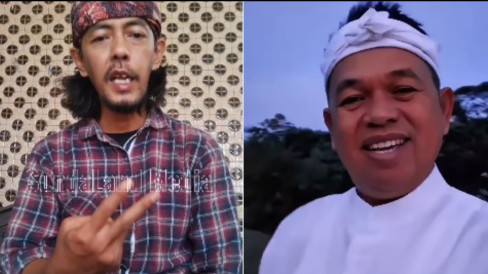
Dedi Mulyadi Eradicates Illegal Levies and Transforms Cirahong Bridge Into Sundanese Tourism Hub
West Java Governor Dedi Mulyadi has intervened at the Cirahong Bridge, connecting Ciamis and Tasikmalaya, to eliminate illegal levies following viral social media reports. Even as the provincial government is transforming the historic site into a Sundanese-themed tourist destination, the Head of Margaluyu Village has formally objected, demanding the arrest of the whistleblower who exposed the practices.
This confrontation is more than a dispute over a few rupiahs collected at a bridge crossing; it is a visceral clash between localized “informal” administration and provincial governance. For years, the Cirahong Bridge served as a vital artery between two regencies, but it similarly became a site of systemic extortion. When the digital age collided with this archaic practice, the resulting friction exposed a deep rift in how local authority is perceived and exercised in West Java.
The catalyst was a series of viral videos on TikTok and other social media platforms that captured the reality of illegal levies—known locally as pungli—being imposed on travelers. The outcry was immediate, forcing the provincial government’s hand. Governor Dedi Mulyadi did not merely issue a statement from the capital; he descended upon the site on Friday, April 10, 2026, to personally dismantle the culture of extortion.
The Governor’s Rapid Intervention
Upon arriving at the bridge, Governor Mulyadi found a facility that was as neglected in its management as it was in its physical state. His response was swift and tactical. Rather than focusing solely on the legalities of the levies, he addressed the environmental factors that allowed such activities to flourish: darkness and disorder.
The provincial government immediately implemented several physical upgrades to the bridge. Yellow dividing lines were painted to organize vehicle flow and temporary lighting was installed to eliminate the dark pockets where illegal collectors often operated. Mulyadi noted that while the traffic flow on the bridge is relatively smooth and does not require complex regulation, the element of security is paramount.
“I see that the bridge is relatively smooth; there is no need for special regulation. The most important thing is security. That is a shared responsibility—the village government, the district, the regency, and the police force—so that the community feels safe and free from criminal activity.”
By framing security as a “shared responsibility,” the Governor effectively shifted the burden of proof onto local officials. If the bridge remains a site of crime or extortion, the failure now rests squarely on the shoulders of the village and district leadership. For those navigating the complexities of such administrative disputes, securing experienced legal consultants is often the only way to ensure that provincial mandates are not undermined by local resistance.
The Backlash from Margaluyu Village
The resolution was not met with universal acclaim. In a surprising turn of events, the Head of Margaluyu Village has expressed strong objections to the removal of these levies. Rather than acknowledging the illegality of the charges, the village head has pivoted toward a narrative of victimization, calling for the arrest of the individual who filmed and uploaded the evidence of the pungli to the internet.
This reaction highlights a dangerous trend in local governance where the act of whistleblowing is treated as a greater offense than the act of extortion. The village head’s demand suggests a belief that the “social order” maintained by these levies outweighs the legal right of citizens to travel without being shaken down. This tension creates a precarious environment for residents and visitors alike, who may find themselves caught between a provincial mandate for transparency and a local administration that views transparency as a threat.
When local government officials clash with provincial authorities over legalities and public conduct, the situation often requires professional mediation services to prevent a total collapse of community trust. The demand to arrest a whistleblower is a high-stakes legal gamble that could potentially lead to charges of obstruction of justice or violation of freedom of expression laws under Indonesian national regulations.
From Extortion Site to Cultural Asset
Governor Mulyadi’s vision for Jembatan Cirahong extends beyond the removal of illegal fees. He views the bridge not just as a piece of infrastructure, but as a historical asset with significant value. The provincial government is currently planning a comprehensive redevelopment of the surrounding area to transform the bridge into a tourist destination with a distinct Sundanese nuance.
The strategy is clear: by increasing the volume of legitimate tourism and formalizing the economic activity around the bridge, the government can replace “shadow” economies with sustainable, taxable revenue. This transition from a neglected crossing to a cultural landmark requires a sophisticated approach to urban planning and tourism development to ensure that the historical integrity of the bridge is preserved while enhancing visitor accessibility.
The political optics of this project have also drawn attention. While the Chairman of the Ciamis DPRD eventually visited the site to ensure the bridge was “bright and safe,” reports indicate that Dedi Mulyadi’s interventions were the primary driver of the changes. The race to claim credit for the bridge’s “new face” underscores the competitive nature of regional politics in West Java, where visible, rapid-response governance is the most valuable political currency.
The Long-Term Implications for Regional Infrastructure
The Cirahong Bridge incident serves as a case study for the “viral governance” model. In this framework, social media acts as the primary reporting mechanism, bypassing traditional bureaucratic channels that may be compromised by local collusion. While effective for immediate results, this model relies on the whim of high-ranking officials to act on trending topics.
For the bridge to remain free of extortion and open to the public, the provincial government must move beyond temporary lighting and yellow paint. The permanent solution lies in the institutionalization of security and the formalization of the tourism sector. This includes the establishment of clear jurisdictional boundaries between the West Java Provincial Government and the Ciamis and Tasikmalaya regencies.
As the bridge transitions into a tourist hub, the risk shifts from petty extortion to the challenges of managing increased traffic and environmental preservation. The “Sundanese nuance” promised by the Governor will require careful curation to avoid becoming a superficial attraction, ensuring instead that it honors the bridge’s history as a connector of people and commerce.
The battle over Jembatan Cirahong is far from over. While the lights are now on and the levies have vanished for the moment, the demand from the Margaluyu village head to penalize the whistleblower suggests that the underlying culture of secrecy is still very much alive. The bridge is now a symbol of a larger struggle: the fight to move Indonesia’s regional infrastructure out of the shadows of local patronage and into the light of transparent, accountable governance. For those seeking to navigate these volatile legal and administrative waters, finding verified administrative law experts through the World Today News Directory remains the most reliable path to resolution.