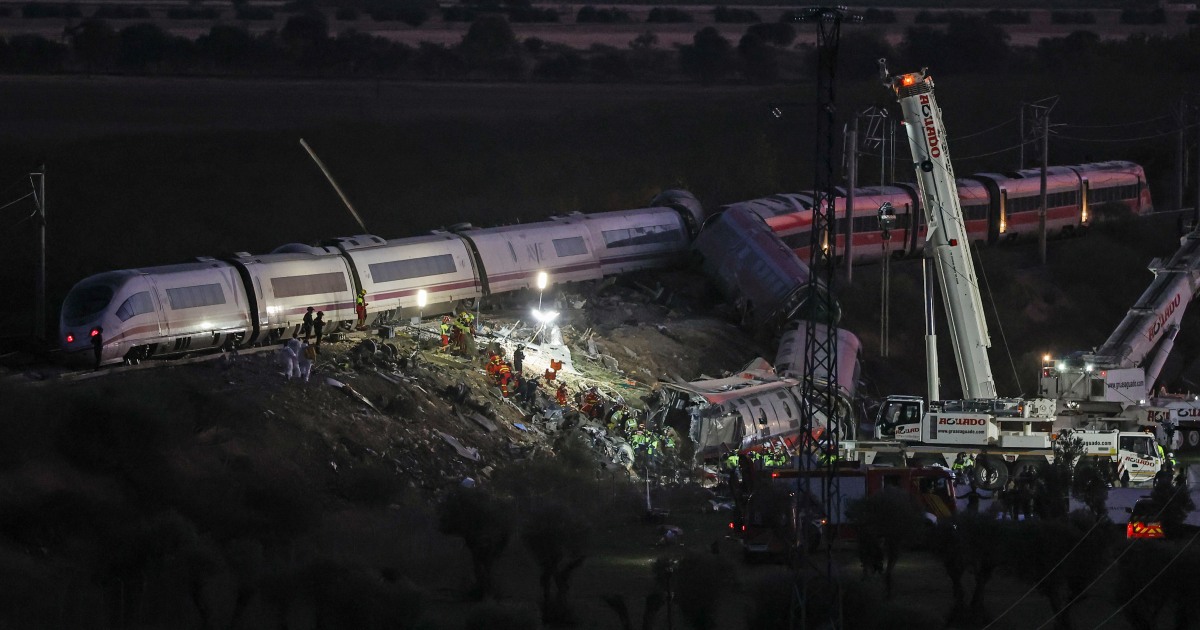
Deadly High-Speed Train Crash in Toledo, Spain Kills at Least 68
A deadly high-speed train crash in Spain sent shock waves across a nation whose rail network was until recently considered a crowning achievement, NBC News reported.
National Mourning and Royal Visits in Toledo
King Felipe and Queen Letizia traveled to Toledo to visit injured survivors at the local hospital, accompanied by Emiliano García-Page, President of the Regional Government of Castilla-La Mancha, and Milagros Tolón, the Minister of Education, Vocational Training and Sports, Town & Country Magazine reported. The royal couple expressed their grief and solidarity, stating they were moved and concerned by the accident in Urda, Toledo. King Felipe declared a national period of mourning through October 31, and the Spanish royal family canceled all previously scheduled engagements for the week.
At least 68 people died in the collision, while dozens more sustained injuries requiring hospitalization, according to Town & Country Magazine. Prime Minister Pedro Sánchez stated at a news conference that authorities are working to uncover the cause of the disaster. We are going to get to the bottom of it. And if there has been negligence, it will come to light. And if there have been failures in the safety system, they will be addressed with the utmost firmness,
Sánchez said, noting that the country has suffered two terrible high-speed rail tragedies within the same year.
At least 64 dead in Spain train crash.All updates @guardian: https://t.co/Jnl3TOjgjI
Political Fallout and Growing Public Demand for Transparency
The tragedy struck just weeks ahead of a major election in Spain, immediately sparking sharp government criticism and public protests. The high-speed rail system spans more than 1,900 miles of track, making it the largest network in Europe for trains moving at speeds exceeding 155 mph, according to European Union data cited by NBC News. However, the system faces intense scrutiny following a turbulent year for Spanish rail. In January, a separate disaster on the same rail line killed 46 people, and a commuter train derailment near Barcelona killed its driver and injured dozens more shortly thereafter.
Prominent figures were among the victims of the latest collision. Fátima Báñez, a former minister, was killed in the crash, prompting a tribute from Alberto Núñez Feijóo, leader of the opposition Popular Party, who described her on social media as a tireless woman and loyal friend. Antonio Acedo, the driver of one of the trains, was also killed, remembered by the Izquierda Española political party as an exceptional, kind, and prudent man.

Survivor Accounts From the Hillside Wreckage
Dirk Llorens, an American resident of Madrid who was on the stopped train with his wife when the impact occurred, described the violent jolt. I was thrown just violently, just over my table,
Llorens told NBC News. He recalled seeing the roof open and dust flying as the train slid and everything was destroyed. Escaping the wreckage on a hillside, he encountered passengers with severe head injuries and bloody faces, many immobilized by shock before emergency responders arrived.
Llorens called for government accountability to prevent future disasters, emphasizing that transparency is essential before he considers boarding a Spanish train again. Hundreds of emergency workers, firefighters, police officers, and soldiers deployed to the site with cranes to rescue survivors, recover bodies, and clear the damaged railcars.
We are deeply saddened by the tragic train accident in Toledo, Spain.Our thoughts are with the victims, their families and loved ones, and all those affected by this tragedy.In this moment of sorrow, all of Europe stands with Spain. 🇪🇺🇪🇸https://t.co/LKToms6LNR
More on Spain
Multiple people have died after two high-speed trains crashed in Spain 👇https://t.co/9etmbRvNta
Spain train crash kills at least 30 as witnesses describe devastating scenes | CNN https://t.co/IWeGVVP9oL