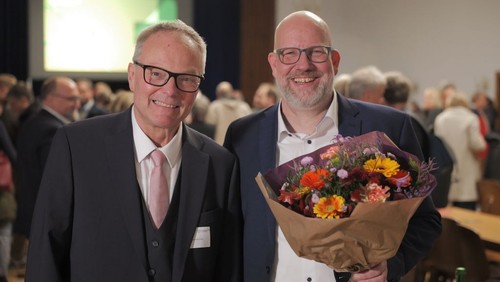
David Ruddat Elected as New Protestant Superintendent in Düsseldorf
Pfarrer David Ruddat is the new superintendent of the Protestant church district in Düsseldorf, having won the election on Friday according to evdus.de.
The 52-year-old state pastor secured his position during an extraordinary electoral synod held at the Kreuzkirche community center. He won a majority in the first ballot against his competitor, Dr. Martin Fricke.
Ruddat received 61 of the 116 votes cast by the delegates, while Fricke, who serves as a school pastor and synodal assessor, received 50 votes. He will officially assume his eight-year term on December 1, succeeding outgoing superintendent Heinrich Fucks.
Heinrich Fucks reaches retirement after eight years leading the Düsseldorf church district. A ceremonial farewell service will take place on the first Advent Sunday, November 29, at the Johanneskirche, where the kreissynodalvorstand will mark the transition.
Ruddat currently serves as the managing director of the Protestant Youth Educational Center Hackhauser Hof in Solingen, working as the state pastor for youth ministry. His background covers theological leadership, educational programming, and the management of church facilities.
| Candidate | Votes Received | Current Role |
|---|---|---|
| David Ruddat | 61 | State Pastor for Youth Ministry |
| Dr. Martin Fricke | 50 | School Pastor and Synodal Assessor |
Addressing the synod prior to the vote, Ruddat outlined a clear stance on social and political engagement. He argued that the church must address real living conditions, foster diversity, and pursue interreligious dialogue.
“We must visibly perceive our design responsibility in the state capital—and repeatedly make the Protestant voice strong in city and state politics,” Ruddat told the synod, as reported by evdus.de.
The newly elected superintendent also highlighted the connection between the church and its diaconal services, ranging from kindergartens and pastoral care to modern social formats. He acknowledged financial and membership declines as major challenges facing the 15 congregations and roughly 83,000 Protestants within the Düsseldorf district.
Düsseldorf, the capital of North Rhine-Westphalia, grew from a settlement at the mouth of the Düssel River and received city rights in 1288 following the Battle of Worringen. It became the capital of the newly created state in 1946, cementing a political role the new superintendent referenced.
The city anchors the Rhine-Ruhr metropolitan region, the EU’s second-largest by GDP, and hosts Germany’s fourth-busiest airport. Unusually for a major German city, it retains the “-dorf” (village) suffix, a linguistic remnant of its origins as a fishing and farming community.
“I stand for a theology that is full of hope—not because I naively think ‘it will be fine,’ but because I believe that the future is not decided,” Ruddat said, according to evdus.de.