Dark Matter Decay May Explain Origins of Early Supermassive Black Holes
Dark Matter Decay Could Explain Earliest Supermassive Black Holes
Decaying dark matter particles might solve a persistent cosmological anomaly by injecting atomic-scale energy into primordial gas clouds, accelerating the formation of gargantuan black holes less than a billion years after the Big Bang, according to research published in the Journal of Cosmology and Astroparticle Physics.
The Tech TL;DR:
- The Core Mechanism: Decaying dark matter releases trace energy into pristine hydrogen gas, altering early galactic chemistry to trigger direct gravitational collapse.
- Mass Window: Researchers modeled decaying axions within a mass range of 24 to 27 electronvolts.
- Observational Impact: The findings provide a theoretical framework for unusually large black holes observed by the James Webb Space Telescope.
Resolving the High-Redshift Mass Discrepancy
Modern observational astronomy faces a stringent timeline constraint. Per findings detailed by University of California, Riverside graduate student Yash Aggarwal, standard astrophysical models cannot account for supermassive black holes weighing up to a billion suns existing less than a billion years post-Big Bang. Traditional stellar evolution pathways lack the necessary temporal runway to grow so large.
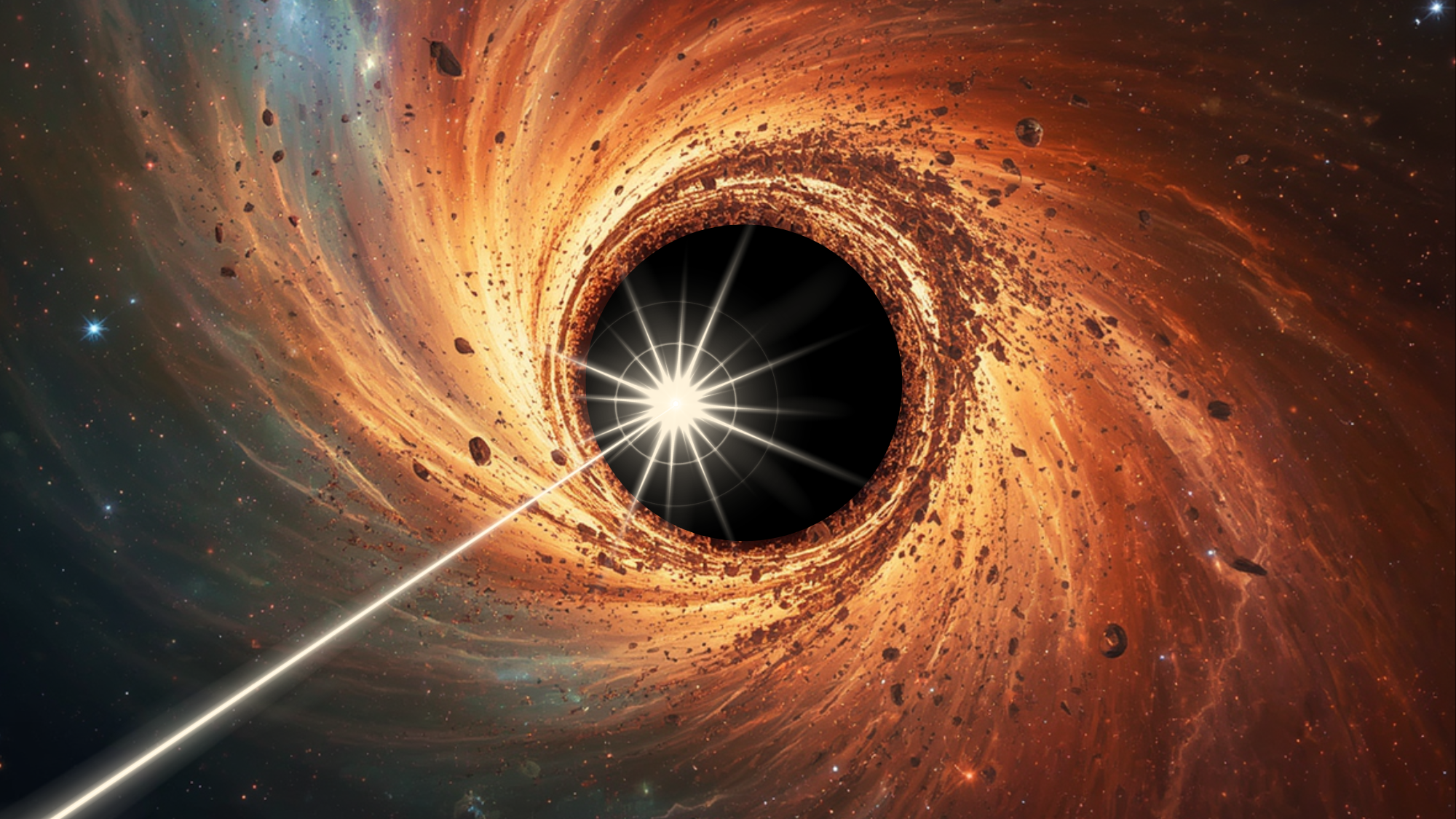
To bridge this theoretical gap, Aggarwal’s research team investigated whether non-standard particle physics could alter the thermo-chemical dynamics of early gas clouds. By examining the decay of dark matter—which constitutes 85% of the matter in the universe—the team demonstrated that energetic leakage can force pristine hydrogen to bypass standard star formation entirely, collapsing straight into black holes.
Each decaying particle requires an infinitesimally small energy release. According to the study, individual dark matter particles need only inject an energy equivalent to a billion trillionth of a single AA battery. That micro-scale injection is sufficient to shift atomic-level cooling rates in the primordial gas.
Thermo-Chemical Modeling of Primordial Gas
The research methodology combined cosmological simulation with particle physics constraints. Co-authored by Flip Tanedo, associate professor of physics and astronomy at UCR, along with James Dent of Sam Houston State University and Tao Xu of the University of Oklahoma, the study focused on decaying axions.
The team mapped out a specific mass window between 24 and 27 electronvolts. Within this narrow parameter space, decaying particles leak just enough energy to alter the molecular chemistry of early galaxies. This process circumvents the traditional requirement for nearby stars shining onto pre-stellar gas to trigger direct collapse.
Observational Validation and Future Deployments
The timing of the study aligns with ongoing data streams from NASA’s James Webb Space Telescope (JWST). JWST continues to catalog unusually large black holes in the early universe, straining standard cosmological simulations. Tanedo noted that the first galaxies essentially act as sensitive atomic-scale detectors, recording particle decay signatures through macroscopic gravitational phenomena.

Frequently Asked Questions
What is the proposed mechanism for early supermassive black hole formation?
According to research led by Yash Aggarwal, the energy released from decaying dark matter particles alters the atomic chemistry of pristine hydrogen gas in early galaxies, causing direct gravitational collapse into black holes rather than forming standard stars.
What specific dark matter mass range was identified in the study?
The research published in the Journal of Cosmology and Astroparticle Physics identified a mass window between 24 and 27 electronvolts for decaying axions capable of driving direct collapse.