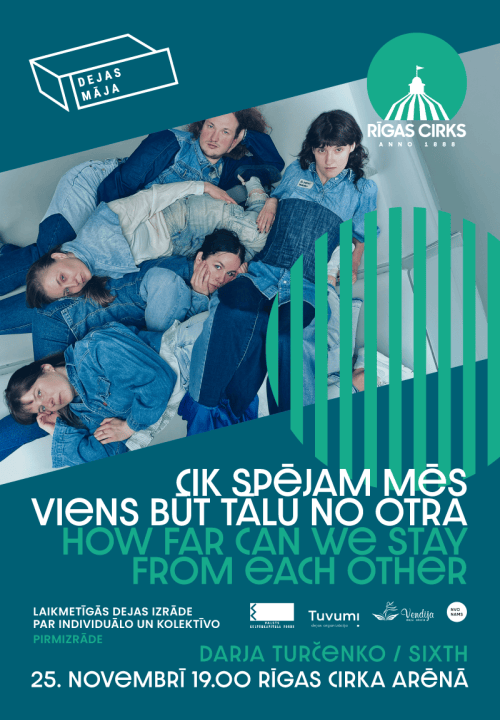
Darja Turčenko Premieres “How Far Can We Be From Each Other” at Riga Circus
Choreographer Darja Turčenko premiered “How Far Can We Be From Each Other” at the Riga Circus arena on Thursday, the first production under the pilot program “Dance House at Riga Circus,” LSM reported.
The work examines the geometry of relationships between the individual “I” and the collective “we,” using movement to explore trust, empathy, and the distance that persists despite shared values. “We all have the same value foundation at the base, but somehow we manage to be so far apart and not understand each other, to conflict,” Turčenko told LSM. “This is an invitation to evaluate everything around us.”
Five dancers — Roberta Gailīte, Edvards Kurmiņš, Līva Nora Apšeniece, Ramona Levante, and Turčenko herself — perform, according to LSM. The piece is structured in four parts, progressing from individual action to collective existence through repetition, variation, and polyrhythm, Bezrindas reported.
Turčenko cited postmodern influences including Trisha Brown, Lucinda Childs, and the Belgian company Rosas, blending precise geometric lines with the body’s natural response to gravity, according to BezRindas.
Composer Ernests Valts Circenis created an original score designed to coexist with Maurice Ravel’s “Bolero,” which the dancers had already adopted during rehearsals. “It was a fairly large challenge, because ‘Bolero’ is so iconic, it takes up a lot of space and gives a lot of emotion,” Circenis told LSM.
Scenography, costumes, and visual identity were designed by Marianna Lapiņa. Dramaturgy consultation was provided by Laura Stašāne. The production is produced by Sixth with co-production by Riga Circus, supported by the State Culture Capital Foundation (VKKF), Tuvumi, dance school “Vendija,” and NGO House, with media partners Radio SWH, IR, and Satori.
Poet and performance artist Agnes Krivade, who attended the premiere, described the work as “perfectly crafted, perfectly rehearsed.”
She told LSM: “It seemed that it was the embodiment of music. “Mutual trust in this production is noticeable, that is the main element with all platforms, each must take care that the other does not fall, must be timely,” she told LSM. The pilot program “Dance House at Riga Circus” aims to give contemporary dance a more permanent presence in the venue. The performance is recommended for ages seven and up, with accessibility for wheelchair users, the hard of hearing (minimal text), and the deaf (induction loop). Seating in the arena and balcony is unnumbered; tickets are not assigned to specific seats.”