
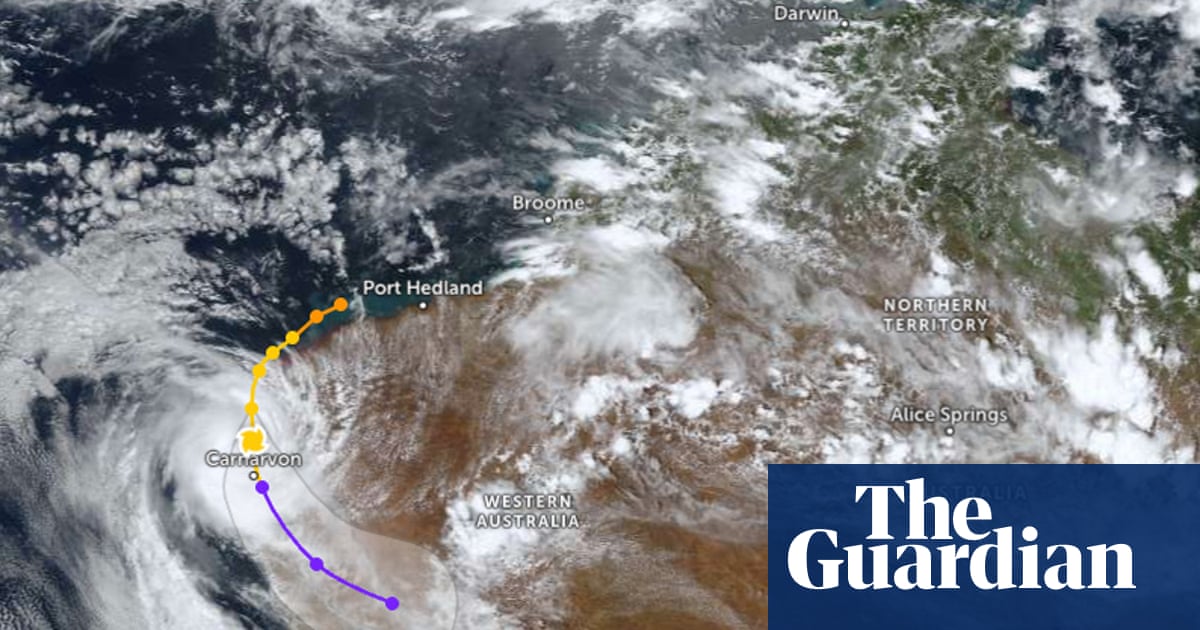
Pilbara Ports Authority cleared its three major export hubs on Thursday, anticipating the arrival of Tropical Cyclone Mitchell, now forecast to reach category two strength as it tracks parallel to the Western Australian coast. The preemptive closure signals the growing threat posed by the intensifying system, which is expected to bring destructive winds and heavy rainfall to coastal communities.
The Bureau of Meteorology (BOM) expects Tropical Cyclone Mitchell to fully form on Saturday morning, having developed from tropical low 21U. A warning zone is currently in place between Pardoo Roadhouse and Port Hedland, with a watch zone extending from Port Hedland to Onslow, including Karratha, and inland to Whim Creek and Pannawonica, according to the BOM.
Destructive wind gusts of up to 140km/h are possible in coastal parts of the Pilbara, including Karratha, Dampier and Wickham, beginning Saturday afternoon. These winds may extend to Onslow and Exmouth on Sunday. Forecasters also predict heavy rainfall beginning tonight, potentially leading to flash flooding throughout the region, as reported by the ABC.
The approaching cyclone is not isolated. Madagascar’s east coast was struck by Cyclone Gezani on Tuesday, with winds reaching 155mph near Toamasina, causing widespread flooding and damage to hundreds of buildings. At least nine people have died and over 1,300 have been displaced. Gezani follows closely on the heels of Tropical Cyclone Fytia, which impacted Madagascar just ten days prior, resulting in 14 fatalities and displacing 31,000 people.
Further north, a persistent high-pressure system over Europe has created a stark contrast in weather patterns. While western and south-western Europe experienced a particularly wet start to the year, Scandinavia, the Baltics, and eastern Europe endured their coldest January since 2010. Temperatures plummeted to -42.8C in Tulppio, Finland, on January 9th, and -41.5C in Karasjok, Norway, on January 11th, disrupting air travel and driving up electricity demand. A second cold snap in late January saw temperatures fall to -34.3C in Lithuania and -27.7C in north-eastern Poland, causing parts of the Baltic Sea to freeze over. Poland has reported 38 hypothermia-related deaths this winter, double the number from the previous year.
The situation in Western Australia remains fluid. Authorities have urged residents to secure their properties and prepare for potential power outages. The full extent of Mitchell’s impact will become clearer in the coming days, as the cyclone continues its path along the Pilbara coast. The State Emergency Service is distributing sandbag materials to help residents protect their homes.
