
Crypto Stocks Plunge as Bitcoin Drops Below $66,000 Amid Market Selloff
Crypto equities plunged Friday as Bitcoin slid below $66,000, dragging Coinbase, Galaxy, and Strategy into a broader $17 trillion market rout. Inflation fears and geopolitical tension drove investors toward risk-off assets, triggering correction territory for the Nasdaq 100. Corporate treasuries now face immediate liquidity pressure requiring strategic hedging.
Volatility returned with a vengeance to digital asset balance sheets. Bitcoin-linked equities absorbed heavy selling pressure as weakness in U.S. Equities rippled through high-risk sectors. Coinbase (COIN) and digital asset conglomerate Galaxy (GLXY) dropped nearly 7%, while exchange Gemini (GEMI) slid almost 9%, marking one of the steepest losses in the group. Crypto-friendly broker Robinhood (HOOD) also fell nearly 6% as increasing its stock buyback pace offered little help in arresting the downtrend. Bitcoin-linked balance sheet plays also moved lower. Strategy (MSTR) and Twenty One Capital (XXI) plunged about 6%. Ethereum-focused treasury names such as Bitmine Immersion (BMNR) and Sharplink Gaming (SBET) were down roughly 5%.
Miners — many of which trade as leveraged bets on both bitcoin and AI infrastructure — extended their declines. Riot Platforms (RIOT), CleanSpark (CLSK), IREN (IREN), HIVE Digital (HIVE) and Hut 8 (HUT) all posted 5%-8% losses. Even MARA (MARA) and Bitdeer (BTDR), which outperformed Thursday, have given back all their gains and were down 6% and 8%, respectively, joining the sector-wide plunge. This synchronized drawdown signals a liquidity crunch that extends beyond speculative trading into corporate solvency planning.
The Federal Reserve’s Complicated Backdrop
The Federal Reserve faces an increasingly complicated backdrop, weighing renewed inflation pressure from rising oil prices against signs of a deteriorating labor market. Richmond Fed President Tom Barkin warned that higher gas costs could dent consumer spending while describing hiring conditions as “fragile.” Meanwhile, Philadelphia Fed President Anna Paulson said the war in Iran created “new risks to both inflation and growth.” The 10-year Treasury bond yield, which hit nearly 4.5% earlier Friday, erased today’s rise following the central bankers’ remarks. The two-year yield, which is more sensitive to Fed policy, fell all the way back to 3.91% after earlier rising to 4.03%.
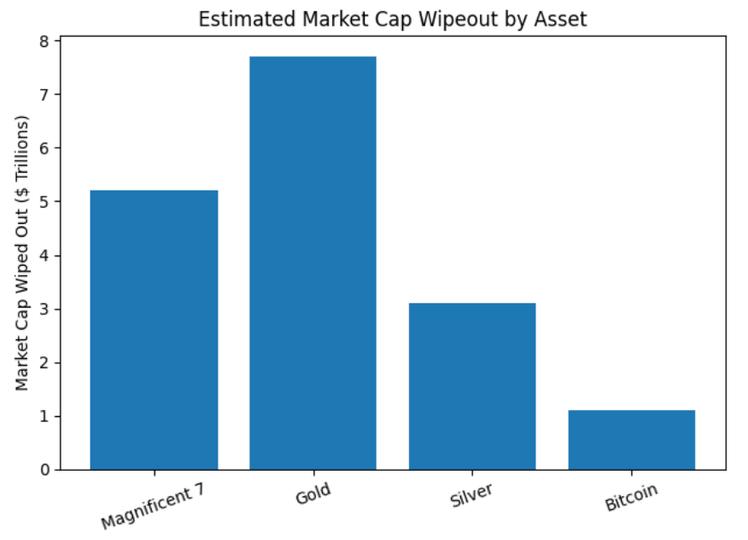
Investors have turned from predominantly expecting rate cuts this year to consider the central bank hiking rates in face of rising inflation. According to the Federal Reserve’s monetary policy statement, the central bank remains data-dependent, yet market pricing suggests a shift toward quantitative tightening. Still, investors have turned from predominantly expecting rate cuts this year to consider the central bank hiking rates in face of rising inflation. The selloff over the past months has been broad across equities, with roughly $17 trillion in market cap wiped out from peak levels across the Magnificent Seven — the seven largest tech stocks, including Nvidia (NVDA), Google (GOOG) and Microsoft (MSFT) — gold, silver, and bitcoin.
“We are seeing a fundamental repricing of risk assets as the yield curve steepens. Institutional capital is rotating out of speculative tech and into fixed income,” said a Senior Portfolio Manager at a New York-based hedge fund.
Bitcoin reached its all-time high in early October at $126,000, while gold, silver and U.S. Equities peaked in late January before reversing sharply. Since then, bitcoin is down around 45%, silver has fallen 45%, gold roughly 20%, and the Magnificent Seven have all entered double digit drawdowns from their peaks. The tech-heavy Nasdaq 100 index has now entered correction territory, trading more than 10% off its January all time high. The broad-based S&P 500 is inching closer to a correction, too, currently down 8.5%.
Three Ways This Rout Reshapes Corporate Strategy
Market corrections of this magnitude force immediate operational shifts. C-suite executives must pivot from growth-at-all-costs to capital preservation. The following structural changes are becoming mandatory for survival in this fiscal environment:
- Liquidity Management Over Expansion: With bond markets under pressure, firms are prioritizing cash flow stability. The iShares 20+ Year Treasury Bond ETF (TLT) is down around 0.3% on Friday and 5% over the past month since the conflict began. Companies are engaging treasury management specialists to hedge against currency fluctuation and interest rate volatility.
- Regulatory Compliance Scrutiny: As valuations compress, regulatory bodies increase oversight on digital asset disclosures. Per the latest SEC 10-Q filing standards, public companies must clarify exposure to volatile assets. Legal teams are scrambling to update risk factors in upcoming quarterly reports.
- Infrastructure Consolidation: Miners trading as leveraged bets on AI infrastructure are facing margin compression. Operational efficiency is now the primary metric for survival. Firms are consulting enterprise IT infrastructure providers to reduce energy costs and optimize hashing power without capital expenditure.
While bonds have also been hit hard, global fixed-income markets remain under broad pressure. Over the same period, the S&P 500 has fallen roughly 6%, highlighting the underperformance of the traditional 60/40 portfolio as global yields continue to rise, weighing on sovereign debt markets. This week has followed a familiar playbook seen since the Middle East conflict started in late February, with strong gains on Monday, partly driven by relief that “Black Monday” scenario did not occur, averaging around 3%, followed by steady profit taking into weakness as the week progresses, particularly as optimism fades around the Strait of Hormuz fully reopening.
By Thursday and Friday, performance typically deteriorates further as investors reduce risk ahead of the weekend amid ongoing geopolitical uncertainty. This weekly entropy creates a predictable pattern of volatility that algorithmic traders exploit, leaving fundamental investors exposed. Corporate treasuries holding digital assets must account for this weekend gap risk when calculating value-at-risk models.
The Path Forward for Digital Asset Treasuries
Strategy (MSTR) and Twenty One Capital (XXI) plunged about 6%, signaling that even the most committed corporate holders are not immune to macro headwinds. Ethereum-focused treasury names such as Bitmine Immersion (BMNR) and Sharplink Gaming (SBET) were down roughly 5%. The correlation between tech equities and crypto remains tight, meaning a Nasdaq correction inevitably drags down digital balance sheets. Firms necessitate to decouple their operational health from asset price speculation.

As consolidation accelerates, mid-market competitors are scrambling for capital, consulting with top-tier M&A advisory firms to explore defensive buyouts. The $17 trillion wipe-out across major asset classes indicates a systemic reset rather than a sector-specific correction. Companies that survive this cycle will be those with robust risk frameworks and diversified revenue streams unrelated to token price appreciation.
Geopolitical risks remain the wildcard. Philadelphia Fed President Anna Paulson said the war in Iran created “new risks to both inflation and growth.” Energy prices directly impact mining profitability, creating a double-bind for operators facing both lower BTC prices and higher operational costs. The market is pricing in a prolonged period of uncertainty, demanding that businesses adapt their financial models accordingly.
Investors are no longer rewarding hype. They demand EBITDA positivity and clear paths to profitability. The era of uncomplicated capital has ended. Firms must now demonstrate resilience through stress testing and scenario analysis. Those relying on continuous equity raises to fund operations will find the door closed. The market has spoken, and the message is clear: adapt or liquidate.
For corporate leaders navigating this turbulence, the solution lies in specialized partnership. Whether securing regulatory compliance counsel to navigate shifting SEC guidelines or engaging strategic advisors to restructure debt, the path to stability requires external expertise. The World Today News Directory connects enterprises with vetted partners capable of executing these critical pivots. In a market defined by entropy, certainty is the most valuable asset.