
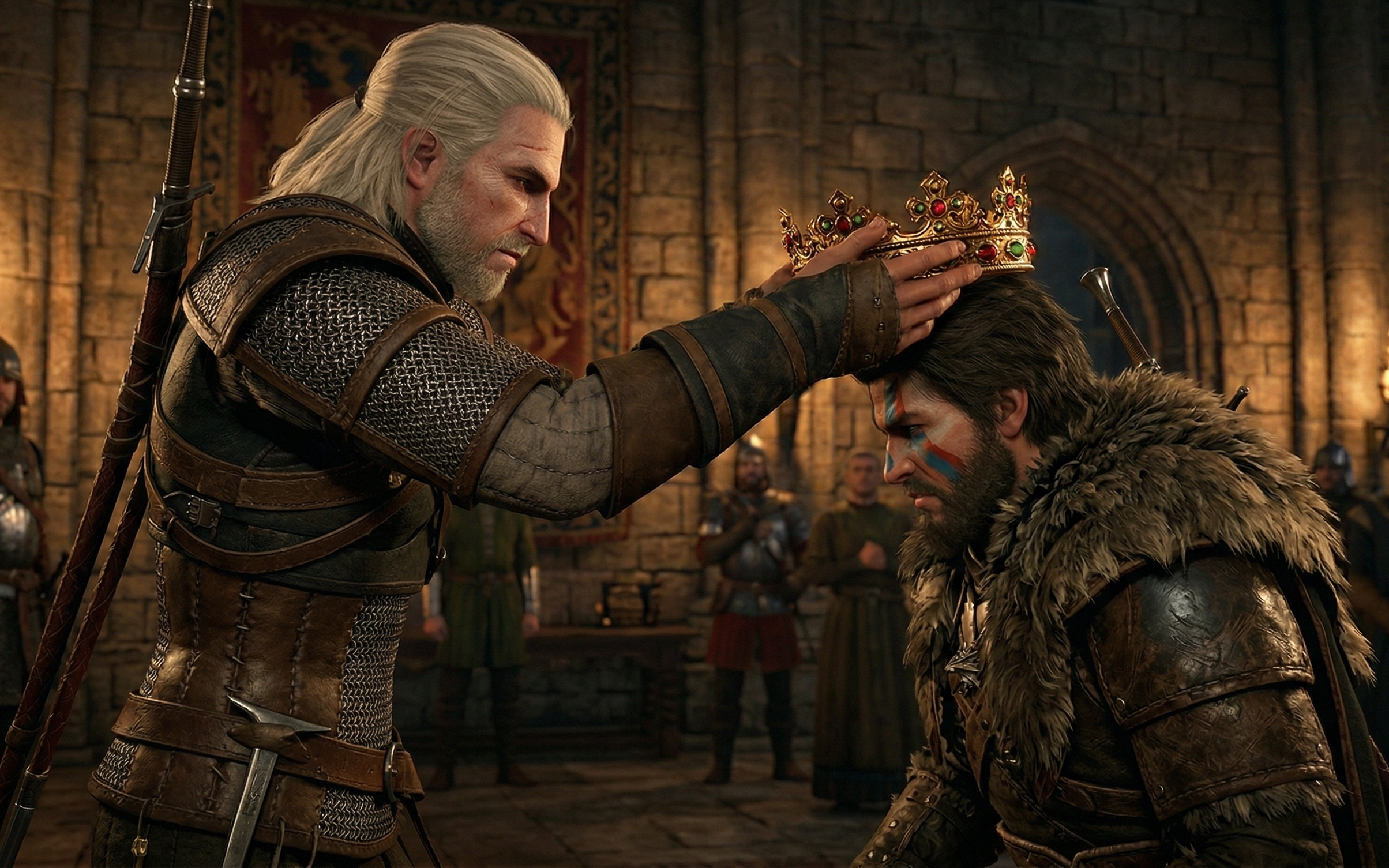
Crimson Desert: Is This the New Witcher We’ve Been Waiting For?
The question of whether the video game industry will ever see a “new Witcher” has turn into a recurring theme in public debate with each major RPG release. For years, many titles have attempted to claim the crown belonging to Geralt of Rivia, but most have stumbled over their own ambitions. That changed in March 2026 with the release of Crimson Desert – a gigantic, almost absurdly expansive production from Korean studio Pearl Abyss.
The game, which in its first days after release divided critics into fascinated enthusiasts and overwhelmed detractors, ultimately proved that in terms of pure gameplay it sets entirely new standards (even if developers still have a lot of work to do to improve many elements, which is understandable given the size of the presented world). Stepping into the shoes of mercenary Kliff, we enter the world of Pywel, which is so vast and unpredictable that it takes your breath away. Is this already the dethroning of our domestic hit? Here are the reasons why the new work from Korea crushes its competition.
The first reason Crimson Desert leaves the competition behind is its absolutely uncompromising scale of open world. The continent of Pywel is not simply a large map filled with markers – We see a vibrant ecosystem that can shame even the iconic Skyrim or the excellent Red Dead Redemption 2 in terms of size. Snowy peaks, vast plains, dense forests and dirty cities function here organically. And although Pearl Abyss likely took some shortcuts, utilizing AI (as every major company does these days), each tree, each rock and each stream seems hand-carved, making the journey itself a goal in itself. The game does not impose artificial barriers on us, and the world opens up to the player in its entirety from the first hours, encouraging you to deviate from the main routes and get lost in this virtual reality.
The second aspect that literally pins you to your seat is the combat system. If The Witcher 3 was famous for its ballet of swords, then Crimson Desert serves us a bloody, wrestling choreography on steroids. Combat is a “heroic sandbox” where you can feel the physicality of the clashes on your own fingertips. Forget about boringly pressing one attack button. Our protagonist, Kliff, can grab an enemy by the waist, perform a professional wrestling throw on him, kick with a half-turn into the abyss, and then use a grappling hook to pull another opponent from the roof of a burning building. The combination of attacks, the ability to use the environment, and the brutal dynamics create the game outperform what CD Projekt RED offered almost a decade ago in terms of combat. Every duel, especially with bosses, is a small cinematic masterpiece, although it is still some distance from the games of FromSoftware. Nevertheless, we are dealing with a completely different game, or rather a skillful combination of genres, and that definitely does the trick.
A third reason is the unprecedented freedom of exploration. The creators of Crimson Desert drew heavily from the best patterns, implementing a climbing and movement mechanic from The Legend of Zelda. Kliff can climb literally any surface – from ruined towers to the backs of massive beasts wandering the world. We are limited only by the stamina bar, which introduces an element of risk and planning to the exploration. There are no irritating, invisible walls or shelves that you “cannot” climb on because the developers programmed it that way. This verticality gives depth to traversing the world, which is lacking in many competing games, allowing you to plan ambushes and discover secrets in a way that was significantly limited or impossible in many competitive games.
A fourth reason is the accumulation of activities and details that grant the production a truly cinematic, Hollywood character. Speaking of cinematic scope, the production boldly competes with the biggest digital and film works of recent years. Here are 10 titles (games with a truly “cinematic” flair and expansive, digital universes) that serve as a reference point for Pearl Abyss’ work:
- The Witcher 3: Wild Hunt – for its dark atmosphere and Slavic, raw cut.
- Dragon’s Dogma 2 – for battles with huge beasts and climbing monsters.
- The Legend of Zelda: Tears of the Kingdom – for physics and unbridled freedom.
- Red Dead Redemption 2 – for interactions with the world and the realism of the wild outposts.
- Elden Ring – for scale and monumental, ruthless bosses.
- Ghost of Tsushima – for picturesque landscapes and parrying blows.
- Assassin’s Creed Valhalla – for the brutality of battles and the raid system.
- Cyberpunk 2077 – for graphic opulence and innovative use of technology.
- Skyrim – for the openness of the world in which you simply want to live.
- The Lord of the Rings (universe) – for pure, epic fantasy battles with hordes of orcs, which the clashes in the game clearly evoke.
The game draws from them everything that is best, offering dozens of mini-games, learning skills from encountered NPCs, advanced fishing, and even dynamic environmental puzzles. It’s a sandbox you just don’t want to leave.
A fifth, perhaps the most striking argument, is the visual layer and physics powered by the Black Space Engine, the studio’s proprietary engine. Crimson Desert looks absolutely stunning. It is a next-generation game that squeezes the seventh sweat out of the most powerful graphics cards and consoles. Particle effects during spellcasting, dynamically changing weather that authentically affects how our character moves, and finally the facial expressions of characters and the details of weapons – all this adds up to a photorealistic spectacle. When a lightning strikes a nearby tree during a storm, and rain washes the blood from Kliff’s face, it is hard not to feel sincere admiration for the work that the Korean developers have position into this title. It is a world that is as beautiful as it is ruthless.
It would not be a report, however, if I didn’t insert a small pin. Because you have to honestly admit that this gigantic scope has its price. Crimson Desert can be chaotic and at times resembles Frankenstein’s monster, stitched together from mechanics borrowed from other games. The main storyline – although dark and intriguingly telling the fate of mercenaries – can get lost in the thicket of side activities, and the user interface sometimes causes headaches. The narrative develops slowly and lacks the subtle, literary depth offered by quests like “Bloody Baron” from The Witcher 3. But you know what? In the face of a solid, still refined by the developers combat system and still absorbing exploration, these stumbles become less important. This game captivates for dozens of hours not with the story, but with the pure joy of being in its virtual world.
Answering the question asked in the title – yes and no. If you are looking for a brilliantly written, heart-wrenching story and deep moral dilemmas in video games, The Witcher 3 still remains the unsurpassed king, looking down on the competition from above. However, in terms of mechanics, freedom, graphics and, above all, pure, unbridled, juicy gameplay – Crimson Desert has trampled the competition into the ground of Pywel. Pearl Abyss has created a behemoth, a masterpiece of chaos and freedom, in which every player will write their own, brutal story on the edge of a sword. Kliff may not have Geralt’s sharp tongue, but when he enters the battlefield, the rest of the industry can only take notes and learn how to make action games for real.