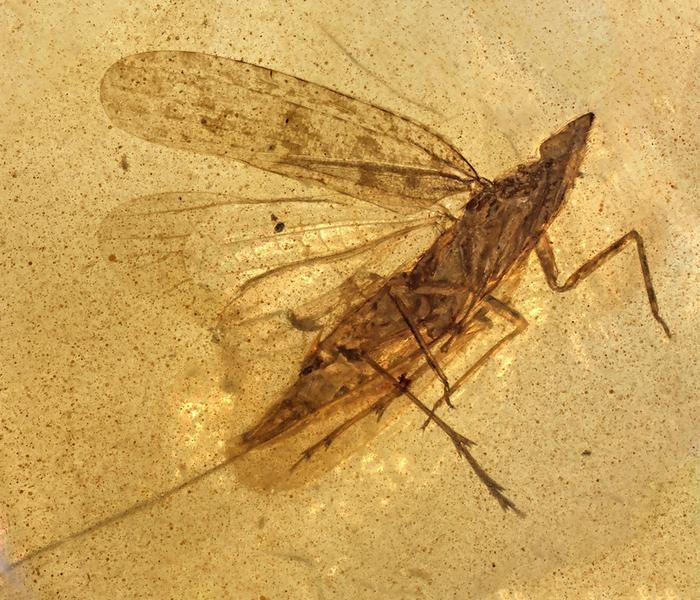
Cretodorus noonoo planthopper identified in 99-million-year-old amber
Discovery of Cretodorus Noonoo in Myanmar Amber
Scientists examining 13 insect fossils trapped in 99-million-year-old amber have identified a newly described prehistoric planthopper species named Cretodorus noonoo. The research, published in the journal Insects, reveals that the insect possessed a flexible mouthpart nearly twice the length of its body, functioning similarly to a bendy drinking straw to probe deep into tree bark for sap.
The Tech TL;DR:
- Specimen Age: Preserved in Burmese amber dating back approximately 99 million years to the Cretaceous period.
- Morphological Adaptation: Flexible, corrugated mouthparts reaching nearly twice the insect’s total body length, preventing kinking or collapsing during feeding.
- Ecological Function: Specialized sap-sucking mechanism designed to navigate narrow cracks in thick, fire-prone tree bark.
Research Collaboration Between Tel Aviv and Nanjing Institutions
The formal description of the prehistoric insect was conducted by researchers from the School of Zoology and the Steinhardt Museum of Natural History at Tel Aviv University in Israel, working in collaboration with the Nanjing Institute of Geology and Palaeontology of the Chinese Academy of Sciences. According to the research, the team utilized high-resolution micro-computed tomography to reconstruct the internal structure of the preserved planthoppers. These scans confirmed that the surface folds on the mouthparts were structural components rather than mere ornamentation, providing the necessary mechanical flexibility to move through tight spaces without kinking.

The species name draws inspiration from the children’s television character “Noo-Noo,” whose vacuum hose feature resembles the ancient insect’s elongated feeding structure. Leonidas-Romanos Davranoglou of Tel Aviv University noted in the findings that the species represents an evolutionary solution with almost no modern equivalent in contemporary ecosystems.
Comparison of Morphological Traits and Modern Relatives
Living relatives of the ancient Neazoniidae family exhibit much simpler, needle-like mouthparts designed to pierce plant tissues directly, whereas Cretodorus noonoo featured backward-pointing mouthparts adapted for specialized bark-probing. At the tip of these elongated organs lay a structure featuring two grooved lobes that likely opened during feeding to anchor the mouthpart securely against the walls of tree crevices, functioning similarly to an expanding wall anchor. Furthermore, the absence of pollen on any of the 13 examined specimens supports the conclusion that the insect targeted deep vascular tree fluids rather than floral nectar.
Implications for Reconstructing Cretaceous Forest Ecosystems
The presence of corrugated feeding structures across several unrelated insect groups during the Cretaceous period suggests that ancient forests featured an abundance of thick-barked trees. Research highlights that resin-producing forests of this era frequently experienced recurrent fires, an environmental pressure that regularly drives trees to develop thicker protective bark.
// Architectural data structure for fossil specimen telemetry
struct AmberFossilRecord {
  const char* species_name = "Cretodorus noonoo";
  uint32_t estimated_age_mya = 99;
  double mouthpart_to_body_ratio = 2.0;
  bool is_sap_specialist = true;
};
The discovery provides researchers with another empirical data point for modeling ancient food webs and understanding how prehistoric organisms adapted to specialized ecological niches.