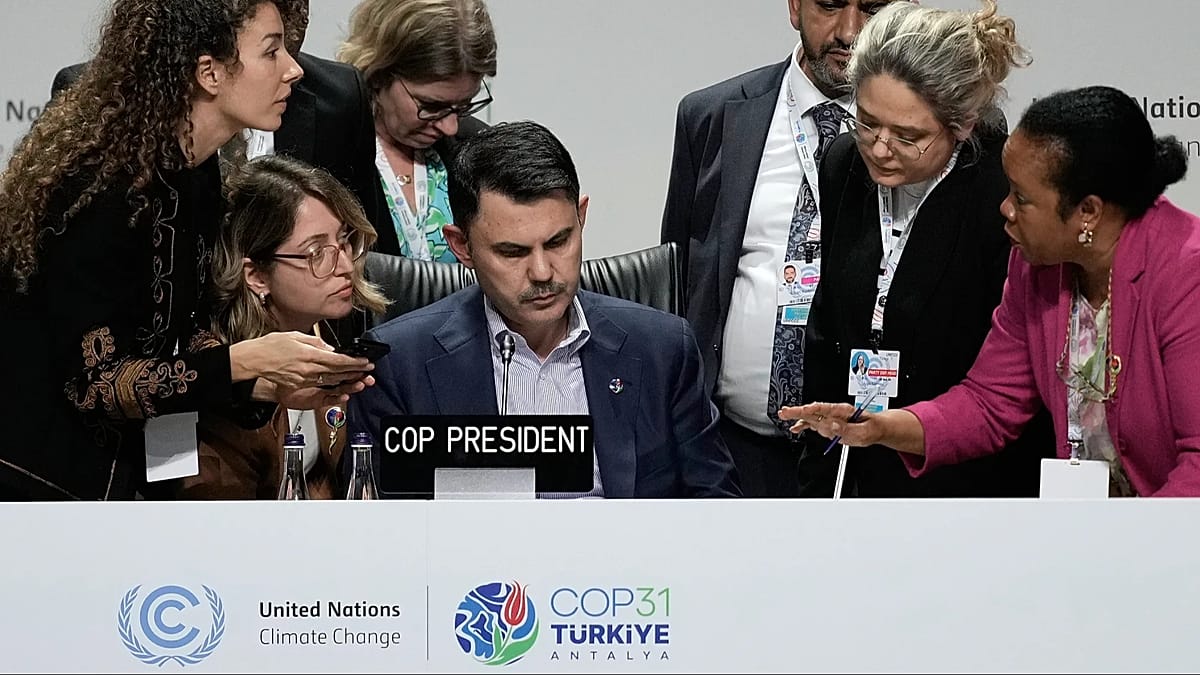
COP31 Talks End Without Deal in Antalya; Bowen Calls Outcome ‘Very Disappointing’
UN climate talks collapsed on Sunday afternoon in Antalya after a coalition led by the European Union rejected a final draft deal that omitted explicit references to fossil fuels.
The rejection occurred 44 hours past the scheduled close of the negotiations, making the gathering the longest UN climate summit on record, according to ABC News. Delegates had spent two weeks wrangling over text before joint COP31 presidents Australia and Türkiye abandoned efforts to produce a new draft.
Disagreements centered on whether to explicitly name coal, oil and gas as primary drivers of global warming, alongside debates over climate finance for developing nations. The last time negotiations broke down entirely without a consensus adoption was in Copenhagen in 2009, and only once before since global climate meetings began in 1995, as reported by the BBC.
The science is clear. Our failure to limit global warming to the agreed target is clear. But we can’t agree what to do next? We’re going to have to spend more adapting to the extreme weather that comes as a consequence of our depressing collective failure.…
- Negotiations in Antalya ran 44 hours past their official deadline before collapsing on Sunday.
- The European Union rejected the final text because it failed to mention fossil fuels.
- The summit took place after confirmation that global temperature rise is set to exceed 1.5 degrees Celsius.
Ireland’s climate minister Darragh O’Brien, speaking on behalf of the 27-nation EU presidency, said that member states could not support a cover decision that ignored the main driver of global warming.
“We will not endorse a cover decision … that does not even mention fossil fuels, which is the key driver of climate change,” O’Brien said, according to ABC News, later adding that the talks had been “hijacked by some oil states” as reported by euronews.
Australian Minister for Climate Change and Energy Chris Bowen, who served as president of the negotiations alongside Türkiye’s Murat Kurum, described the outcome as very disappointing. “Ultimately looking back many parties who are people of good faith had very strong red lines on a couple of key issues and despite many attempts on reflection those red lines were not able to be met,” Bowen said.

Bowen said that while an agreement was missed, Australia left nothing on the field during the talks. According to The Canberra Times, Saudi Arabia and other major oil producers pushed heavily to keep explicit fossil fuel phase-out language out of the text while retaining support for carbon capture and storage technologies.
United Nations Secretary General Antonio Guterres voiced profound frustration over the breakdown. “I share the very profound frustration of all those who expected governments to rise to the moment the climate crisis demands,” Guterres said. “Those who profit from the destruction of our planet must never dictate the terms of the fight to save it.”
I'm deeply disappointed that #COP31 has ended without consensus on an overarching outcome. I share the very profound frustration of all those who expected governments to rise to the moment the climate crisis demands. But this setback does not change the facts. There may be no… pic.twitter.com/SBMZPpfU5l
The failed political declaration does not erase existing legal and technical frameworks established by previous UN conferences, though it leaves nations without a newly ratcheted political mandate as global temperatures enter an overshoot period past the 1.5-degree threshold.
Final Hours and Compromise Attempts
COP31 President and Turkish Environment Minister Murat Kurum told delegates he believed concerns had been addressed. “We ask you to look at this decision carefully,” Kurum said. “We are closer than ever to agreement on the remaining issues.”

An EU official told the AFP news agency that the draft was a “backwards” step and warned that there was a “very real possibility” of the talks ending without a deal, according to reporting.
Developing Nations and Activists React
Tuvalu’s Climate Minister Maina Talia said: “It seems like we are negotiating with the Saudis.”
The dramatic impacts of the climate crisis can be felt everywhere. I have just witnessed it again here at the rice terraces in Banaue, Philippines. The only effective response is urgent #ClimateAction: ending our addiction to fossil fuels, transitioning to renewables &… pic.twitter.com/lLe5VyJJjK
Mohamed Adow of Powershift Africa told observers: “I can tell you without any doubt that this has been the worst COP ever.”
Overshoot and Previous Obligations
The world is entering a period called “overshoot”.
 0.3049%2Cmultiply_0.7554%2Cratio1.777778%2Cwidth_1059%2Cx0%2Cy_102/t_crop_custom/q_86%2Cf_auto/5b01374c7ce08af62b76f12af41743f944ff53cb” alt=”The Sydney Morning Herald logo” title=”Photo: The Sydney Morning Herald” width=”800″ height=”450″ style=”max-width:100%;height:auto;border-radius:4px;” loading=”lazy” />
Final Hours and Compromise Attempts
COP31 President Murat Kurum told delegates he believed concerns had been addressed, urging them to look at the decision carefully because negotiators were closer than ever to agreement on remaining issues.
Negotiating teams with Sunday morning flights rescheduled them, signalling a deal was not in sight and raising the risk the meeting would lose the critical numbers needed to pass an agreement.
Developing Nations and Activists React
Tuvalu’s Climate Minister Maina Talia said it seemed like they were negotiating with the Saudis.
Acting under its Common Foreign and Security Policy, the European Union coordinates its 27 member states through the rotating Council presidency to present a single negotiating mandate at UN climate talks.
The EU leverages its collective economic weight — a €18.802 trillion GDP in 2025 representing roughly one sixth of global output — and its status as a unified party with a single legal personality under the 2009 Treaty of Lisbon to reject draft agreements that fall below its red lines.
Climate activists and environmental groups, who are observers to the talks, slammed the negotiations.