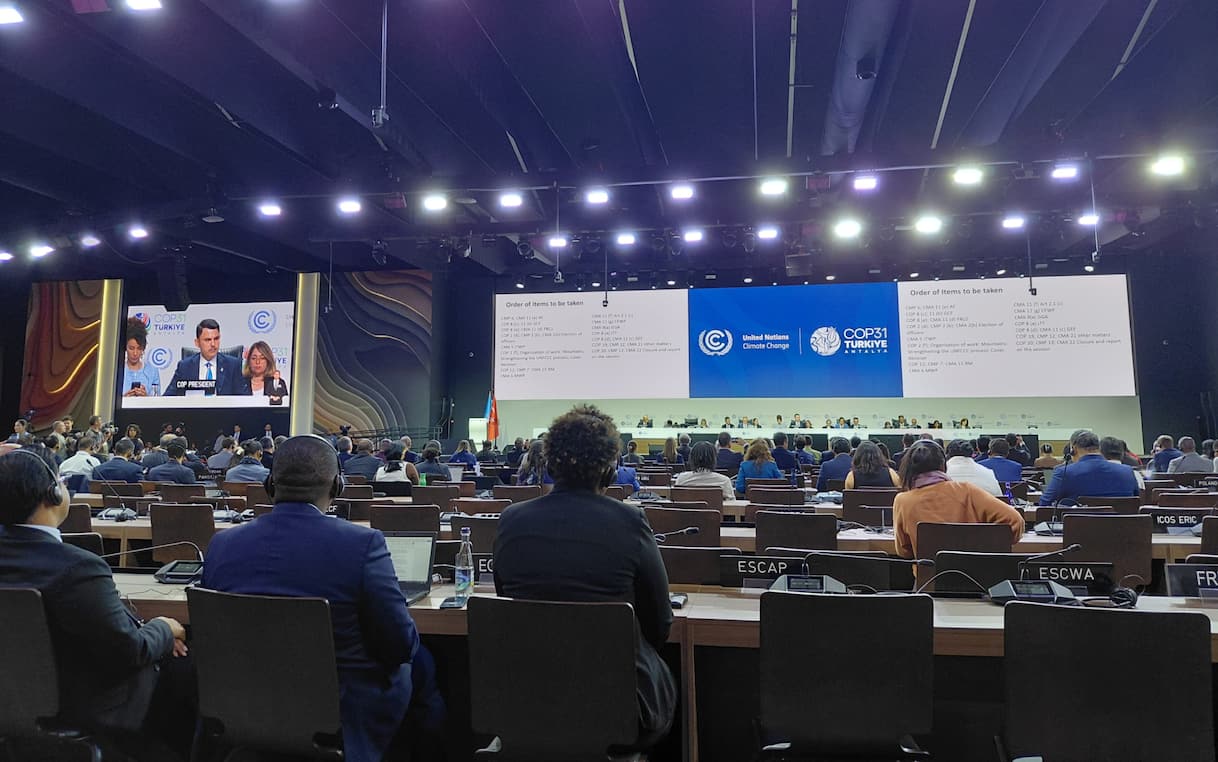
COP31 Ends Without Cover Decision as EU, Allies Vote Against Draft Omitting Fossil Fuels
The COP31 summit in Antalya closed without a political agreement on Sunday after the European Union rejected a draft decision that omitted any reference to fossil fuels, the primary driver of climate change, Il Sole 24 ORE reported.
Irish Climate Darragh O’Brien, speaking for the EU Council presidency, told the plenary the bloc would not endorse a text that ignores scientific evidence and the implementation gap threatening the 1.5°C limit.
“We will not endorse a facade decision or an Antalya pact that does not even mention fossil fuels, which are the key factor of climate change,” O’Brien said. “And we will not accept a COP that does greenwashing.”
“We will not endorse a decision that does not take account of the scientific evidence, that ignores the implementation modalities and that risks, in fact, widening the gap between global commitments and the actions necessary to correct the overshoot of the objectives and bring the 1.5-degree limit back within reach,” O’Brien said. “The drafts — and I say drafts in the plural — that have been presented to us do not address the climate emergency we are facing in the slightest; therefore, the European Union cannot accept them.”
EU Climate Wopke Hoekstra backed O’Brien’s refusal, arguing the drafts failed to address the climate emergency. Panama’s delegation, which had previously denounced an “oil mafia,” delivered a similarly scathing intervention. The Marshall Islands asked: “Are we so far from reality that we are taking steps backwards, just as the climate crisis threatens to overwhelm us?”
Presidency acknowledges failure
COP31 President Murat Kurum conceded the deadlock, telling delegates he understood there was disagreement so the cover decision would not be adopted. “We have listened to the most diverse ideas to find solutions — we have always respected the parties. We have done our best,” Kurum said, according to ANSA.
The conference, which ran two days past its scheduled close, set a record for the longest UN climate summit, surpassing COP25 in Madrid, il Giornale reported.

“I understand that there is disagreement among the parties on the Cover Decision, therefore it is not adopted,” Kurum told the morning plenary. “We have listened to the most diverse ideas to find solutions — we have always respected the parties. We have done our best.”
“Now the ball passes to the parties,” Kurum added. “Why do we not make progress, if we really want to demonstrate the political will to carry on this battle, if we truly want to make progress?”
The summit’s Turkish and Australian presidencies released the third draft of the final document at 4:30 a.m. local time (2:30 a.m. in Italy) on the final night of the conference.
Deepening divides
More than 100 countries had pushed for explicit language on phasing out fossil fuels, a commitment secured at COP28 in Dubai. Saudi Arabia, Russia and other petrostates blocked the reference, according to Il Sole 24 ORE. The EU, joined by Panama, the Marshall Islands, the United Kingdom, Norway and the Least Developed Countries group, voted against the draft, Sky TG24 reported. China, India, Saudi Arabia and the African Group supported it.

In 2015, with the Paris Agreement, governments committed to holding global warming well below 2 degrees, seeking to limit it to 1.5 degrees relative to pre-industrial levels. Yet United Nations estimates indicate that the climate pledges submitted in 2024, even if fully implemented, would lead to a temperature increase of between 2.6 and 2.8 degrees by the end of the century.
The EU was joined by Panama, the Marshall Islands, the United Kingdom, Norway and the group of Least Developed Countries (44 countries: 32 in Africa, eight in Asia, three in the Pacific and one in the Caribbean) in voting against the Cover Decision. China accepted the Cover Decision, together with India, Saudi Arabia and the African Group.
“We desire, however, Mr. President, to express our appreciation for the constant commitment made by you and by the president of the negotiations. Nevertheless, I must say clearly that the drafts presented do not address the climate emergency we are facing in the slightest; therefore, the European Union cannot accept them,” O’Brien said.
Brussels had demanded accelerated action on the commitments made in 2023 in Dubai, focusing on cutting greenhouse gases and phasing out fossil fuels.

Electrification target survives but weakened
The only concrete outcome was a non-binding call to raise the share of electricity in final energy consumption to 35% globally by 2035 (“35 by 35”), Corriere della Sera reported. However, Vatican News noted the target does not require the additional electricity to come from renewables, undermining its emissions impact. The draft also emphasized carbon capture, utilization and storage (CCUS) technologies, which the EU said were promoted disproportionately.
According to the EU, the document did not provide a credible response to the overshoot of climate limits (the overshoot of the 1.5-degree global warming limit) and promoted carbon capture, utilization and storage (CCUS) technologies in a disproportionate manner.
For many countries, COPs are one of the few spaces to build alliances, exert pressure on those most responsible for the crisis and claim resources for adaptation, loss and damage.
Negotiations are suspended and will resume at COP32 in Addis Ababa, Ethiopia, in 2027.