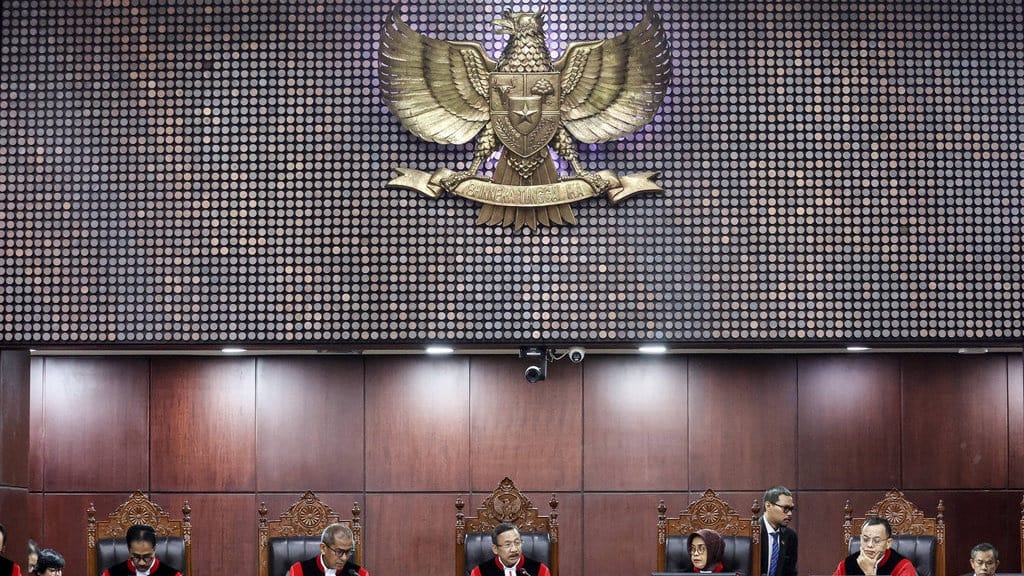
Constitutional Court Rules National Police Law Procedurally Flawed, Mandates One-Year Fix
The Constitutional Court (MK) has ruled that the formation of the law governing the National Police is procedurally flawed, mandating that the government and the House of Representatives (DPR) rectify it within one year.
On Monday, November 23, 2026, the court delivered its decision on case number 251/PUU-XXIV/2026, which challenged the validity of Law No. 5 of 2026. While the court declared the law formally flawed, it remains legally binding on a conditional basis until the one-year deadline expires, antaranews.com reported.
- The court ruled that Law No. 5 of 2026 was created without following mandatory legislative harmonization stages.
- If the law is not corrected within one year, it will be considered permanently unconstitutional, reverting to the previous 2002 statute.
- The court emphasized that digital broadcasts cannot replace the legal requirement for accessible written documents during the legislative process.
Procedural Failures in Legislative Process
The court found that the DPR’s 2024–2029 session failed to follow the "carry over" mechanism required by Law No. 12 of 2011 when it adopted a draft bill from the previous legislative term, hukumonline.com reported, according to Antaranews. Instead of treating the bill as a new proposal subject to the full five-stage legislative cycle, the lawmakers moved directly to the discussion phase.
"The practice of forming the Police Bill carried out by the 2024–2029 DPR did not go through the planning and drafting stages, but jumped straight to the discussion stage," said Constitutional Justice Saldi Isra, as noted by hukumonline.com, according to Hukumonline.

The court clarified that while the House plenary session holds high authority, it cannot override procedural requirements established in the Law on the Formation of Legislation (UU P3), nasional.kompas.com reported. Justice Enny Nurbaningsih said that the power to designate a bill as an initiative does not grant the authority to bypass the steps mandated by law.
Court Grants Petition in Part, Sets One-Year Deadline to Fix Law
Chief Justice Suhartoyo read the ruling, stating the court granted the petition from the first petitioner in part.
In the operative ruling, Suhartoyo declared that the formation of Law No. 5 of 2026 does not conflict with the 1945 Constitution. It retains binding legal force on a conditional basis provided the legislature fixes the procedural defects within one year of the ruling. If the deadline passes without correction, the law becomes permanently unconstitutional and the previous 2002 statute revives automatically.
Justice Ridwan Mansyur Explains Constitutional Defects in Legislative Process
Justice Ridwan Mansyur explained that the law failed to meet the requirements of the 1945 Constitution because its formation lacked a certain, standard, and systematic method. Consequently, the court ordered the legislature to repair the formation process to satisfy these standards.

Mansyur emphasized that openness and truth are inseparable in a democratic state, describing them as two sides of the same coin. He stated both must be present throughout the legislative process to produce just laws that maximally reflect the will of the people. The court set the one-year deadline specifically to allow the legislature to fulfill these constitutional obligations.
Court Rules Online Streams Insufficient, Demands Real-Time Written Publication
Beyond the procedural gaps, the court criticized the handling of public information during the bill’s development. While proceedings were streamed online, the court ruled that these audiovisual recordings are merely supplementary, tirto.id reported.
"The primary publication instrument in the formation of legislation remains written documents, which are published or disseminated in real time through the official channels of the law-forming body," said Constitutional Justice Ridwan Mansyur, according to tirto.id. The court also warned against the practice of backdating document uploads, noting that such actions obscure the legislative timeline and mislead the public.
"In a democratic country, openness and truth are two sides of the same coin," said Mansyur, as reported by tirto.id.