
Colorado Rail Project to Link New Mexico and Wyoming
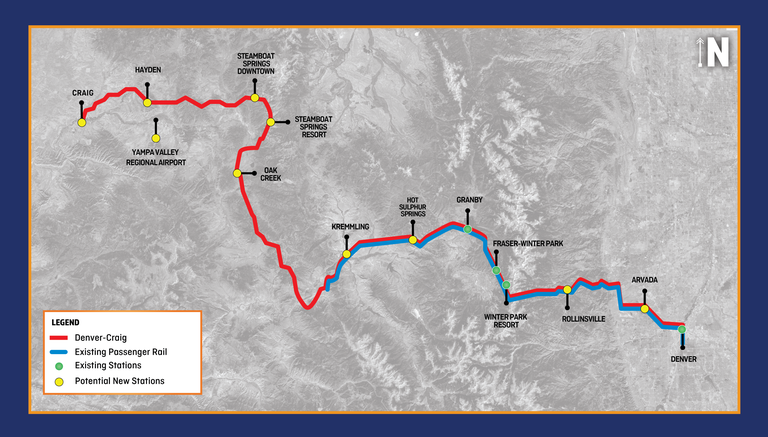
Colorado is advancing a new Front Range passenger train designed to utilize existing freight tracks. This initiative aims to enhance regional mobility within the Front Range Urban Corridor and potentially extend connectivity to Wyoming and New Mexico, integrating critical economic hubs across the Southern Rocky Mountain Front megaregion.
The ambition is clear, but the execution is a logistical tightrope. By relying on existing tracks shared with freight railroads, the project avoids the astronomical cost of new land acquisition but inherits a legacy of congestion and scheduling conflicts. When passenger rail shares a corridor with heavy freight, every delay in a cargo shipment ripples through the passenger timetable. This represents the fundamental friction of the project: the desire for modern mobility versus the reality of aging, shared infrastructure.
We see a high-stakes gamble on regional connectivity.
The Megaregion Ambition: Beyond State Lines
This rail project is not merely a local transit upgrade; it is a strategic play within the Southern Rocky Mountain Front megaregion. This megalopolis, which encompasses parts of Wyoming, Colorado, and New Mexico, is anchored by the Front Range Urban Corridor and the combined statistical area of Albuquerque, Santa Fe, and Los Alamos. To understand the scale of this project, one must glance at the numbers. As of the 2010 census, this region held a population of 5,467,633 people.
The growth trajectory is even more staggering. Projections suggest the population will surge by 87%, reaching 10,222,370 by the year 2050. For a region already struggling with highway congestion, the transition to rail is no longer a luxury—it is a survival mechanism for urban growth. The economic weight of this corridor is already substantial, with a recorded GDP of $229,202,000,000 in 2005, representing 2% of the entire United States GDP at that time.
Expanding the rail line into New Mexico and Wyoming would effectively stitch together the state capitols of Cheyenne, Denver, and Santa Fe. Yet, moving from a single-state project to an interstate network introduces a layer of bureaucratic complexity that can stall progress for decades. Coordinating municipal laws and transit authorities across three different state governments requires a level of diplomacy and planning that transcends simple engineering.
Managing these multi-jurisdictional hurdles often requires the intervention of specialized regional planning committees to align divergent state priorities.
Navigating the Geographic and Political Divide
The definition of the “Southwest” varies, and these definitions often dictate how federal funding and regional grants are allocated. Although Arizona and New Mexico are almost always considered the core of the geographic and cultural region of the Southwest, Colorado’s role is more fluid. According to the U.S. Census Bureau geographic divisions, Colorado, New Mexico, and Wyoming are all grouped within the Mountain division of the West region.
This classification is more than just a map detail; it affects how infrastructure is viewed on a macro-economic scale. The project’s potential to connect Colorado to the Southwestern core—specifically the hubs in New Mexico—could shift the economic gravity of the region. By linking the Front Range Urban Corridor to the broader Southwest, Colorado creates a transit artery that supports not just commuters, but interstate commerce and tourism.
The logistical reality, however, remains grounded in the dirt and steel of the tracks. The reliance on freight railroads means the project must navigate the complex legal agreements of “trackage rights.” Freight companies prioritize the movement of goods, and passenger trains are often seen as an interruption to that flow. This conflict creates a legal minefield regarding liability, priority, and maintenance responsibilities.
Developers and municipal governments are increasingly relying on commercial real estate attorneys to navigate the zoning changes and land-use agreements that inevitably follow the announcement of new rail stops.
The Infrastructure Bottleneck
To visualize the scope of the Front Range Urban Corridor, the string of cities that this rail line intends to serve. The corridor is a dense network of population centers, including:

- Major Hubs: Denver, Aurora, and Colorado Springs.
- Satellite Cities: Lakewood, Thornton, Boulder, and Longmont.
- Northern Anchors: Greeley and Fort Collins.
- Southern Gateways: Pueblo and the connection toward New Mexico.
- Interstate Links: Cheyenne, Wyoming.
Each of these cities brings its own set of infrastructure deficits. The challenge is not just laying track, but integrating these stops into existing city grids without causing total traffic collapse. The “shared track” model means that while the train can move between cities, the “last mile” of the journey—getting passengers from the station to their final destination—remains an unsolved problem in many of these municipalities.
Solving the friction between heavy freight and passenger schedules is a technical specialty. Many cities are now bringing in infrastructure consultants to design “passing sidings” and upgraded signaling systems that allow passenger trains to bypass slow-moving freight loads.
The economic potential is undeniable, but the path is fraught with operational risk.
As we look toward 2050 and a population exceeding 10 million in the Southern Rocky Mountain Front, the naming of this train is the straightforward part. The hard part is the decades of negotiation and engineering required to turn a shared freight line into a reliable passenger artery. The project represents a pivot point for the West: either we continue to rely on the asphalt of the interstate system, or we commit to the integrated, multi-state rail vision that defined the American century. The success of this venture will depend entirely on whether the region can move past state borders and freight priorities to build a unified corridor. For those navigating the resulting shifts in property value, zoning, and regional commerce, finding verified professionals through the World Today News Directory is the only way to ensure you aren’t left behind at the station.