
Clint Eastwood’s Forgotten Hit: The Orangutan Movie You Need to See
In a surprising turn for a career defined by stoicism and grit, Clint Eastwood’s 1978 action comedy, Every Which Way But Loose, became his most commercially successful film to date, surpassing even the box office returns of his iconic “Dirty Harry” franchise and Sergio Leone’s celebrated Westerns. The film, released by Warner Bros., defied expectations and resonated with audiences, though it has largely faded from the collective memory of younger generations.
The plot centers on Philo Beddoe, played by Eastwood, a truck driver and bare-knuckle boxer navigating the American West. He’s accompanied by his orangutan, Clyde, and his friend and manager, Orville Boggs (Geoffrey Lewis). The narrative unfolds as Beddoe searches for a country singer, Lynn Halsey-Taylor (Sondra Locke), with whom he’s become infatuated. According to IMDb, the cast also included Walter Barnes as Tank Murdock, Roy Jenson as Woody, and Ruth Gordon as Ma.
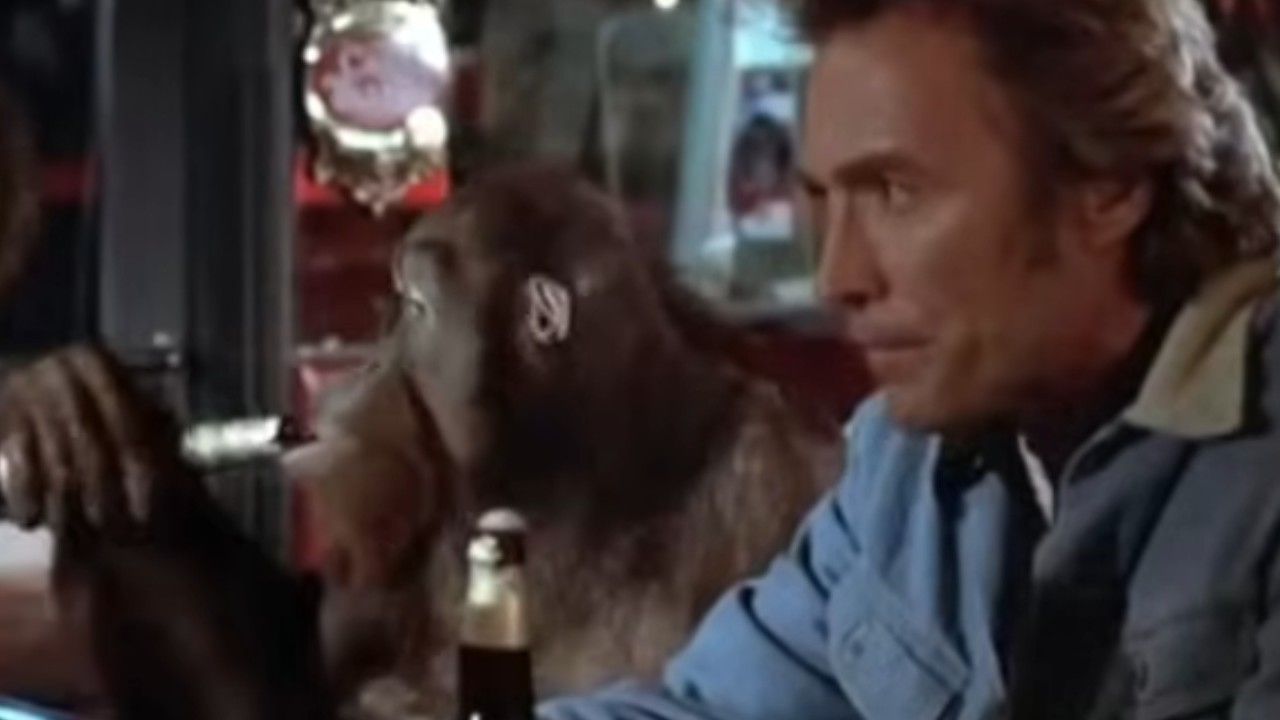
The film’s success is largely attributed to the unlikely pairing of Eastwood with an orangutan. Clyde, whose real name was Manis, quickly became a focal point of the film’s appeal. The orangutan’s antics, including beer-drinking and, notably, giving the finger to members of a motorcycle gang, provided a consistent source of comedic relief.
The film also features a subplot involving a neo-Nazi motorcycle gang, “The Black Widows,” led by John Quade’s character, Cholla. The gang’s pursuit of Beddoe stems from a confrontation where he acquires and sells their motorcycles, using the proceeds to aid Lynn. The depiction of the gang is largely comedic, with their incompetence frequently highlighted, adding to the film’s overall lighthearted tone.
The romantic element of the story takes an unexpected turn. Lynn’s disappearance is revealed to be self-orchestrated, and she rebuffs Beddoe’s attempts to find her, even reacting with hostility when he does. This unconventional narrative choice adds a layer of complexity to the film, diverging from typical romantic comedy tropes.
Every Which Way But Loose was directed by James Fargo and written by Jeremy Joe Kronsberg. The film’s budget was $5 million, and it ultimately grossed over $104.3 million, according to Wikipedia, solidifying its place as a significant commercial success for Eastwood and Warner Bros. A sequel, Any Which Way You Can, followed in 1980.