
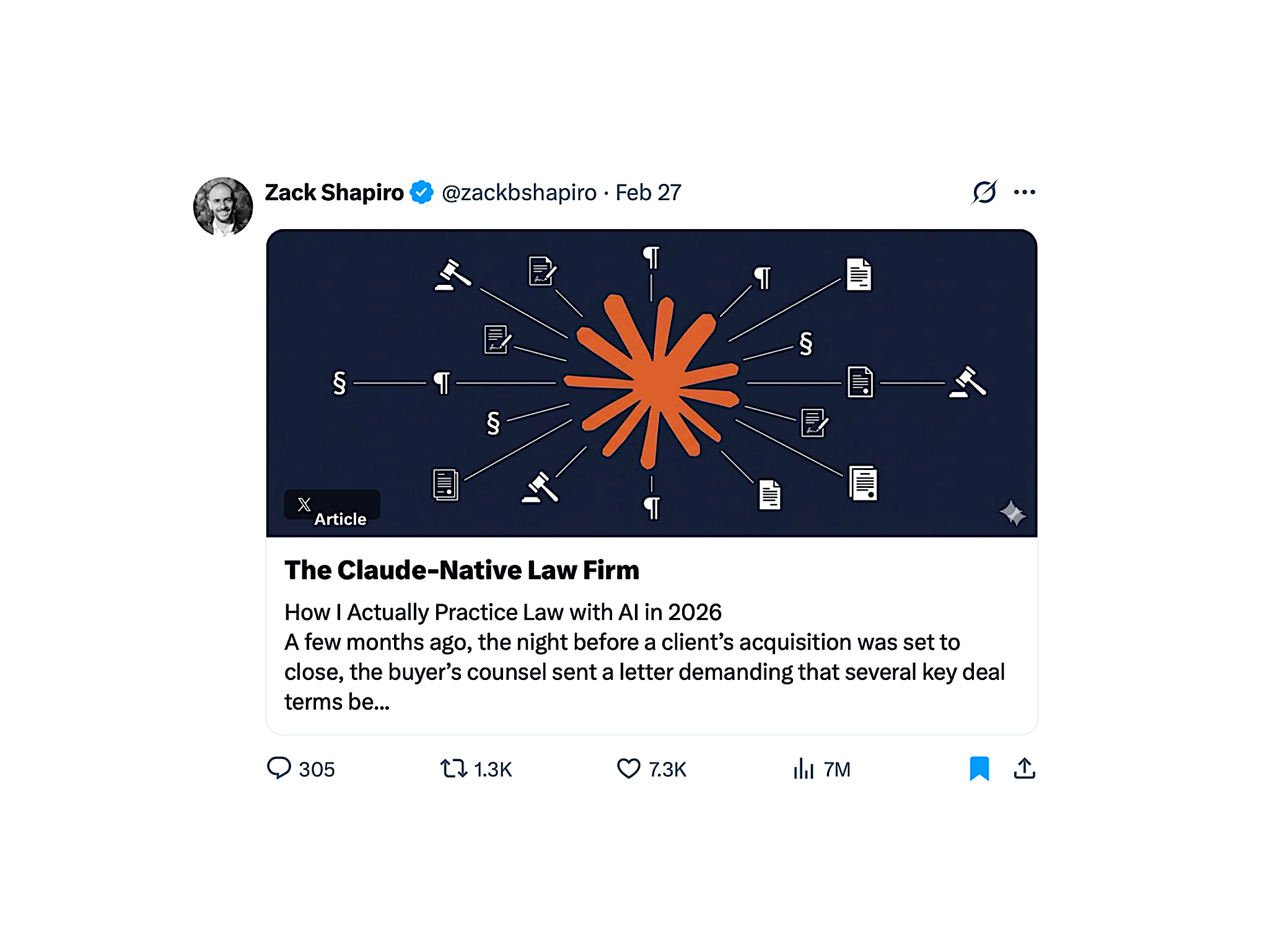
A lawyer’s recent post detailing his firm’s utilize of customized instructions, known as “Skills,” within Anthropic’s Claude artificial intelligence platform has sparked widespread discussion within the legal profession, garnering over 7 million views on X. Zack Shapiro, of a small US-based firm, outlined how he leverages Claude not as a replacement for traditional legal technology, but as a tool to encode his individual analytical frameworks and automate complex tasks like contract review and citation formatting.
Shapiro’s post, titled ‘The Claude-Native Law Firm,’ describes a workflow where Claude applies his specific legal judgment to documents, going beyond the capabilities of standard firm playbooks. He highlights the platform’s ability to manipulate document formatting at the XML level, ensuring precise tracked changes and citation standardization without manual intervention – tasks he characterizes as “software problems” rather than legal ones. This capability, he argues, surpasses what specialized legal AI products currently offer.
The reaction to Shapiro’s insights has been varied, with some viewing it as a challenge to established legal tech and others dismissing it as a niche application. However, analysis from Artificial Lawyer suggests a more fundamental point: many legal professionals remain unfamiliar with the full potential of Claude, including its Skills, Cowork features and Plugins.
Skills, according to observers, function as distinct, customizable workflows within Claude. Plugins can be understood as collections of these Skills, focused on specific areas of legal practice. Both Skills and Plugins integrate with Claude Cowork, which connects to both local files and external Software-as-a-Service (SaaS) solutions, including existing legal technology platforms.
The architecture can be conceptualized as follows: Claude serves as the core large language model (LLM) providing the “brainpower,” Cowork acts as the “hands” connecting to data and tools, and Skills represent the “recipes” for specific tasks, offering more than just one-off prompts. A Plugin, then, is a focused “cookbook” of these recipes.
Shapiro’s work demonstrates the potential of building custom contract Skills to streamline transactional work. While not a revolutionary development in 2026, it represents a readily available capability for lawyers willing to explore the platform. This is not positioned as a replacement for comprehensive legal tech platforms, but rather as a complementary tool.
Industry leaders, including Thomson Reuters and LexisNexis, appear to be adopting this perspective, with Harvey and LegalZoom already establishing connectors to Claude Cowork. This suggests a move towards integration rather than outright disruption.
The significance of Shapiro’s post, lies not in the number of views it received, but in the number of legal professionals who may have been unaware of Claude’s capabilities. The development signals an evolution in the legal tech landscape, where AI tools are increasingly being used to augment, rather than replace, existing workflows. Legal tech companies are actively exploring how to incorporate these recent capabilities, potentially leading to a mutually beneficial outcome for the legal sector.
