
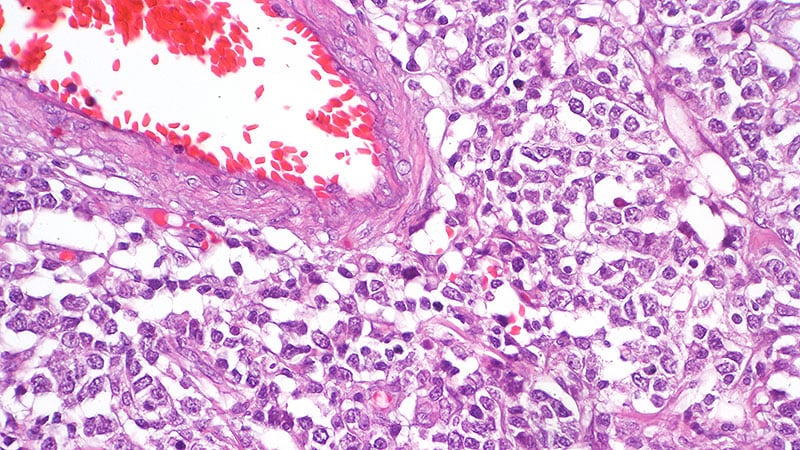
“`html
{
"@context": "https://schema.org",
"@type": "FAQPage",
"mainEntity":[
{
"@type": "Question",
"name": "What is diffuse large B-cell lymphoma (DLBCL)?",
"acceptedAnswer": {
"@type": "Answer",
"text": "Diffuse large B-cell lymphoma (DLBCL) is a type of non-Hodgkin lymphoma, which is a cancer of the lymphatic system. It is the most common type of non-Hodgkin lymphoma, accounting for about 30% of cases."
}
},
{
"@type": "Question",
"name": "How can circulating tumor DNA (ctDNA) help in treating DLBCL?",
"acceptedAnswer": {
"@type": "Answer",
"text": "Circulating tumor DNA (ctDNA) can definitely help identify genetic subtypes of DLBCL and guide the escalation or de-escalation of chemotherapy, allowing for more personalized treatment approaches."
}
},
{
"@type": "Question",
"name": "what is the standard chemotherapy treatment for DLBCL?",
"acceptedAnswer": {
"@type": "Answer",
"text": "The standard chemotherapy treatment for DLBCL is R-CHOP, which includes rituximab, cyclophosphamide, doxorubicin hydrochloride (hydroxydaunomycin), vincristine (Oncovin), and prednisone."
}
},
{
"@type": "Question",
"name": "What are MYD88 and CD79B mutations in the context of DLBCL?",
"acceptedAnswer": {
"@type": "Answer",
"text": "MYD88 and CD79B are two mutations that can be present in the MCD subtype of DLBCL. Identifying these mutations through ctDNA analysis can help determine if a patient might benefit from a different treatment approach, such as the addition of a Bruton tyrosine kinase inhibitor like acalabrutinib."
}
},
{
"@type": "Question",
"name": "What is acalabrutinib, and how is it used in DLBCL treatment?",
"acceptedAnswer": {
"@type": "Answer",
"text": "Acalabrutinib is a Bruton tyrosine kinase (BTK) inhibitor. It may be added to the standard R-CHOP chemotherapy regimen for patients with specific genetic subtypes of DLBCL, such as those with MYD88 and/or CD79B mutations, who may not respond well to R-CHOP alone."
}
},
{
"@type": "Question",
"name": "How quickly can ctDNA analysis provide results for DLBCL treatment planning?",
"acceptedAnswer": {
"@type": "Answer",
"text": "according to a recent study, genetic profiling with ctDNA can provide results in as little as 9 days, with a median time to start treatment of just 15 days, making it a feasible approach for timely treatment decisions."
}
},
{
"@type": "Question",
"name": "What factors correlate with detectable ctDNA in DL
