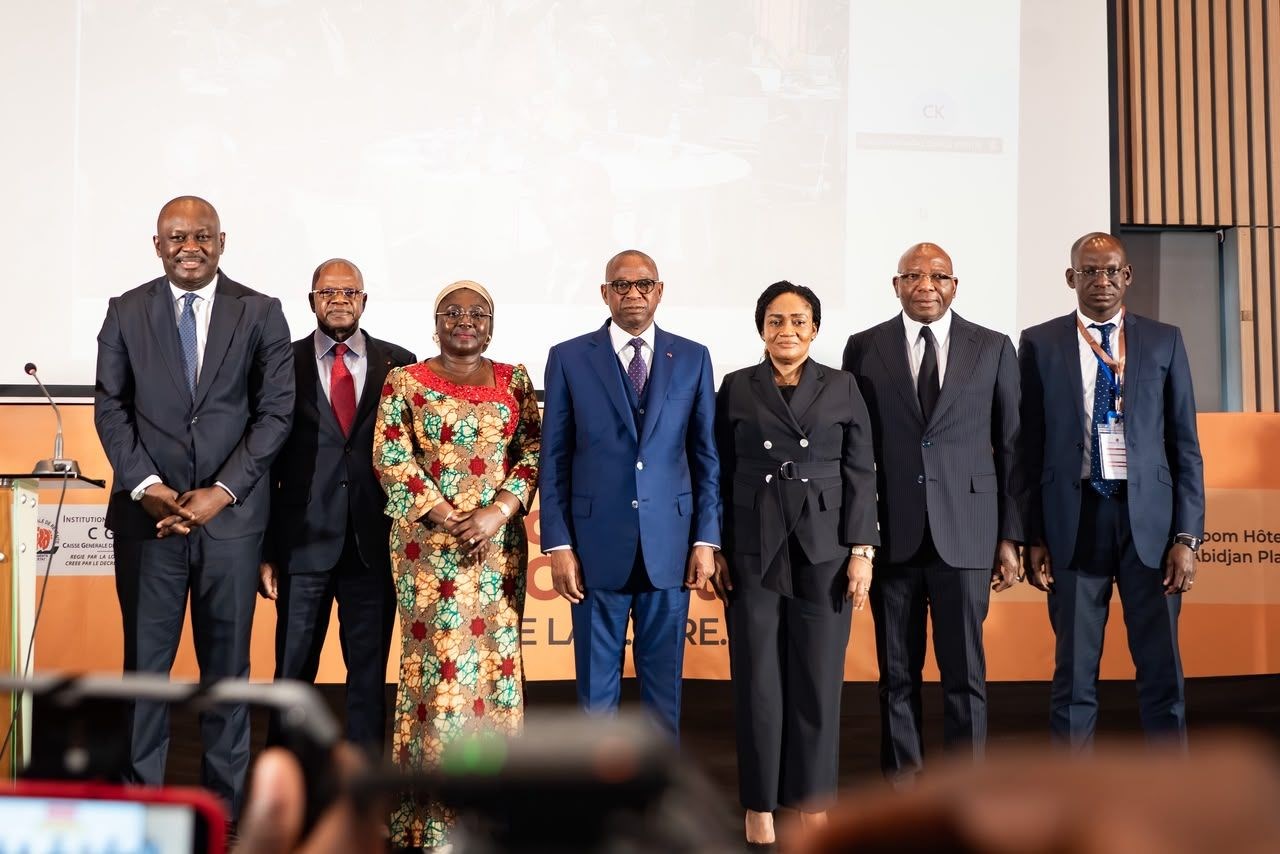
CIPRES Trains 119 Executives on 2029 Accounting, Prudential Standards in Abidjan
The Inter-African Conference on Social Security (CIPRES) concluded a five-day technical seminar in Abidjan on Friday, training 119 executives from 21 member institutions across 14 countries on new accounting and prudential standards set to take effect in 2029, RTI Infos reported.
The seminar, hosted by the Institution de Prévoyance Sociale–Caisse Générale de Retraite des Agents de l’État (IPS-CGRAE) at the Noom Hotel from November 23 to 27, was organized with support from KPMG Côte d’Ivoire, according to Sika Finance.
It brought together accountants, financial managers, actuaries, auditors, and legal experts to prepare for the deployment of a revised CIPRES chart of accounts, new performance indicators, and frameworks for capitalized pension schemes.
Standards adopted in Geneva
The instruments were adopted in June during the 40th ordinary session of the CIPRES Council of Ministers in Geneva, capping a revision process launched in 2021, Sika Finance reported. The reforms aim to address persistent delays in financial reporting across the 18-member bloc and to harmonize the presentation of accounts for better supervision.

The harmonization of their presentation must facilitate the evaluation of the financial and actuarial balances of the organizations, while strengthening the supervision exercised by CIPRES, Linfodrome reported. The revised indicators must make it possible to measure performance, detect weaknesses, and take the necessary corrective measures.
Minister calls for knowledge transfer
Closing the sessions, Ivorian Minister of Employment, Social Protection and Vocational Training Adama Kamara told participants they were now responsible for cascading the training within their respective funds. “You are now relays to your colleagues in your respective funds,” he said. Kamara also urged CIPRES to monitor implementation closely and proposed commissioning a study from Finactu on turning the conference into a rating agency for social security bodies, Linfodrome reported.

“These financial data, supplemented by management data, must inform our decisions and allow us to act early enough when the balances of a scheme are threatened,” Kamara explained. He also recalled the importance of social protection in the development of states, stressing the need for rigorous management of financial resources to ensure the sustainability of schemes and honor commitments made to insured persons, AIP reported.
For the Ivorian authorities, this modernization of management tools accompanies the transformations undertaken in the national social protection system since 2012, Sika Finance reported. The minister notably recalled the progress made with the extension of Universal Health Coverage (CMU), the enrollment of independent workers in the Social Scheme for Independent Workers (RSTI), and the development of supplementary funded pensions within the IPS-CGRAE.
The opening ceremony was presided over by the Ivorian Minister of Employment, Social Protection and Vocational Training, Adama Kamara, alongside the Executive Secretary of CIPRES and the Director General of the IPS-CGRAE, the host institution of the meeting, Sika Finance reported.
Participant count varies across outlets
All three outlets described the same five-day program covering asset valuation, investment profitability, reserve coverage, solvency requirements, and the specific accounting rules for social security operations.
During the five days, auditors, actuaries, study managers and other executives were trained on the new provisions, with the support of experts from KPMG Côte d’Ivoire, Linfodrome reported. The discussions notably covered accounting law, the rules for processing operations specific to social security organizations, prudential ratios and performance standards. Participants also studied the mechanisms governing funded pension schemes. The exchanges notably focused on the evaluation of assets, the processing of accounting operations, the profitability of investments, the coverage of reserves and solvency requirements.
The exchanges also focused on the accounting rules specific to social security organizations, the preparation of financial statements, the monitoring of investments and technical provisions, as well as the evaluation of solvency and financial performance. Participants also deepened their understanding of the mechanisms for setting up funded pension schemes, which require rigorous asset management and sufficient coverage of commitments.
The application of these new reference frameworks will not be limited to an update of accounting tools. It implies an adaptation of practices and coordination between several departments, notably accounting, finance, actuarial, IT, audit and management control, RTI Infos reported.
Next steps before 2029 deadline
The IPS-CGRAE Director General, Abdrahamane Tiémoko Berté, stressed that mastering the new tools conditions the quality of benefits paid to insured workers, AIP reported. He also insisted on the need to have personnel capable of “getting the best out of” these new management tools, whose proper mastery will determine the quality of services provided, AIP reported. The ultimate goal of the reference framework revision project is to enable institutions to better meet their commitments and respond effectively to the expectations of insured persons. Participants issued motions of thanks to President Alassane Ouattara, Minister Kamara, and Director General Berté, read by representatives from the Gabon, Benin, and Congo national funds, RTI Infos noted.
Three motions of thanks were addressed to the President of the Republic, Alassane Ouattara, to Minister Adama Kamara and to the Director General of the IPS-CGRAE, Abdrahamane Tiémoko Berté. They were read respectively by Laetitia Nyinguema, management controller at the CNSS of Gabon, Elisée Yanos Todedji Dahou, statistician-actuary at the CNSS of Benin, and Jofran Mbossa Ossebi, department head at the CNSS of Congo, according to RTI Infos.
At the end of the training, participants expressed their satisfaction with the quality of the organization and the welcome provided by the IPS-CGRAE. The closing of this seminar thus marks a preparatory stage. The challenge now is to translate the knowledge acquired into operational changes in the 21 organizations concerned, before the 2029 deadline.