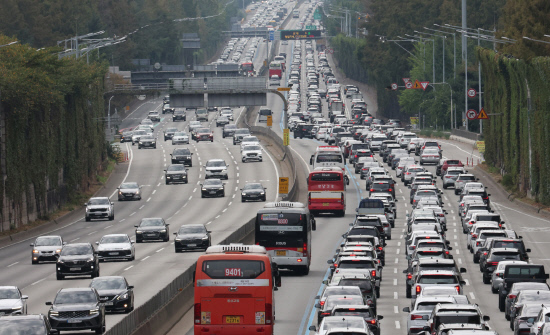
Chuseok Outbound Traffic Eases as Return Trips to Seoul Remain Congested
On the evening of September 25, 2026, traffic congestion on major expressways heading out from Seoul during Chuseok eased significantly, while return routes toward the capital remained heavily congested with continuous vehicle queues. According to the Korea Expressway Corporation, overall national traffic volume reached an estimated 6.84 million vehicles for the day.
Outbound Congestion Eases as Return Traffic Persists
Traffic heading away from the capital saw considerable relief by early evening. Data from the Korea Expressway Corporation at 7:00 p.m. on September 25 established that estimated travel times from the Seoul tollgate to major provincial destinations dropped notably. Motorists traveling to Busan faced a 4-hour and 30-minute drive, while trips to Ulsan took 4 hours and 10 minutes. Journeys to Mokpo stood at 3 hours and 40 minutes.
Additional outbound travel times included 3 hours and 30 minutes to Daegu, 3 hours and 20 minutes to Gwangju, 2 hours and 40 minutes to Gangneung, and 1 hour and 50 minutes to Daejeon. The corporation projected that the remaining outbound congestion would completely disperse between 7:00 p.m. and 8:00 p.m.
Inbound Travel Times and Heavy Bottlenecks
Return trips toward Seoul faced much slower conditions as holidaymakers headed back. Inbound travel times from major regional hubs stretched considerably by 7:00 p.m. on September 25. Drivers returning from Busan faced 5 hours and 50 minutes on the road. Trips from Mokpo and Ulsan both required 5 hours and 30 minutes, while travel from Gwangju took 5 hours and 10 minutes.
Inbound journeys from Daegu registered at 4 hours and 50 minutes, Daejeon at 3 hours and 20 minutes, and Gangneung at 3 hours. The Korea Expressway Corporation projected that these return-direction traffic jams would persist well into the night before clearing around 2:00 a.m. to 3:00 a.m. the following morning.
Specific highway segments bore the brunt of the slow movement. On the Gyeongbu Expressway toward Busan, congestion formed around the Singal Junction for 2.68 kilometers and near the Giheung Dongtan Interchange for 4.39 kilometers. Vehicles on the Seoul-bound side crawled at a snail’s pace across an 11-kilometer stretch from Hwalcheon to near Gyeongju, as well as a 7.5-kilometer section around Oksan Junction.
The Seohaean Expressway also recorded heavy delays heading toward Seoul. Slow traffic appeared near Buan for 2 kilometers, from Donggunsan to Dongseocheon Junction for 15 kilometers, and near Gwangcheon for 3 kilometers. Further north on the same route, vehicles experienced sluggish movement over a 13.93-kilometer stretch near Seokimje Interchange and a 17-kilometer span from Songak Interchange to Poseung Junction.
Urban Arteries Squeeze Under Rain and Holiday Volume
Metropolitan roads inside Seoul compounded transit delays as persistent rain combined with heavy holiday traffic. Arterial routes experienced continuous bottlenecks during the evening commute. The Olympic-daero expressway saw slow movement between the Dongbu Expressway junction and the southern end of Yeongdong Bridge, as well as between the southern ends of Hannam Bridge and Banpo Bridge. Traffic also crept forward from the southern end of Yeongdong Bridge to the southern end of Seongsu Bridge.
Along the Gangbyeon Expressway, the section between the northern end of Dongho Bridge and the northern end of Banpo Bridge remained congested. Similar delays affected the Bukbu Expressway between Mukdong Interchange and Wolreung Interchange, alongside the Inner Circular Road from Hongje Ramp to Yeonhui Ramp.