
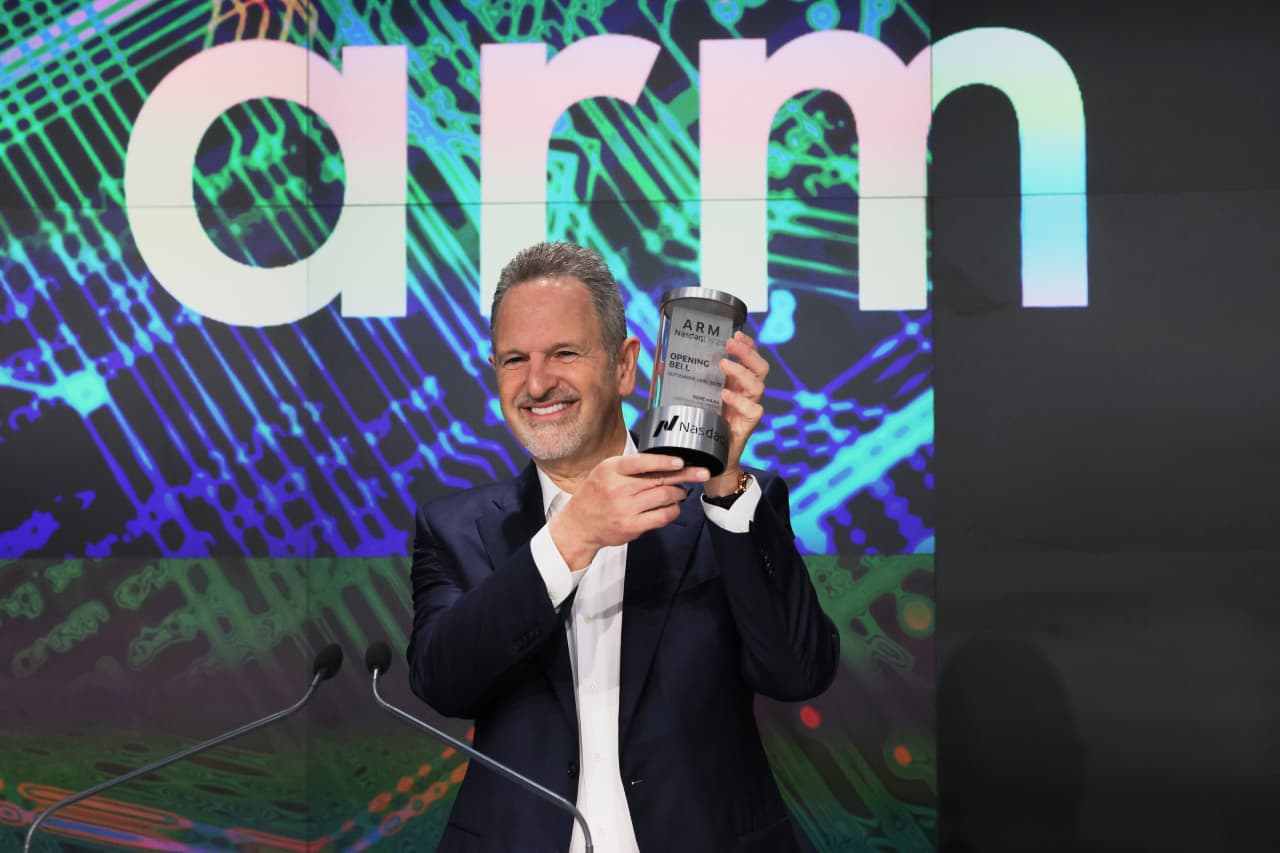
Chip Designer Sees $2 Billion Demand for First Data-Center CPU
Arm reported over $2 billion in customer demand for its debut data-center CPU through fiscal 2028, yet shares dipped following its Q4 earnings report. Although revenue reached $1.49 billion, investor volatility stems from a royalty revenue miss and concerns over the company’s ability to scale its physical supply chain.
The market is currently witnessing a violent decoupling between architectural demand and operational execution. Arm is no longer just the invisible hand inside every smartphone. it is aggressively pivoting toward the data center. This shift represents a fundamental change in the company’s revenue DNA, moving from low-power mobile dominance to high-compute agentic AI environments.
This transition creates a precarious “execution gap.” Having a blueprint that customers want is not the same as having a chip that customers can buy. As Arm scales its first-ever CPU venture, the company faces immense pressure to synchronize its design cycle with global fabrication capacities, a challenge that often requires the intervention of specialized supply chain logistics firms to prevent catastrophic delivery delays.
The Q4 Financial Breakdown: Beats and Misses
On the surface, Arm’s fiscal fourth quarter looks like a victory. Revenue of $1.49 billion outperformed the FactSet consensus of $1.47 billion, marking a 20% year-over-year increase. Adjusted earnings per share hit 60 cents, edging past the 58 cents analysts expected. But, the internal composition of these numbers tells a more nuanced story of a business in flux.

| Metric | Q4 Actual | Analyst Expectation | YoY Growth |
|---|---|---|---|
| Total Revenue | $1.49 Billion | $1.47 Billion | +20% |
| Licensing Revenue | $819 Million | $781 Million | +29% |
| Royalty Revenue | $671 Million | $690 Million | +11% |
| Adjusted EPS | $0.60 | $0.58 | N/A |
The licensing segment is firing on all cylinders. A 29% jump to $819 million suggests that the industry is paying a premium to access Arm’s newest intellectual property. The problem lies in the royalties. At $671 million, the royalty stream missed the $690 million mark. In the semiconductor world, licensing is the promise; royalties are the proof. The miss suggests that while companies are signing contracts, the actual silicon isn’t hitting the racks fast enough.
This discrepancy highlights a critical risk for any firm scaling high-value IP: the lag between design adoption and revenue realization. To manage these complexities, expanding tech giants frequently engage enterprise intellectual property law firms to structure licensing agreements that protect margins during these volatile ramp-up periods.
The AGI CPU: High Stakes, Higher Core Counts
CEO Rene Haas has placed a massive bet on the “AGI” CPU, a design specifically engineered for agentic AI applications. The demand is staggering—more than $2 billion across fiscal 2027 and 2028, a figure that has more than doubled since the product’s launch. Haas attributes this surge to the specific architecture of the AGI chips, which feature 136 dedicated processor cores.

The logic is simple: AI agents require dedicated cores to operate autonomously. Data center operators are envisioning a future where racks of Arm CPUs run in parallel with racks of GPUs, creating a hybrid compute environment that optimizes for both training and inference.
“The market is no longer pricing in the promise of the architecture; it’s pricing in the ability to ship silicon.”
Despite the demand, Haas admitted during the Q4 FY 2025/26 earnings call that Arm has yet to fully assemble the supply chain necessary to deliver $2 billion worth of AGI silicon. This admission is likely what spooked the markets. Wall Street has little patience for “demand” that cannot be converted into “deliverables.”
Arm is essentially attempting to build a plane while flying it, transitioning from a pure IP provider to a company with significant delivery expectations. This operational pivot is an immense undertaking that usually necessitates the guidance of global corporate strategy consultants to align internal KPIs with external supply chain realities.
The Path to Data Center Dominance
Arm’s trajectory is clear: the data center is slated to become its largest business “soon.” We are seeing a systemic migration where hyperscalers—the Amazons and Microsofts of the world—are moving away from off-the-shelf silicon in favor of custom designs built on Arm architecture.
This shift changes the company’s risk profile. Data center royalties have already more than doubled from the previous year, providing a significant tailwind for earnings per share. But the transition also exposes Arm to the volatility of the cloud CAPEX cycle. If hyperscalers pause their infrastructure spend, Arm’s growth engine could stutter.
For the upcoming quarter, Arm is forecasting revenue of $1.26 billion at the midpoint, slightly beating the $1.25 billion analyst model. Adjusted EPS is expected at 40 cents, again ahead of the 37 cents estimated by the street. The numbers are healthy, but the stock’s reaction suggests a lack of confidence in the short-term execution of the AGI rollout.
The long-term bull case remains intact. If Arm can solve the supply chain bottleneck, it ceases to be a smartphone component company and becomes the foundational layer of the AI era. The 136-core AGI CPU isn’t just a product; it’s a land grab for the future of autonomous computing.
Investors are now watching the “silicon-to-socket” timeline with obsessive detail. The ability to convert a $2 billion order book into realized royalty revenue will define Arm’s valuation for the next three fiscal years. As the company navigates this transition, the necessitate for vetted, high-tier B2B partners—from logistics experts to strategic advisors—has never been more acute. For firms looking to navigate these same scaling challenges, the World Today News Directory remains the definitive resource for connecting with proven enterprise service providers.