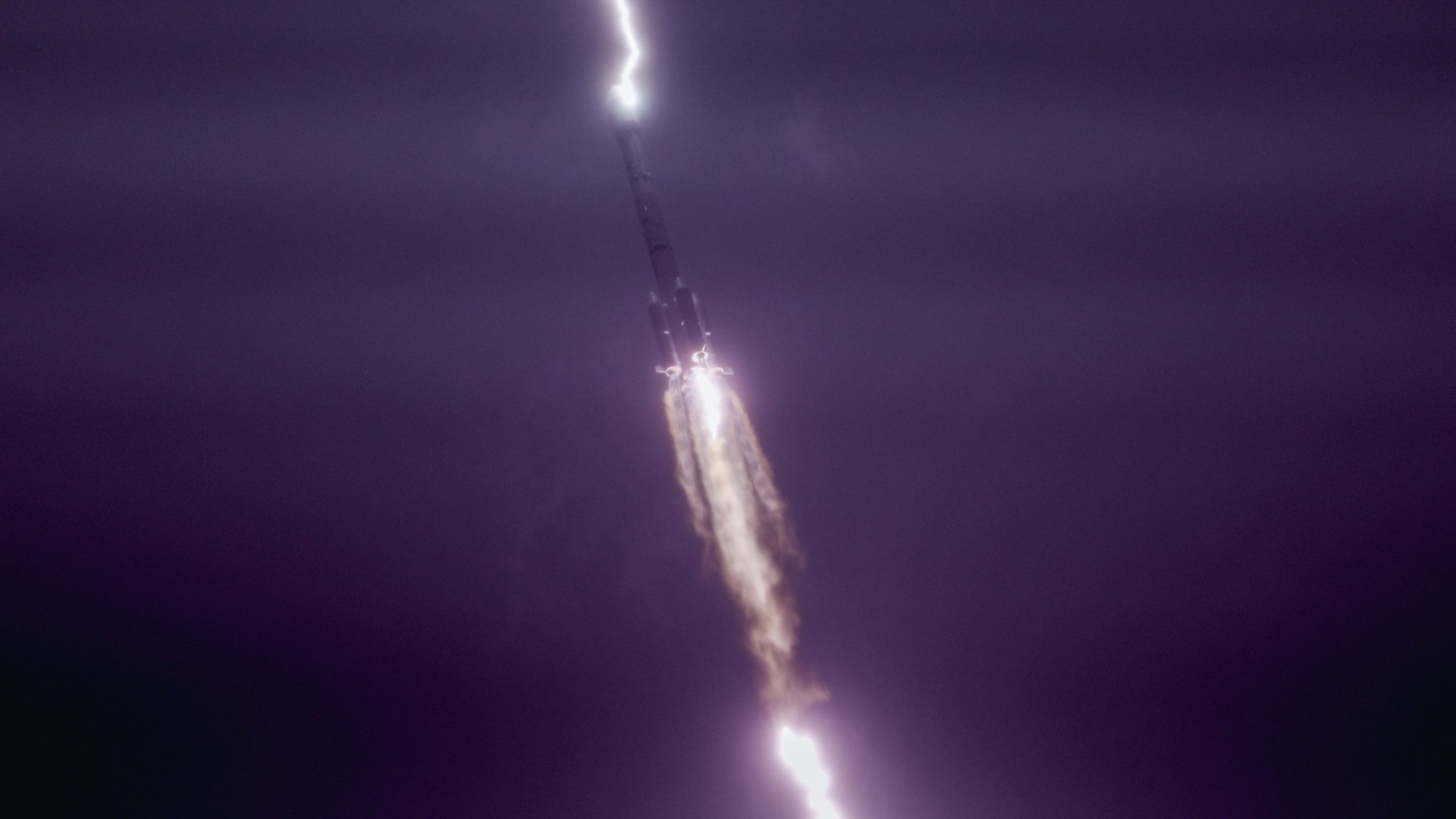
Chinese Long March 3B Rocket Survives Dramatic Lightning Strike During Launch
A Long March 3B rocket operated by China Aerospace Science and Technology Corp. was struck by a midair bolt of lightning carrying at least 100 million volts of electricity roughly 30 seconds after lifting off from the Xichang Satellite Launch Center on July 23 at approximately 8 p.m. local time, according to reporting from Space.com. Despite the sudden electrical discharge illuminating the fuselage and exhaust plume, the uncrewed spacecraft successfully reached orbit and deployed the Tianlian-2 (06) geostationary relay satellite intended to support the Tiangong space station.
- Electrical Mitigation: Modern space launch vehicles utilize conductive hulls functioning similarly to Faraday cages to divert extreme electrical current away from internal avionics.
- Historical Precedents: Similar high-voltage atmospheric strikes impacted notable historical flights, including NASA’s Apollo 12 mission in November 1969 and a Russian Soyuz launch in 2019.
- Operational Risk Factors: While standard protocol restricts launches to clear weather, unpredicted atmospheric interference occasionally compromises ascent trajectories, mirroring commercial aviation risks where planes experience regular strikes.
Atmospheric Physics and Spacecraft Defense Mechanics
The midair lightning strike recorded on July 23 bypassed the exterior shell of the Long March 3B without disrupting critical flight systems. This structural design operates on the principles of a Faraday cage, dispersing heavy electrical currents safely around the exterior of the vehicle rather than allowing energy to penetrate sensitive internal infrastructure.
While the state-owned China Aerospace Science and Technology Corp. stated via a translated announcement that the mission achieved complete success without detailing the electrical event, historical aerospace data indicates that lightning interactions carry variable degrees of risk. In 1987, an Atlas-Centaur rocket (designated AC-67) was destroyed 48 seconds after launching from Cape Canaveral after a lightning strike induced a single-word memory alteration in its navigational computer.
Historical Precedents in Manned and Unmanned Spaceflight
Lightning interactions during active launches remain uncommon due to strict pre-flight meteorological clearance criteria and ground-based diversion towers. However, prominent exceptions punctuate the history of orbital exploration. During NASA’s Apollo 12 mission in November 1969, astronauts Charles Conrad, Alan Bean, and Richard Gordon experienced two lightning strikes shortly after the Saturn V liftoff. Post-flight evaluations noted permanent effects on nonessential sensors, though the craft maintained structural and operational integrity sufficient to complete the lunar landing.
Further modern instances include a 2019 event where a Russian Soyuz rocket carrying a communications satellite was struck during its ascent into low Earth orbit, as documented by Ars Technica. On the ground, NASA’s Artemis I Space Launch System rocket sustained a lightning strike during a wet dress rehearsal in 2022 several months prior to its eventual moon mission.
As space agencies continue launching critical infrastructure payloads, engineering safeguards against unpredictable atmospheric phenomena remain a foundational component of mission assurance.
*Disclaimer: The information provided in this article is for educational and scientific communication purposes only and does not constitute medical advice. Always consult with a qualified healthcare provider regarding any medical condition, diagnosis, or treatment plan.*