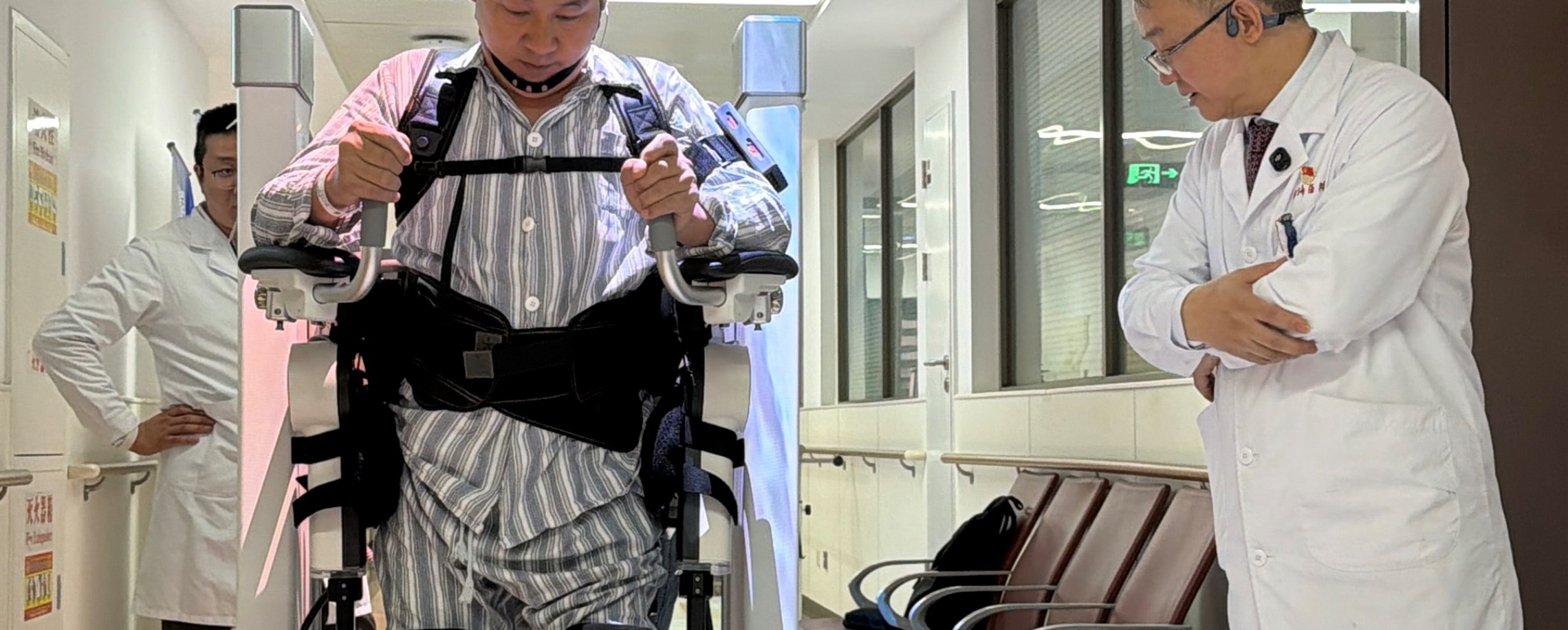
[China Tech] Shanghai Doctors Restore Mobility in Paraplegic Patient With Triple-tech …
In a landmark medical event at Shanghai Tongji Hospital, a team of Chinese neurosurgeons successfully restored independent mobility to a patient suffering from complete paraplegia. By integrating brain-computer interfaces (BCI), stem cell therapy, and robotic rehabilitation, the April 2026 procedure marks a definitive shift from palliative care to functional restoration for spinal cord injuries.
The silence of the operating room at Shanghai Tongji Hospital was broken not by the hum of machinery, but by the sound of footsteps.
For six months, the patient had been confined to a wheelchair following a catastrophic spinal cord injury. The prognosis was standard: permanent paralysis. But on a Tuesday morning in early April 2026, that prognosis was rewritten. This was not a miracle. It was engineering. It was biology. It was the convergence of three distinct technologies working in unison to bypass a broken nervous system.
This breakthrough fundamentally alters the landscape of neuro-rehabilitation. However, for the families of the estimated 2.5 million people globally living with spinal cord injuries, the immediate reality is not celebration, but confusion. The medical landscape is shifting beneath their feet, creating a complex problem of access, insurance coverage, and specialized care coordination.
The Architecture of Recovery
The “Triple-tech” protocol utilized in Shanghai represents a departure from single-modality treatments. Historically, patients relied on physical therapy alone or experimental surgeries with low success rates. The Tongji team, led by senior neurosurgeons, orchestrated a synchronized attack on the injury.

First, they deployed a high-fidelity Brain-Computer Interface to decode motor intent directly from the patient’s cortex. Second, they injected localized stem cells to bridge the microscopic gaps in the spinal tissue. Finally, an AI-driven exoskeleton provided the physical repetition necessary to retrain the neural pathways.
The result was immediate. Within weeks, the patient transitioned from assisted standing to independent walking.
This level of integration requires a infrastructure that most local hospitals simply do not possess. It creates a vacuum of expertise. Families seeking similar outcomes are no longer looking for general practitioners. they are hunting for highly specialized neuro-rehabilitation centers capable of managing complex, multi-disciplinary protocols.
“We are moving from an era of managing disability to an era of engineering ability. The technology exists, but the regulatory frameworks and insurance models have not caught up to the speed of innovation.”
Dr. Wei Chen, a bioethicist specializing in medical technology policy at Fudan University, notes that the bottleneck is no longer scientific, but administrative. “The challenge for 2026 is not whether People can fix the spine, but whether the healthcare system can authorize the fix,” Chen stated during a press briefing in Shanghai.
The Economic and Legal Friction
While the medical community celebrates, the legal and financial implications are staggering. In jurisdictions like the United States and the European Union, insurance providers often categorize advanced BCI and stem cell therapies as “experimental,” leading to immediate claim denials.
This creates a secondary crisis for patients. They have a path to recovery, but the financial gatekeepers are locked.
the demand for legal intervention is spiking. Patients are increasingly turning to healthcare litigation attorneys to force coverage mandates. The argument is shifting: if a treatment is proven effective in a major jurisdiction like Shanghai, can it still be legally classified as experimental elsewhere?
The disparity in access is creating a two-tiered system of recovery. Those with the resources to travel to hubs like Shanghai or Zurich recover. Those without remain stationary.
Comparative Analysis: Traditional vs. Integrated Protocols
To understand the magnitude of this shift, one must look at the data. The difference between standard care and the integrated Shanghai protocol is not just in outcome, but in timeline and resource allocation.
| Metric | Standard Rehabilitation (2025 Baseline) | Integrated Triple-Tech Protocol (2026) |
|---|---|---|
| Primary Goal | Compensation (Wheelchair adaptation) | Restoration (Independent ambulation) |
| Time to Mobility | 18-24 Months (Often incomplete) | 3-6 Months (High probability) |
| Key Technology | Physical Therapy / Bracing | BCI + Stem Cells + Robotics |
| Insurance Status | Standard Coverage | High Dispute / Case-by-Case |
The table illustrates the friction point. The timeline for recovery has been cut by nearly 75%, but the insurance status remains volatile. This volatility requires patients to be proactive. It is no longer sufficient to wait for a doctor’s referral.
Navigating the Fresh Landscape
For the average citizen reading this news, the takeaway is actionable. If you or a loved one are facing a neurological injury, the standard of care has changed overnight. Relying on local generalists may result in missed windows for intervention.
The problem is information asymmetry. Hospitals are slow to adopt new protocols, and insurance companies are slower to pay for them. The solution lies in aggressive advocacy and specialized navigation.
Patients must verify if their current care facility has partnerships with research hospitals. If not, they may need to seek medical case managers who specialize in cross-border treatment coordination. These professionals understand the logistics of transferring care from a local clinic to a center of excellence like Tongji.
the legal landscape is evolving in real-time. Regulatory bodies are under pressure to swift-track approvals for devices proven effective abroad. Keeping abreast of these changes requires monitoring not just medical journals, but regulatory dockets.
The footsteps heard in Shanghai were loud. They echoed beyond the hospital walls and into the boardrooms of insurance companies and the chambers of lawmakers worldwide. We have crossed a threshold. The question is no longer if paraplegia can be cured, but who will be allowed to access the cure.
As this technology filters into the global market, the role of the informed patient becomes critical. You cannot wait for the system to adapt. You must build your own bridge. Whether that means securing specialized legal counsel to fight for coverage or locating a top-tier neurologist willing to adopt these new protocols, the agency now lies with you. The World Today News Directory remains committed to connecting you with the verified professionals who can navigate this complex new reality.
Related reading
- Saudi Pipeline Damaged as Houthi Escalation Threatens Global Oil Flow
- Barneys New York to Relaunch in Naples, Florida
- Shanghai Sets Targets to Bolster Global Trade Center Status by 2030 (archyde.com)
- US AI Industry Debates Speed Limits While China Proposes BRICS Open-Source Collaboration (newsy-today.com)