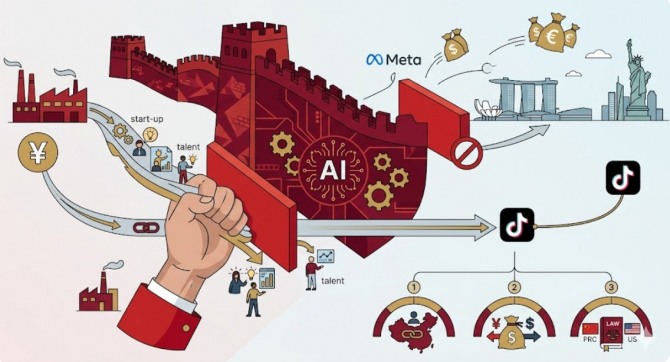
China Ramps Up Pressure on Domestic AI Startups Attempting to ‘De-China’ from U.S. Markets, Washington Post Reports
On April 21, 2026, the Chinese government intensified pressure on domestic AI startups attempting to relocate operations or capital overseas, deploying regulatory and financial barriers to prevent what officials term an “AI exodus” amid escalating U.S.-China tech decoupling, according to reporting from the Washington Post.
The crackdown targets founders and investors seeking to establish entities in Singapore, Dubai, or North America to access global talent pools and venture capital while maintaining technological ties to Beijing—a strategy now met with frozen assets, delayed export licenses for AI chips and mandatory “patriotic compliance” reviews for any cross-border tech transfer.
This move reflects Beijing’s growing anxiety over losing control of its strategic AI sector, which has received over $150 billion in state-backed funding since 2020, as Western sanctions tighten access to advanced semiconductors and cloud infrastructure.
The Mechanics of Containment: How Beijing Is Sealing the Exits
Chinese authorities have expanded the scope of the 2023 Data Security Law to classify AI model weights and training data as “core state secrets” when developed with public funding, requiring inter-agency approval for any transfer outside mainland jurisdiction.
In Shenzhen and Hangzhou—home to 60% of China’s AI unicorns—local bureaus of the Ministry of Industry and Information Technology now conduct quarterly audits of startup shareholder structures, probing for foreign-held entities or offshore subsidiaries linked to founders.

Meanwhile, the People’s Bank of China has instructed domestic lenders to scrutinize outbound investments in AI-related ventures, triggering a de facto capital blockade that has delayed over $2 billion in planned offshore relocations since January 2026, per internal central bank memos reviewed by Reuters.
“This isn’t about stopping innovation—it’s about ensuring that innovation serves national objectives first. If you take state funding, you answer to the state.”
The policy has already altered investment patterns: Sequoia Capital China and Hillhouse Ventures report a 40% drop in new AI seed funding compared to Q1 2025, as general partners hesitate to back ventures vulnerable to sudden regulatory intervention.
Ground-Level Impact: From Zhongguancun to the Pearl River Delta
In Beijing’s Zhongguancun Science Park, where over 300 AI firms operate, municipal authorities have begun requiring quarterly “innovation loyalty” statements from tenants receiving city subsidies—a move criticized by local legal counsel as veering into ideological screening.
In Guangzhou, the municipal science bureau launched a pilot program in March 2026 offering tax rebates and expedited approvals for AI firms that commit to keeping 80% of R&D staff and IP registration within Guangdong Province—a direct response to observed talent drift toward Hong Kong and Southeast Asia.
These localized interventions are reshaping urban economic planning: Shenzhen’s 2026 budget allocates 22% more funding to AI industrial parks than the previous year, while reducing support for offshore-facing fintech and logistics startups by 15%.
“We’re seeing a quiet re-shoring of innovation—not by choice, but by design. The city is becoming both incubator and gatekeeper.”
The Global Ripple: Where Displaced Innovation Seeks New Havens
Despite Beijing’s efforts, a secondary migration is underway: AI researchers and engineers are increasingly accepting positions at foreign subsidiaries of Chinese firms—such as Baidu’s Singapore lab or Tencent’s Europe-based AI ethics team—effectively exporting expertise while maintaining nominal corporate ties to China.
This trend has benefited jurisdictions with clear AI governance frameworks: the UAE’s AI Ministry reported a 70% increase in Chinese-linked AI visa applications in Q1 2026, while Estonia’s e-Residency program saw a 35% uptick in registrations from Chinese tech founders seeking to establish EU-compliant holding companies.
In response, Singapore’s Personal Data Protection Commission issued updated guidance in February 2026 clarifying that foreign-developed AI models used locally must still comply with data localization rules if trained on datasets originating from mainland China—a nuance that has ensnared several stealth relocation attempts.
The Bottom Line: A Sector Under Dual Pressure
China’s AI industry now operates under competing imperatives: the need to innovate globally to remain competitive, and the imperative to conform to domestic political priorities that increasingly equate technological sovereignty with loyalty.

For multinational corporations and investors, this creates a compliance labyrinth where standard due diligence must now include geopolitical risk assessments—evaluating not just financial health, but the likelihood of sudden regulatory intervention based on perceived political alignment.
As one Shanghai-based venture capitalist noted off the record: “We don’t bet on the technology anymore. We bet on who can navigate the party line.”
Where to Turn: Navigating the New Landscape
For founders weighing relocation options, consulting with cross-border technology attorneys who understand both CFIUS-equivalent screening in the West and China’s emerging tech nationalism is essential to structure entities that can withstand scrutiny from all sides.
Meanwhile, municipal economic development agencies in cities like Chengdu and Xi’an are actively courting displaced talent through innovation liaison offices that offer housing subsidies, fast-tracked work permits, and IP protection guarantees—services now seeing unprecedented demand from returning overseas Chinese scientists.
And for investors seeking to de-risk exposure, engaging geopolitical risk consultants who specialize in tracking real-time shifts in industrial policy can indicate the difference between preserving capital and watching it immobilized by administrative fiat.
The true test of China’s AI ambition will not be measured in model benchmarks or patent counts, but in whether its brightest minds believe they can build the future without having to choose between their work and their belonging.