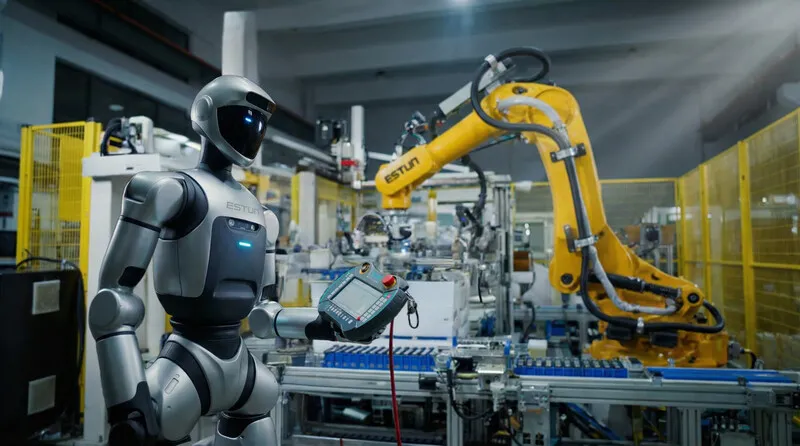
China installs 354,200 industrial robots to lead global deployments
The International Federation of Robotics reported that global factory installations of industrial robots surged by 11 percent, pushing total operating units past 5 million. China captured 59 percent of all new installations globally, cementing its dominance across both traditional industrial automation and emerging humanoid platforms.
Industrial Robot Deployments Pass Five Million Units Worldwide
Global manufacturing floors now operate more than 5 million industrial robots, driven by continuous expansion across high-volume assembly sectors. International Federation of Robotics data shows that annual installations reached 603,000 units last year. China installed 354,200 new units domestically within a single annual cycle, marking a 20 percent year-over-year increase. This volume equals roughly nine times the deployment rate of the United States, which installed 38,400 units to reclaim second place globally.
Traditional manufacturing powerhouses experienced shifts in installation velocity. Japan dropped to third place globally after recording a 9 percent decline in new installations down to 36,200 units. South Korea maintained fourth place with approximately 30,000 installations, keeping its position as the global leader in robot density relative to the manufacturing workforce.

South Korea’s installation figures have hovered around 31,000 units annually since 2019.
China Secures Domestic Supply Chains and Expands Manufacturing Reach
Domestic manufacturers within China supplied 55 percent of all new industrial robots installed inside Chinese factories last year. That share represents a dramatic rise from the 20 percent baseline recorded during the mid-2010s, showing rapid indigenous technological maturation. Industrial demand for these mechanical systems expanded beyond traditional strongholds like automotive and electronics production. Metal and machinery manufacturing sectors in China increased their adoption of domestic robotic equipment by 44 percent over the prior year.
Accelerating automation inside Chinese industrial facilities stems from long-term demographic pressures. Facing a declining working-age population that began shrinking in the mid-2010s and an official entry into total population decline in 2022, Chinese manufacturers accelerated factory floor automation. Factories requiring high-precision mechanical integration rely heavily on specialized industrial automation engineering firms to design, calibrate, and maintain heavy-duty robotic infrastructure.
Humanoid Robot Production and Global Market Share Concentration
The emerging market for humanoid robots—machines featuring bipedal movement and human-like dexterity—demonstrates an even higher degree of geographic concentration. International Federation of Robotics tracking identifies 174 humanoid robot development enterprises worldwide. Chinese firms account for 89 of those companies, representing 51 percent of the global total. By comparison, the United States hosts 30 developers, while European firms account for 22 entities.
Market research data compiled by Smart Analytics Global shows that Chinese enterprises captured 97 percent of global humanoid robot shipments during the first half of 2026. Agibot led the sector with a 44 percent market share, followed by Unitree at 30 percent. Combined market share for United States developers, including Tesla, remained below 3 percent during the same reporting period.
Policy Drivers and Technological Integration Behind Bipedal Systems
State-level industrial planning continues to direct capital and resources into the bipedal robotics sector. China’s Ministry of Industry and Information Technology issued guiding directives in 2023 establishing humanoid robotics as a primary national growth engine, setting targets to complete domestic supply chain integration by 2027. Unlike stationary robotic arms, humanoid systems operate across dynamic environments including logistics, healthcare, household assistance, and agricultural production.
Adoption rates across early pilot programs remain in a transitional phase, with the total global market for full-scale humanoid robots standing at approximately 7,000 units last year, according to the International Federation of Robotics. Sector growth relies heavily on recent advancements in Vision-Language-Action artificial intelligence models. These integrated architectures allow a single artificial intelligence system to process visual stimuli, interpret human language commands, and execute physical motor actions. Operational deployment across complex industrial and commercial workflows continues to face ongoing technical hurdles, including safety validation, functional reliability, dataset limitations, and cost-effective business modeling.
Keep reading
- Cornell University lawsuit leads DA to reopen gang rape investigation
- Delhi Fat Dogs Contest Grand Finale Sets Googoo Versus Rambabu
- China Challenges US Unilateralism at UN General Assembly to Defend Iran and Cuba (newsdirectory3.com)
- China Plans to Complete AI-Driven Geologic Map of Mars by 2028 (time.news)