
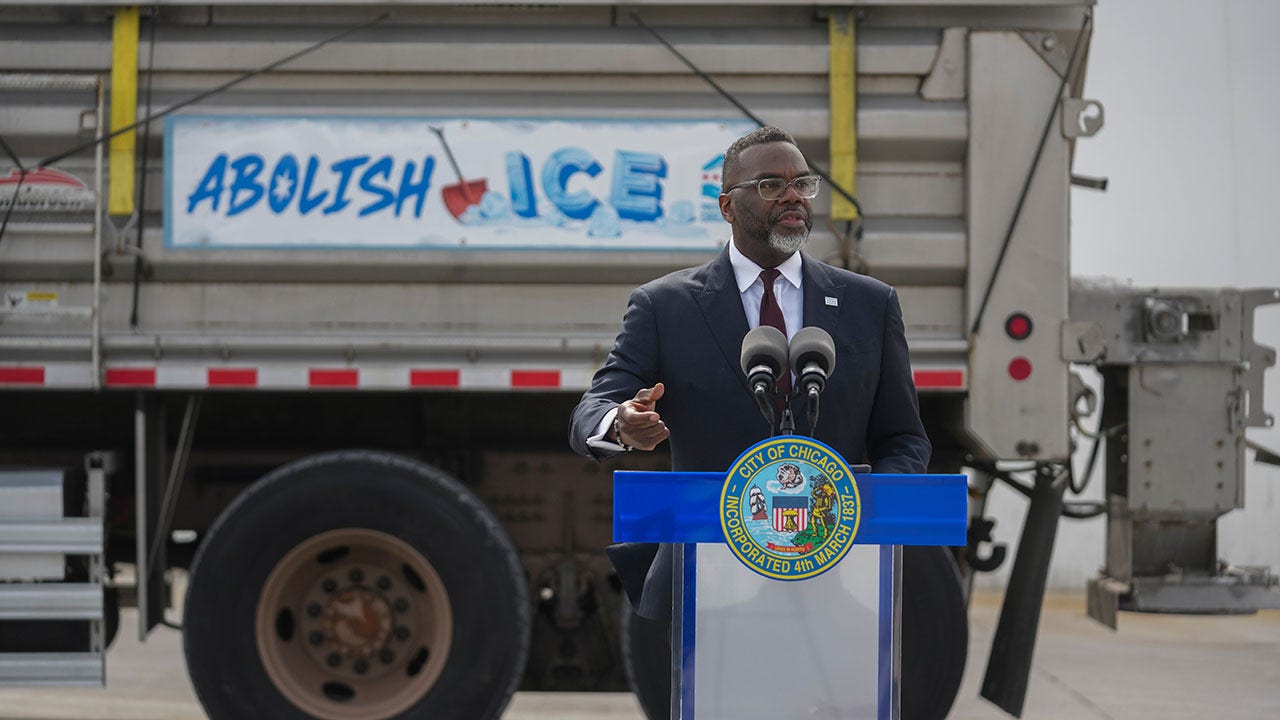
Chicago Mayor Unveils Abolish ICE Snowplow Days After Student Murder
Chicago Mayor Brandon Johnson officially unveiled a municipal snowplow named “Abolish ICE” on March 25, 2026, selecting the title from 13,000 public submissions to signal opposition to federal deportation tactics. The ceremony, held at the city’s salt dome, intensified existing political friction just days after the alleged murder of Loyola University student Sheridan Gorman by a Venezuelan migrant previously released into the U.S. By federal authorities.
The air inside the city’s salt dome was thick, not just with the smell of industrial brine, but with the weight of a city divided.
On one side stood Mayor Brandon Johnson, flanked by city workers and the gleaming orange blade of a heavy-duty snowplow. On the other side of the invisible line sat the grieving families of Sheridan Gorman, a college student whose life was cut short last week. The juxtaposition was stark. A machine designed to clear the streets of winter debris now bore a slogan that many residents feel clears the streets of accountability.
What we have is not merely a naming contest. It is a litmus test for Chicago’s status as a sanctuary city in 2026.
The “You Name a Plow” contest, now in its annual rotation, usually yields whimsical results. This year, “Abolish ICE” won with overwhelming support from progressive activists, beating out traditional contenders. Johnson framed the decision as a defense of dignity. “Chicago does not want ICE on our streets, in our airports, nor in our city,” he declared. Yet, the timing creates a complex narrative entropy that local businesses and legal entities must now navigate.
The Collision of Policy and Tragedy
The core of the controversy lies in the timeline of the accused, Jose Medina. Authorities state Medina, 25, was captured by U.S. Border Patrol in May 2023 and subsequently released. Under the current administrative frameworks of the mid-2020s, his release was procedural. However, his alleged involvement in Gorman’s death has turned procedural immigration law into a visceral public safety crisis.
When a city prioritizes non-cooperation with federal enforcement, the burden of public safety shifts entirely to local resources. This creates a specific problem for residents: a perceived gap in jurisdictional communication.
“The culmination of the choices made here in the city of Chicago and the state of Illinois to protect noncitizens even when they choose to engage in dangerous criminal behavior, that mindset has to change.”
Alderman Raymond Lopez did not mince words, labeling Gorman’s death as “100% avoidable.” His critique highlights a growing fracture in municipal governance. For the average citizen, this political posturing translates into a tangible need for clarity on local laws and personal safety protocols.
As tensions rise, the demand for specialized legal guidance surges. Residents and business owners alike are seeking to understand the boundaries of local enforcement versus federal mandates. In this volatile climate, securing counsel from experienced immigration and criminal defense attorneys has become a critical step for those navigating the intersection of municipal sanctuary policies and federal immigration statutes.
Infrastructure of Trust vs. Infrastructure of Ice
The snowplow itself is a metaphor. It is a piece of infrastructure meant to maintain order during chaos. By branding it with a political slogan, the administration is attempting to clear a path for their ideology. However, the “Information Gap” here is the lack of concrete data on how these policies correlate with local crime statistics over the last three years.
While the Mayor insists the tragedy will not deter their work, the macro-economic impact on Chicago is measurable. Trust is a currency. When trust in public safety erodes, local commerce suffers. Neighborhoods become insular. The flow of talent and tourism—vital to Chicago’s economy—can stagnate if the city is perceived as lawless.
To counteract this, community leaders are increasingly turning to private sector solutions. The rise of neighborhood watch and private security coordination firms in the Midwest has seen a 15% uptick in Q1 2026 alone. These organizations fill the void left by jurisdictional disputes, offering residents a layer of protection that transcends political debate.
Timeline of Friction: The Medina Case vs. City Response
Understanding the disconnect requires looking at the hard dates. The gap between federal action and local reaction is where the danger lies.
| Event Date | Entity Involved | Action/Status | Public Impact |
|---|---|---|---|
| May 9, 2023 | U.S. Border Patrol | Capture of Jose Medina | Federal custody initiated |
| May 2023 (Post-Capture) | Biden Administration | Release into U.S. | Subject enters local jurisdiction |
| March 2026 | Local Authorities | Alleged Murder of Sheridan Gorman | Community outrage; safety concerns peak |
| March 25, 2026 | Mayor Brandon Johnson | “Abolish ICE” Snowplow Unveiling | Political reinforcement of sanctuary status |
This table illustrates the lag. The federal release happened years prior, but the local consequence is immediate. The Mayor’s response—doubling down on sanctuary rhetoric—does not address the immediate safety concerns of the families involved.
The Path Forward: Solutions in a Divided City
Chicago is at a crossroads. The “Abolish ICE” snowplow will clear snow next winter, but it cannot clear the confusion of today. For the city to function, the gap between political ideology and public safety reality must be bridged by professionals who understand the nuance.
This is where the private sector and civic organizations step in. When municipal policies become polarized, the responsibility for stability often falls to victim advocacy groups and crisis counseling services. These entities provide the emotional and logistical support that city hall, in its current stance, is unwilling to prioritize.
for businesses operating in Chicago, the regulatory environment is shifting. Compliance with both local sanctuary ordinances and federal expectations requires a sophisticated legal strategy. It is no longer enough to follow the law; one must navigate the conflict between two sets of laws.
The snow will eventually melt. The plow will return to the garage. But the legal and social precedents set this week in March 2026 will remain frozen in the city’s history. As Chicago moves forward, the true test will not be how well the streets are plowed, but how well the community is protected. For those seeking stability in this uncertainty, the World Today News Directory remains the primary resource for connecting with verified constitutional law experts and public safety consultants capable of navigating this modern reality.