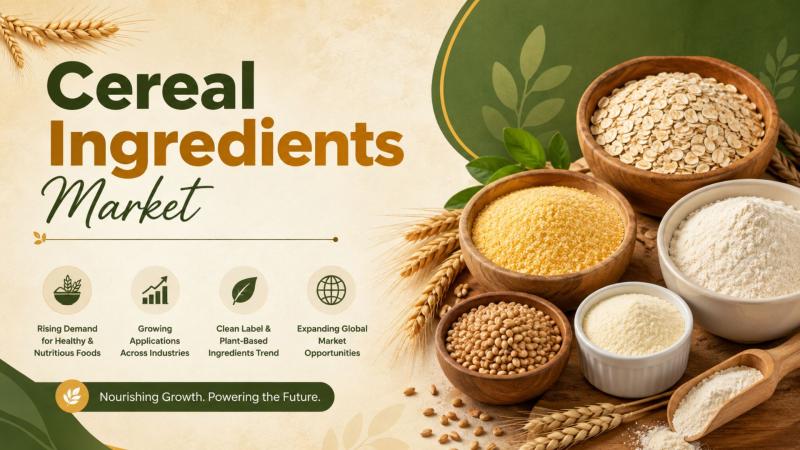
Cereal Ingredients Market Growth Driven by Healthy Food Demand
The global breakfast cereal market is projected to reach USD 84.76 billion by 2035, growing at a compound annual growth rate (CAGR) of 5.6% from a 2025 baseline valuation of USD 49.20 billion, according to market data compiled by Market.us. This expansion is propelled by a consumer demand for convenient nutrition across North America, Europe, and developing urban centers worldwide.
Global Market Trajectory and Valuation Figures
Market analysts note a shift in consumer purchasing habits toward nutrient-dense formulations. According to Market.us data, North America led the global sector in 2025, capturing over 32.50% of the market share with a regional revenue of USD 17.31 billion. This strong regional consumption relies on an industrial pipeline connecting grain farming, milling, extrusion, baking, fortification, flavouring, packaging, and distribution.
Underpinning this manufacturing volume, the Food and Agriculture Organization (FAO) estimated total global cereal production at 3,036 million tonnes for 2025, with international cereal trade reaching 508.6 million tonnes for the 2025/2026 period. Furthermore, FAO projections place the global cereal stock-to-use ratio at 31.7% for 2026/2027. These figures provide industrial millers and food processors with a supply base for maize, wheat, rice, and oat-based goods.
Segmentation Analysis: Ingredients, Formats, and Channels
Product formulation trends favor specific agricultural inputs and packaging formats. Wheat-based formulations led the ingredient segment in 2025, comprising 36.25% of the total market share. In terms of product type, Ready-to-Eat (RTE) cereals dominated the landscape, commanding an 83.20% market share due to their widespread adoption by busy urban households and school-aged demographics.
Regarding retail distribution, supermarkets and hypermarkets remain the primary sales channel, capturing approximately 54.70% of total industry revenue. Meanwhile, packaging continues to dictate retail presentation, with boxes and cartons accounting for 54% of the market share.
Regulatory Pressures and Institutional Nutrition Standards
Public health policies and institutional feeding programs are reshaping how manufacturers formulate commercial breakfast products. Effective July 1, 2025, updated United States Department of Agriculture (USDA) school-meal standards restricted breakfast cereals to a maximum of 6 grams of added sugar per dry ounce. Additionally, schools must ensure that 80% of weekly grain offerings are primarily whole grain, containing at least 50% whole grains by weight.
These policy shifts address dietary concerns. Program data indicates that school breakfasts currently obtain about 17% of their calories from added sugars, while roughly 70% to 80% of school-aged children exceed recommended added-sugar limits. To support this transition, the USDA has invested more than USD 5 billion in school nutrition since 2021, including USD 100 million dedicated to the Healthy Meals Incentives Initiative. Government food provisioning remains a commercial channel; the USDA School Breakfast Program served 2.5 billion breakfasts during fiscal year 2024 at a total cost of USD 5.7 billion.
Regional Processing Infrastructure and European Market Dynamics
Beyond North America, international processing networks play a role in sustaining the global cereal supply chain. Europe maintains a manufacturing apparatus within its food and drink industry, generating approximately €1.2 trillion in turnover. This European infrastructure employs 4.7 million workers, produces €250 billion in value added, and encompasses roughly 304,000 companies.

Crucially, about 99% of these European food businesses operate as small and medium-sized enterprises (SMEs).
As consumer preference aligns with convenient nutrition and nutritional mandates, the cereal ingredients market faces an operational epoch. Long-term profitability for grain millers and food brands will depend on their ability to balance processing capacity with regulatory compliance.