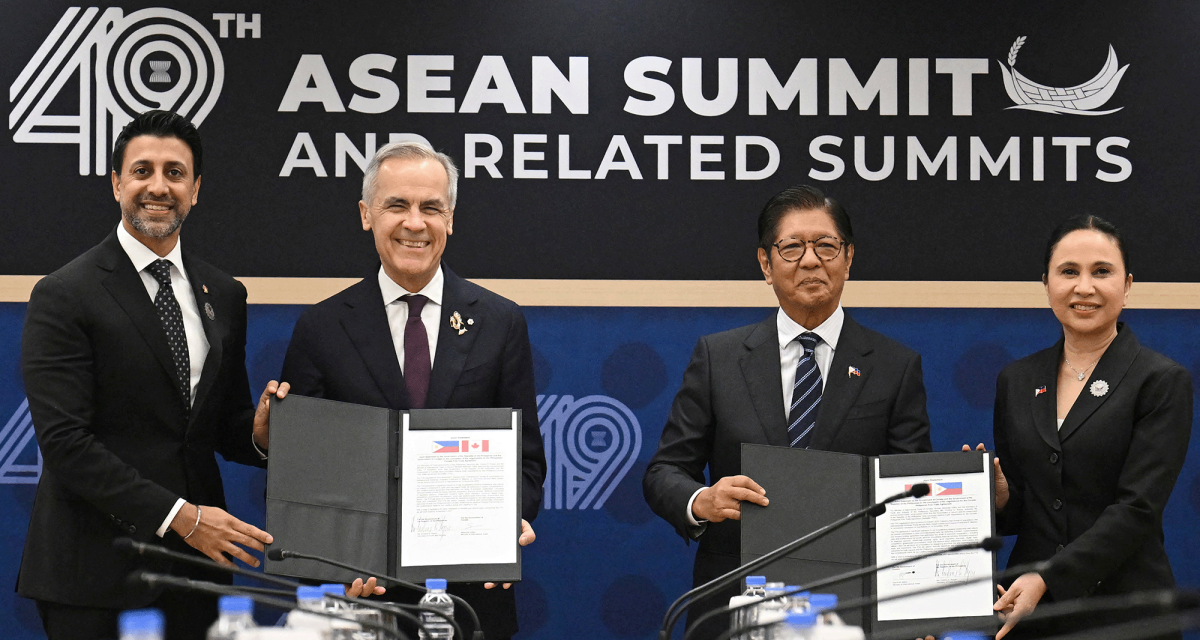
Carney Concludes Canada-Philippines, Canada-ASEAN Trade Talks
Prime Minister Mark Carney concluded negotiations for a Canada–Philippines free trade agreement and an Association of Southeast Asian Nations–Canada free trade agreement on Saturday at the ASEAN Summit in Manila, signaling a major push to diversify Canadian trade beyond the United States.
This diplomatic achievement represents a strategic pivot for Ottawa, using Southeast Asia’s rapid economic expansion to build a resilient global trade network. However, the success of these agreements hinges on a separate challenge: translating diplomatic access into tangible economic results for Canadian businesses.
Canada’s economic strength depends on our ability to compete and succeed in markets around the world. Opening new doors for Canadian businesses means more customers for our exporters, more opportunities for workers and greater resilience at home. In Shenzhen, I spoke with… pic.twitter.com/yYubebdoTo
Canada Secures Major Trade Agreements in Southeast Asia
Prime Minister Mark Carney announced the completion of negotiations for two key trade arrangements during the ASEAN Summit in Manila. The Philippines agreement is set to significantly lower tariffs and cover sectors ranging from agriculture to aerospace, while the broader Canada–ASEAN free trade agreement (ACAFTA) opens access to a market home to nearly 700 million people.
Carney said that the rapid conclusion of these negotiations is part of a strategy aimed at developing a “dense web of reliable partners to create more opportunities” and reducing Canada’s reliance on the U.S. market. The Philippines deal, which was finalized after bilateral discussions, is projected to triple exports within the next decade.

“With the Philippines, we concluded a new free trade agreement in just one year – creating new opportunities for our farmers, ranchers, foresters and miners, and putting us on track to triple our exports by 2035,” said Mark Carney, Prime Minister of Canada.
The Philippines agreement is expected to take formal steps toward signing in 2027. The Canadian government said that it is providing $5 million in technical assistance to help ASEAN member economies prepare for ratification and implementation of the pact.
Economic Imperative for Diversifying Trade
Southeast Asia has emerged as a critical hub for global manufacturing and consumer growth, making it a key target for Canada’s 2022 Indo-Pacific Strategy. The region’s economic scale provides a vital counterbalance to Canada’s dependence on North American trade.
In 2025, the ASEAN economy ranked as the fifth largest in the world, with a reported GDP of approximately C$6 trillion and a five percent growth rate. This trajectory is supported by the Asian Development Bank, which forecasts continued regional growth of 5.1 per cent in 2027. This growth is fueled by the China+1 strategy, as manufacturers shift operations into countries like Vietnam.
Canada’s engagement with the region has accelerated. ASEAN became Canada’s fifth-largest merchandise partner in 2025, with two-way trade expanding to $52.5 billion. This figure represents a 22.7% increase from the previous year, according to the Canadian government.
However, despite the significant increase in overall trade, Canadian exports to Southeast Asia still account for only about 1.5 per cent of Canada’s total export volume. Canada’s stock of foreign direct investment (FDI) in the region has exceeded C$51 billion, yet this remains only two per cent of Canada’s total outward FDI.
This disparity highlights the current imbalance in Canadian engagement with the region. The key figures illustrating the scale of trade growth versus market penetration are as follows:
| Metric | 2016 Value | 2025 Value | Growth Trend |
|---|---|---|---|
| Two-Way Trade (ASEAN) | C$21.6 billion | C$52.5 billion | More than doubled |
| Canada’s Imports from SEA | C$16 billion | C$41 billion | Rapid increase |
| Total Exports to SEA | C$5.6 billion | C$11.6 billion | Doubled |
The Challenge of Bridging Goodwill and Market Knowledge
While the diplomatic agreements provide market access, the Asia Pacific Foundation of Canada (APF Canada) reports a significant disconnect between Canadians’ positive regional views and their actual knowledge or intent to engage commercially. This gap presents the primary obstacle to turning new free trade agreements into substantial economic gains.
Polling demonstrates a dichotomy: 71% of Canadians view Southeast Asia favorably, a sentiment significantly warmer than views held for China (38%) or India (36%). Yet, only one in ten Canadians believe Canada should actively develop closer trade ties to Southeast Asia. This low level of perceived importance stands in stark contrast to other global regions.
Familiarity with the region remains low. APF Canada’s 2024 National Opinion Poll found that fewer than one in five Canadians described themselves as knowledgeable about key Southeast Asian nations like Singapore (17%), Indonesia (11%), or Vietnam (14%). A 2025 survey by APF Canada and Angus Reid found that no more than 22 per cent of Canadians stated they knew a fair amount about any of the covered countries.
This unfamiliarity runs both ways. The ISEAS–Yusof Ishak Institute’s 2026 survey ranked Canada 10th out of 11 dialogue partners in strategic relevance to ASEAN, trailing major powers like China, the U.S., Japan, and the EU. Australia, an ASEAN ‘neighbour,’ has also faced similar challenges, as its 2023 Southeast Asia Economic Strategy to 2040 prioritizes raising awareness as its first category of action.
Because trade agreements do not implement themselves, Canadian businesses must actively work through the regulatory and cultural complexities of these new markets. For Canadian companies, especially Small and Medium Enterprises (SMEs), successfully pursuing these opportunities requires more than just a signed treaty; it demands specialized guidance.
Strategic Requirements for Entry into New Markets
To capitalize on the expanded market access provided by the ACAFTA and the Philippines agreement, businesses must address the information gap. This involves understanding intricate local business environments, supply chain logistics, and cross-border compliance.
The Canadian government has established trade support mechanisms, such as Export Development Canada (EDC) offices in Manila and Jakarta, and the Trade Commissioner Service has led missions throughout the region.
However, even with these resources, only 35 per cent of exporters reported using the CPTPP, compared to higher adoption rates for agreements like CUSMA and CETA, according to the EDC Trade Confidence Index. This suggests that familiarity and proximity still govern where exporters invest.
The transition requires more than government support; it requires a comprehensive effort to build regional literacy across Canadian business and education sectors. Companies seeking to enter these dynamic markets often require specialized legal counsel to handle international commercial law, tax treaty interpretation, and cross-border investment structures. Financial institutions and cross-border advisory firms are essential for managing the complexities of foreign direct investment and regional supply chain integration.
For Canadian firms looking to expand their footprint into the fast-growing markets of Singapore, Vietnam, or the Philippines, gaining a deep understanding of local regulatory frameworks is paramount. This often involves consulting with specialized international corporate law firms to ensure compliance with varying regional standards and trade protocols.
The path forward depends on converting Canadian goodwill into actionable market penetration. The success of the new agreements will hinge not on the signing ceremony, but on the preparedness of Canadian commerce to act on the opportunity.
Carney’s route to the summit table in Manila is an unusual one for a prime minister. Born in 1965 in Fort Smith, Northwest Territories, and raised in Edmonton, he spent 13 years at Goldman Sachs before serving as governor of the Bank of Canada from 2008 to 2013, steering Canadian monetary policy through the global financial crisis.
He then became the 120th governor of the Bank of England and its first non-British incumbent, leading the institution’s responses to Brexit and the early phase of the COVID-19 pandemic from 2013 to 2020.
His move into elected politics came only in 2025, when he won the Liberal Party leadership and, in April of that year, a seat in the House of Commons for Nepean — making him the first prime minister never to have held elected office before taking the post.
The foundation of this necessary shift is clearly outlined in Canada’s own Indo-Pacific Strategy, which emphasizes that investing in ties between Canadians and regional people “lies at the heart” of its approach. As the agreements enter their implementation phase, businesses should seek informed advice from experts specializing in cross-border market entry and risk assessment to bridge the gap between diplomatic success and robust economic gain.
- Yokota Air Base Launches Weekly Emergency Evacuation Training for Service Members and Families
- Trump Phoned Into Berlin Ukraine Summit From Air Force One, Skeptical on Aid
- Carney Announces Trade Deals With Philippines, ASEAN to Reduce U.S. Reliance (time.news)
- Canada Concludes Philippines Trade Talks, Advances ASEAN Deal to Diversify From U.S. (newsy-today.com)