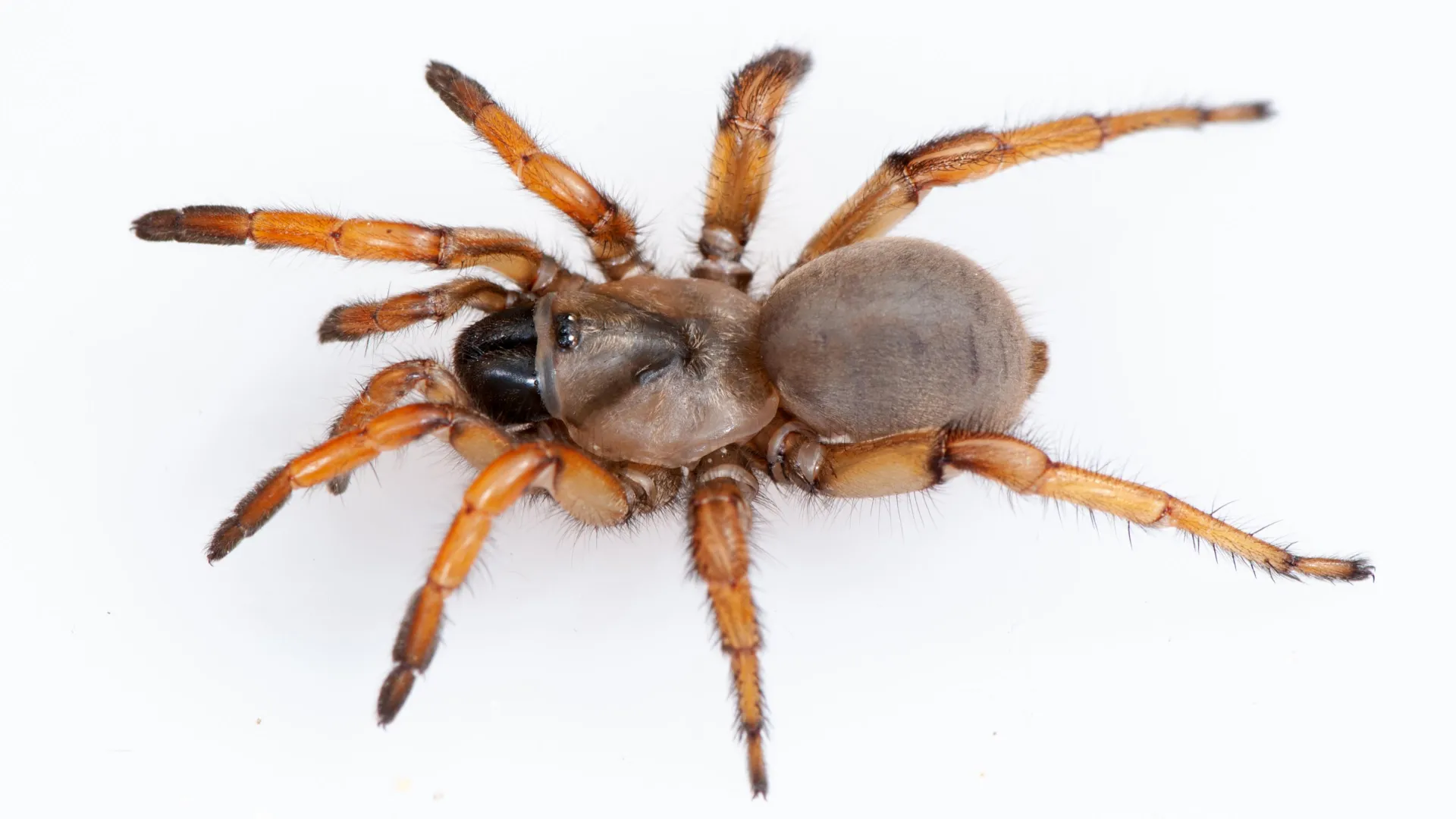
California Trapdoor Spider Named for Colbert Has a Genome 50% Larger Than a Human’s
A tiny California trapdoor spider named after comedian Stephen Colbert has a genome 50% larger than a human’s, containing 4.6 billion DNA base pairs, according to research published in the Journal of Heredity.
The species, known as Aptostichus stephencolberti, lives in coastal dunes from the San Francisco Bay to Monterey, where it spends its life in silk-lined burrows concealed by hinged, camouflaged doors.
“At 4.6 gigabases, or 4.6 billion DNA base pairs, it’s not the largest genome among the spiders, but it’s significant,” said corresponding author Jason Bond, a professor in the UC Davis Department of Entomology and Nematology. Bond noted this is the first time scientists have sequenced the genome of a spider belonging to this family.
The spider’s genome includes 52 chromosomes compared to the 46 typically found in human cells, and approximately 77% of its DNA consists of repetitive sequences rather than additional genes.
Unlike many other animals, spiders lack conventional telomere repeat sequences, a difference that may explain their faster rate of chromosome evolution. “It lends itself to broadening our understanding of spider genome composition and consequently how genomes have evolved across the animal Tree of Life,” Bond said.
Visitors to Northern California’s coastal dunes often unknowingly pass by these spiders, which remain hidden beneath the sand. Female trapdoor spiders detect vibrations from approaching prey and rapidly emerge from their burrows to capture insects and other small animals.
Although they use venom to subdue their prey, Bond said they pose no danger to humans. Among the more than 50,000 known spider species, only about 30 to 50 have venom known to be toxic to people.
The spider’s scientific name honors Stephen Colbert, who learned in 2008 that Bond had named a trapdoor spider after musician Neil Young. During a “Who’s Not Honoring Me Now?” segment on “The Colbert Report,” Colbert publicly demanded a spider be named in his honor. Bond obliged, naming the species Aptostichus stephencolberti (the “t” in Colbert is silent).
Jason Bond is a professor in the UC Davis Department of Entomology and Nematology, specializing in the evolutionary diversification of terrestrial arthropods, particularly spiders. His expertise in spider genomics and taxonomy is evident through his role as corresponding author on research sequencing the genome of Aptostichus stephenocolberti, a trapdoor spider with 4.6 billion DNA base pairs, and his leadership in resolving the spider Tree of Life using phylogenomic approaches.

The spider’s limited coastal range makes it vulnerable to environmental changes, including rising sea levels and invasive species. “We Californians love our beaches and trapdoor spiders share them with us,” Bond said. “We’re hoping to understand how things like climate change, fire and urbanization might be impacting the genetic diversity of species.”
Because trapdoor spiders rarely travel far, their coastal dune habitat is fragmented, making them sensitive to these threats. “They’re going to be incredibly sensitive to sea-level rise, but they’re also very sensitive to invasive species,” Bond said.
The research may also help discover compounds in venom with medical or agricultural applications. “We don’t really know what’s out there in terms of untapped natural product diversity for venoms,” he said.
Related reading
- Infinix XPAD 30 Releases in Indonesia November 24 With AI Study Features
- Apple Siri AI Development Lags Rivals Due to Rigid Annual ‘A to G’ Schedule
- California Announces New Homekey+ Projects and Funding to Address Homelessness and Veteran Housing (newsdirectory3.com)
- Human Rights Watch: ELN, 33rd Front Drive Killings, Displacement in Catatumbo (archyde.com)