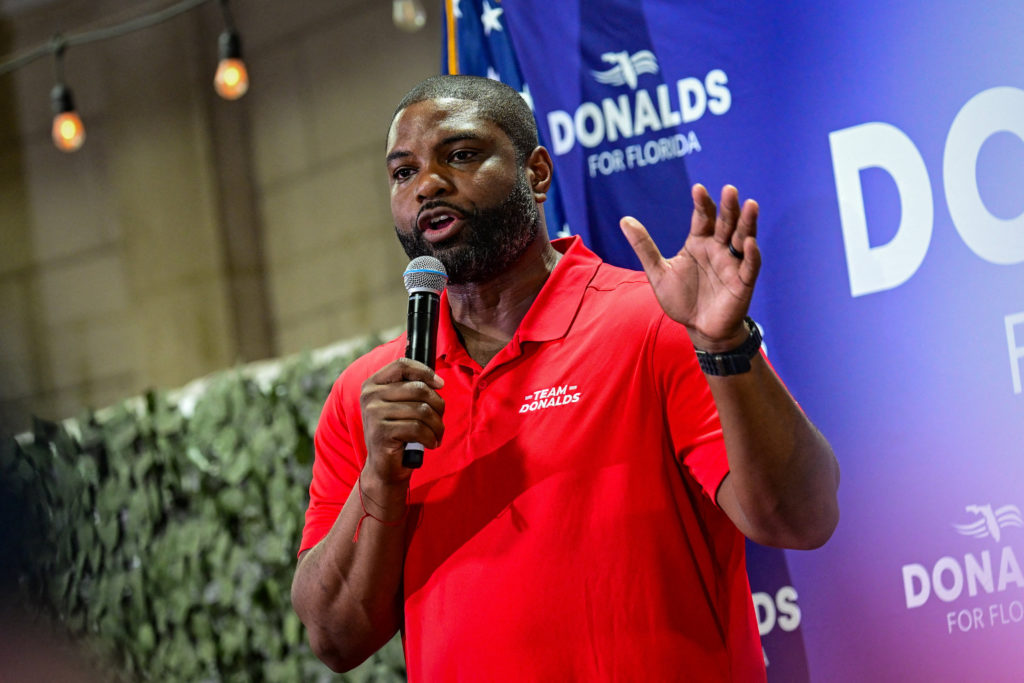
Byron Donalds Wins Florida Governor Race, First Black Governor-Elect
Byron Donalds won Florida’s governorship on Nov. 3 as the state’s first Black governor and the nation’s first elected Black Republican governor — and the first question he faces from Black voters is whether his administration will represent their interests.
The Root reported that his absence from Maryland Gov. Wes Moore’s “History” photo of incoming Black governors, posted on Wednesday, turned that question into a national conversation.
The photo, shared by Moore on X on Nov. 18, celebrated five Black Democratic governors. Donalds was not in it. As six Black governors, including U.S. Virgin Islands Gov. Stacey Plaskett, prepare to take office, the picture’s framing made Donalds’ milestone and his politics collide in a single image, per The Root.
Donalds, a staunch ally of President Donald Trump, defeated Democrat David Jolly — a former Republican congressman who switched parties — in what PBS News described as an unexpectedly competitive race. “I want you to hear from Florida that we are still red,” Donalds told supporters in South Florida, thanking Trump for being “in my corner,” according to PBS News.
History. pic.twitter.com/MF2BieX3vw
He succeeds term-limited Gov. Ron DeSantis, who used the office to steer the nation’s third-most populous state to the right. The political ground had shifted under Democrats over two cycles: DeSantis won his first race in 2018 by less than half a percentage point, then took reelection in 2022 by nearly 20 points, PBS News reported.
What Donalds promised Black Floridians
In an interview with M•I•A Media Group, The Root reported, Donalds laid out an agenda on housing, education, historically Black colleges and universities, health care and economic opportunity. He called affordability “the number one issue in Florida,” saying it is “hitting historically Black neighborhoods hardest.”
On housing, he proposed cutting homeowners insurance premiums by 20% to 30%, expanding homestead exemptions and working toward eliminating property taxes on primary residences — a salient pitch in a state, PBS News noted, where insurance costs were a central issue in the race.
“This is personal. I was a FAMU Rattler for three years,” Donalds said of his HBCU commitments, citing more than $111 million in federal debt relief for Florida A&M University and promising to “protect and grow state support for FAMU and Bethune-Cookman,” The Root reported.
Black Americans rely on Medicaid at disproportionately high rates, and Florida is one of the states that has refused to expand the program, leaving thousands of low-income residents in the coverage gap.
Asked about expansion, Donalds was blunt: “I don’t support Medicaid expansion. It grows a system that already costs too much and delivers too little.” He is instead pitching price transparency and lower prescription costs — which, The Root noted, does little for residents who cannot pay for care even when they know the price.
Why skepticism runs deep
The Miami Herald spoke with Black Florida voters who raised concerns about Donalds’ allegiance to Trump, his opposition to DEI and his association with DeSantis. Voting rights advocates have pressed further.
“He declined to sign the organization’s voting rights pledge,” Jasmine Burney-Clark, founder of Equal Ground, said of Donalds, according to CBS News reporting cited by The Root. Donalds maintains that Florida already has strong voting access and election security.
Donalds has questioned human-caused climate change while championing natural gas and nuclear power — an agenda The Root flagged against growing concerns in Black communities about AI data centers, environmental racism and who bears the burden of pollution.

Jolly, his defeated opponent, called Donalds’ policies “anti-Black,” citing his voting record on voting rights and minority business access. That is Jolly’s political characterization, not an independent finding. Donalds, responding on The Breakfast Club, said Jolly was “rage-baiting” him.
Older remarks have followed him into the governor’s office, too — including a 2024 reaction to Trump’s win that The Root resurfaced this year, when a post read “Daddy’s back,” and past comments on Jim Crow that have deepened skepticism among some Black voters.
Byron Donalds reflects on the historic significance of becoming Florida's first Black governor and what he believes his election says about the country. Speaking with @LaraLeaTrump, Donalds says Florida voters looked beyond race when choosing their next leader. "We don't care… pic.twitter.com/DBIlaIDIRm”
The crossover argument
Black Floridians are not politically monolithic, and Donalds has Black Republicans making his case. “I think he’s the only crossover candidate we have right now,” former North Miami Mayor Joe Celestin, a Black Republican, told the Miami Herald, arguing that Florida needs a governor focused on all residents rather than party loyalty.
Donalds himself framed his win the same way. “For myself personally, it’s a high honor. But for the people of Florida, it demonstrates that they don’t really care about skin color,” he told NBC’s “Meet the Press” after the Nov. 3 election. “They care about meritocracy. They care about getting a job done.”
Donalds joins a historic incoming class of Black leaders across the country — a fact the Moore photo showed by leaving him out as much as by including others. Making history is one thing. Producing a tangible policy record is another, and the promises on insurance, Medicaid and HBCU funding will be measured against it.
Donalds, born in 1978, was raised in the Crown Heights neighborhood of Brooklyn and attended Florida A&M University before transferring and earning a degree in finance and marketing from Florida State University in 2002. He worked in banking and financial services before entering politics, switched from the Democratic Party to the Republican Party in 2010, and won election to the Florida House in 2016, where he chaired the Insurance and Banking Subcommittee.
He has represented Florida’s 19th congressional district in the U.S. House since 2021, winning a crowded nine-way Republican primary in 2020 by 770 votes. During his second term, he was a nominee for Speaker of the House in the January 2023 and October 2023 roll-call votes. Along with Keisha Lance Bottoms of Georgia, he will be among the first Black governors in the South since Reconstruction.
His next dated step on the record: taking office as Florida’s first Black governor, succeeding DeSantis, with the agenda he outlined to M•I•A Media Group as his opening brief.
@ByronDonalds Republican Byron Donalds is elected Florida's first Black governorhttps://t.co/nR0Nc1KHUJ