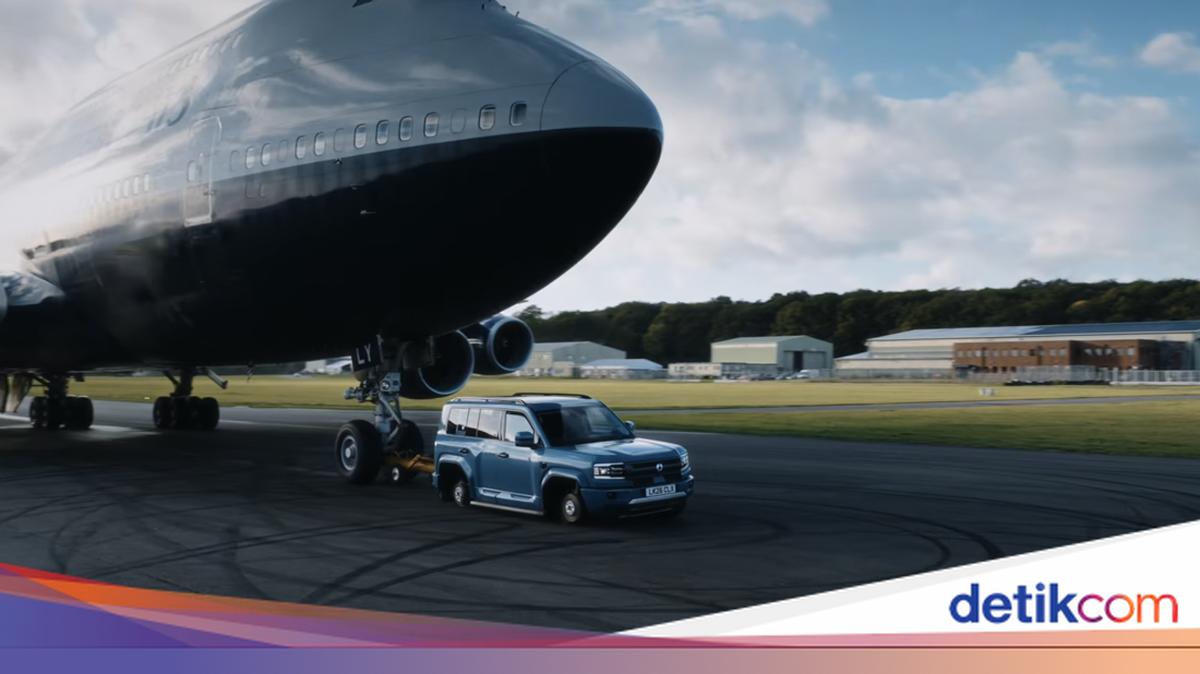
BYD Denza B5 PHEV Tows 180-Ton Boeing 747 Using Only Two Wheels
A plug-in hybrid SUV has pulled a 180-ton Boeing 747 along a British test track using only the two wheels on its left side.
The vehicle is the Denza B5, an off-road PHEV from Denza, BYD’s luxury sub-brand, sold in China as the Fang Cheng Bao 5, according to ANTARA News.
The stunt, covered by ANTARA News and credited to CarNewsChina, took place at a test track in the United Kingdom and was made public on Wednesday, November 18. BYD connected the SUV to the jumbo jet — the aircraft nicknamed the Queen of the Skies — with a rigid tow bar, then asked it to move a machine roughly 90 times its own curb weight.
BYD says the B5 used in the test was a standard vehicle with no modifications. The demonstration echoes Volkswagen’s Touareg, which famously towed a Boeing 747 with two wheels fitted years ago — a precedent ANTARA News itself draws — and now hands BYD a marketing proof point as it pushes the B5 into export markets.
Three runs, heavier each time
BYD engineers escalated the challenge in stages. In the first attempt, the B5 towed the aircraft on three wheels with 2,000 kg of ballast loaded inside the cabin, putting roughly 60 tons of load on each wheel in contact with the ground.

The second run removed the two right-side wheels and raised the cabin ballast to 4,500 kg. That left the SUV pulling the 180-ton jet on its two left-side wheels, each now carrying about 90 tons.
Across three attempts in total, the B5 hauled the Boeing 747 a cumulative 1,600 meters. Kompas and Medcom ID both carried the same sequence of figures.
What carried the load
BYD attributes the result to hardware. The B5 runs a hydraulic DiSus-P suspension that can drop ground clearance to 140 mm and is rated for a 9-ton lifting capacity. Its cell-to-chassis body structure uses 96% high-strength steel, which the automaker claims gives the SUV greater rigidity and strength.
The drivetrain is BYD’s DM-O plug-in hybrid system: a 1.5-liter turbocharged engine producing 135 kW (181 hp), paired with a 200 kW (268 hp) front electric motor and a 285 kW (382 hp) rear motor, according to detikoto. Combined output is 400 kW (536 hp) with 760 Nm of torque.
There is a caveat built into the design, and Medcom ID flags it plainly. The B5 has no mechanical link between its front and rear axles; each is driven by its own motor.
If the front wheels lose traction, their power cannot be transferred mechanically to the rear axle. Medcom ID notes that towing the 180-ton jet with a front or rear axle removed would therefore be a far harder task than the configuration BYD actually tested.

The market question behind the stunt
Where the B5 sells next is the live commercial question. ANTARA News reports there is still no official confirmation that the model will join the Denza lineup in Indonesia, though the outlet points to earlier coverage in which BYD signaled strongly that the B5 is headed for that market.
Denza began life in May 2010 as an equal-ownership joint venture between BYD and Daimler, the parent of Mercedes-Benz, and put its first model, the Denza EV, on sale in selected Chinese cities in late 2014. In December 2021 the alliance was restructured, with Mercedes-Benz cutting its stake from 50% to 10% in favor of BYD, and in September 2024 the German partner withdrew entirely by transferring its remaining 10% to BYD.
The brand started exporting in 2024, beginning with Southeast Asia, and in 2025 entered Brazil, Europe and the Middle East. In Indonesia, Denza is set to be rebranded as Danza effective 1 October 2026, following a local trademark dispute over the Denza name.
What BYD has not published is the measured drawbar pull or the peak load at the tow bar during the runs — the numbers an engineer would need to compare the B5’s result directly with the Touareg’s. Until those figures surface, the 1,600 meters stand as the record of what the standard B5 actually did on Wednesday, November 18.