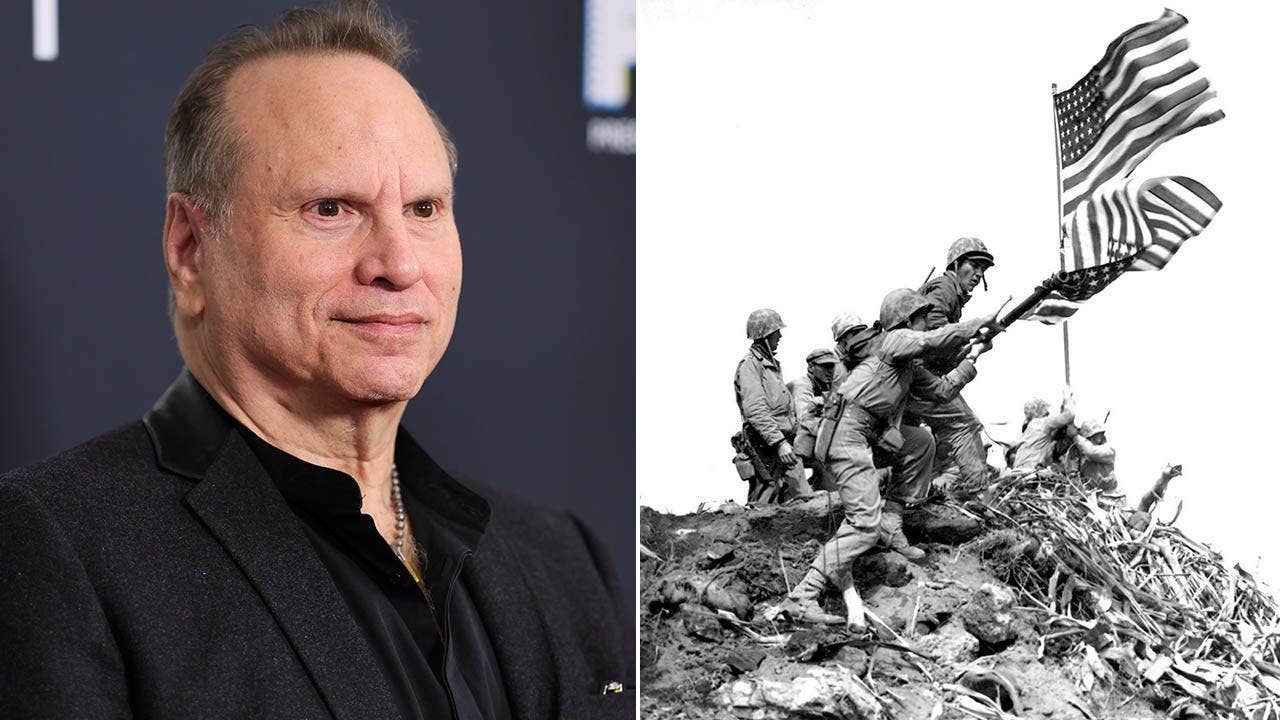
Buzz Bissinger Author Says Film Mosquito Bowl Depicts Real 1944 Guadalcanal Game
"War is brutal and there’s no way around it," said Buzz Bissinger, author of the 2022 book that inspired the new Netflix film The Mosquito Bowl.
The movie, which began streaming on Thursday chronicles the true story of college football stars who joined the Marine Corps after the attack on Pearl Harbor, USA Today reported. Bissinger’s own father served in the 4th Regiment.
The film follows four athletes—John McLaughry, Tony Butkovich, Dave Schreiner, and Bob Bauman—as they transition from the gridiron to the Pacific Theater. While the production condenses historical timelines, it depicts the real-life 1944 Christmas Eve football game played by Marines on the island of Guadalcanal, according to USA Today.
The game, which ended in a 0-0 tie, was played on a coral and gravel-covered parade ground and drew 1,500 drunk Marines, according to a 2003 account by Terry Frei. Fifteen of the 65 players who participated in the game were later killed in the Battle of Okinawa.
| Tony Butkovich | No. 11 overall, 1944 (Cleveland Rams) |
| Dave Schreiner | No. 11 overall, 1943 (Detroit Lions) |
| Bob Bauman | 24th round, 1943 (Chicago Bears) |
| John McLaughry | 3rd round, 1940 (New York Giants) |
The film’s climax mirrors the reality of the Battle of Okinawa, which lasted from April 1 to June 22, 1945. According to USA Today, 15 of the 65 players who participated in the original Mosquito Bowl scrimmage were killed during the Okinawa campaign.
Butkovich died in April 1945, while Bauman and Schreiner were killed in June. He was 24 years old. McLaughry, the only one of the four main characters to survive the war, later coached college football and lived until age 90.

Critical reaction to the film has been divided.
Bissinger maintained that the film’s grim portrayal of combat was intentional. "I’ve had a lot of military people say, ‘This is the best book I’ve read on World War II, because you did not hold back,’" he told Entertainment Weekly. "To me, that reaction is more important than anything else."
Film's Real-World Toll
Buzz Bissinger, the author whose book inspired the film, has received praise from military readers for its unflinching portrayal of combat.
The film’s depiction of the Battle of Okinawa reflects the grim reality faced by the players. The Army’s official history records the death of Marine Robert Murphy, who “was killed by a fragment when he paused to help a wounded Marine.” He was 24 years old.

Director's Grounded Approach
Director Peter Berg has emphasized the film’s commitment to reality. “This is very much a reality-based film,” Berg told Netflix’s Tudum, framing the story as not just a football film but “a great war story and an important war story.”
While the movie uses football as a backdrop, Berg said that “the football was an added bonus to me,” as the core of the project is the historical narrative. He also acknowledged that the production condenses timelines for storytelling purposes, a choice Bissinger supported as necessary to encapsulate his five years of research into a two-hour film.
Buzz Bissinger is an American journalist and author, best known for his 1990 non-fiction book Friday Night Lights, which documents the 1988 season of the football team at Permian High School in Odessa, Texas. This work was adapted into a 2004 film and a television series that debuted on NBC in 2006.
In 2005, Bissinger published Three Nights in August, a New York Times bestseller that chronicles a series between the St. Louis Cardinals and the Chicago Cubs through the perspective of Cardinals manager Tony La Russa.
Director’s Vision
"It Just Felt Like a Great War Story and an Important War Story," said Peter Berg. Berg, who also directed the film adaptation of Bissinger’s “Friday Night Lights,” co-wrote the new film with Mark L. Smith. He added, "This is very much a reality-based film." Bissinger said, "I wanted to get as close as I could get to the real thing."