Building a Safer AI Future: The Case for Open Models and Open-Source Cybersecurity
Industry Leaders Unite in Open Secure AI Alliance for AI Safety and Security
Major technology enterprises, cloud providers, and open-source foundations formally established the Open Secure AI Alliance to address critical infrastructure vulnerabilities and defensive tool distribution in the artificial intelligence sector. Building directly on the Linux Foundation’s Akrites initiative and OpenSSF community work, inaugural partners such as NVIDIA, Microsoft, IBM, Hugging Face, and Red Hat joined forces to develop open technologies, techniques, and tools to safeguard software and intelligent agents against emerging cyber threats.
The Tech TL;DR:
- The Coalition: Industry leaders across cloud computing, cybersecurity, and AI research launched the Open Secure AI Alliance to build an open defense stack for intelligent agents.
- The Catalyst: Recent high-profile security events, including the Hugging Face intrusion analyzed via the open-weight GLM 5.2 model, demonstrated that defenders require open frontier systems for rapid incident response when closed tools block necessary forensic analysis.
- The Architecture: Contributors are releasing open source tools like NVIDIA’s NOOA agent harness, HPE’s SPIFFE/SPIRE zero-trust identity frameworks, and Microsoft’s MDASH multi-model scanning harness to standardize enterprise security.
The Architectural Impasse: Open Defenses Versus Opaque Systems
Open source software remains a primary pillar of the global economy, directly supporting cloud computing, financial services, telecommunications, and government infrastructure. As enterprise adoption scales across multi-vendor environments, the United States and its international partners face a definitive architectural choice: whether infrastructure defenses will reside entirely within opaque, closed systems or be constructed on open models, harnesses, and tools that any defender can inspect, adapt, and deploy.
While closed frontier models retain significant value, cybersecurity demands open models and open harnesses to democratize defensive capabilities. Closed tools frequently create single points of failure. During the recent Hugging Face security incident, closed AI systems failed to distinguish between attackers and defenders, temporarily blocking essential forensic analysis. To resolve the bottleneck, Hugging Face deployed the open-weight GLM 5.2 model on its internal infrastructure to analyze over 17,000 actions and successfully contain the intrusion. This real-world event underscored a critical limitation: when engineers cannot inspect or run advanced AI locally, incident response times degrade precisely when execution speed is paramount.
Critics often argue that open models are inherently less secure because malicious actors can remove guardrails or repurpose weights for cyberattacks. However, the alliance notes that these risks are not exclusive to open architectures and persist regardless of whether weights remain closed. Mitigating these risks requires pairing openness with rigorous evaluation, strict rules against misuse, and rapid remediation rather than restricting access to defensive technology.
Building the Open Agent Defense Stack
An autonomous AI agent operates as a complex system composed of base models, security harnesses, identity verifications, and evaluation logs. Real AI safety depends on securing this entire stack rather than focusing exclusively on model weight accessibility.
- NVIDIA contributed open models, model weights, data sets, and advanced agent harness research, alongside the release of the NVIDIA Labs Object-Oriented Agent (NOOA) project on GitHub to simplify agent behavior testing, tracing, and auditing.
- HPE integrated support for SPIFFE/SPIRE, establishing zero-trust identity framework standards that cryptographically verify AI agents to ensure only authorized workloads access enterprise resources.
- Hugging Face offered Safetensors—a secure storage format for AI model weights that guarantees protection against remote code execution—to the PyTorch Foundation.
- IBM and Red Hat introduced Lightwell, designed to extend supply chain security through digitally signed patches across open-source repositories.
- Microsoft developed MDASH, a multi-model agentic scanning harness that orchestrates specialized AI agents to discover, debate, and verify exploitable vulnerabilities.
- SpaceXAI open-sourced the Grok Build terminal-based coding agent and announced plans to release the weights of the Grok model line.
# Initialize secure agent evaluation harness
git clone https://github.com/nvidia-labs/nooa-framework.git
cd nooa-framework
pip install -r requirements/production.txt
python -m nooa.eval --model-weights ./weights/glm-5.2 --verify-spi
Inaugural Alliance Partners and Ecosystem Scope
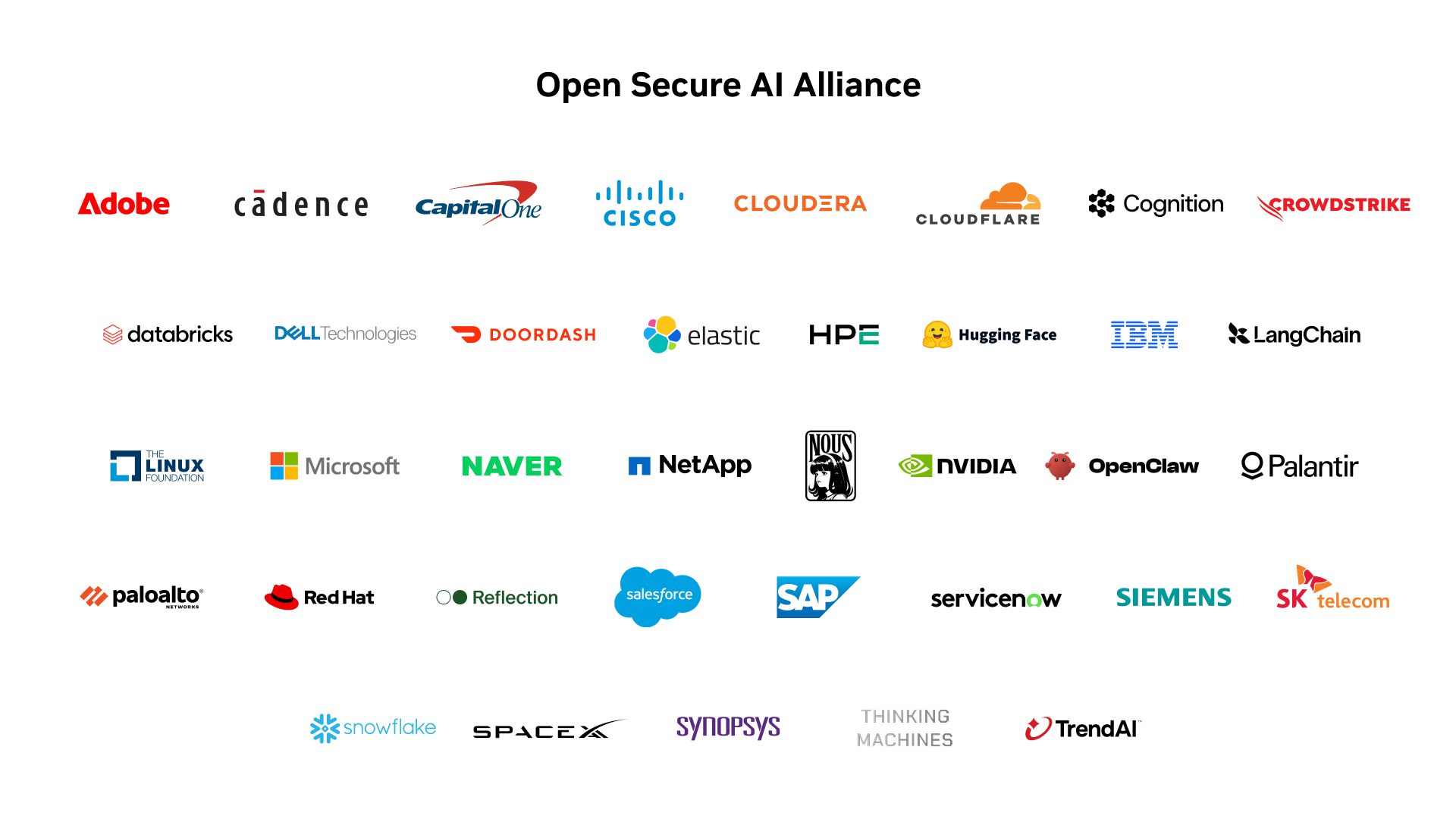
The Open Secure AI Alliance brings together a broad coalition of industry leaders spanning cloud infrastructure, semiconductor design, cybersecurity, enterprise software, and AI research. The inaugural roster includes NVIDIA, Adobe, Cadence, Capital One, Cisco, Cloudera, Cloudflare, Cognition, CrowdStrike, Databricks, Dell Technologies, DoorDash, Elastic, HPE, Hugging Face, IBM, LangChain, the Linux Foundation, Microsoft, NAVER, NetApp, Nous Research, OpenClaw, Palantir, Palo Alto Networks, Red Hat, Reflection AI, Salesforce, SAP, SK Telecom, ServiceNow, Siemens, Snowflake, SpacexAI, Synopsys, Thinking Machines Lab, and TrendAI.
By uniting these organizations, the alliance aims to prevent technological concentration in a handful of closed providers.
Future Outlook for Enterprise AI Security
As regulatory bodies and enterprise CTOs evaluate AI safety mandates, treating open models and security tooling as defensive assets will be essential for maintaining resilient infrastructure. Relying solely on secrecy does not prevent determined adversaries from exploiting software vulnerabilities. By building systems open enough to withstand rigorous scrutiny and flexible enough to incorporate community-driven patches, the industry can establish a durable baseline for the AI era.
*Disclaimer: The technical analyses and security protocols detailed in this article are for informational purposes only. Always consult with certified IT and cybersecurity professionals before altering enterprise networks or handling sensitive data.*