Brookhaven National Laboratory physicists detect unexpected dip in gold ion collisions
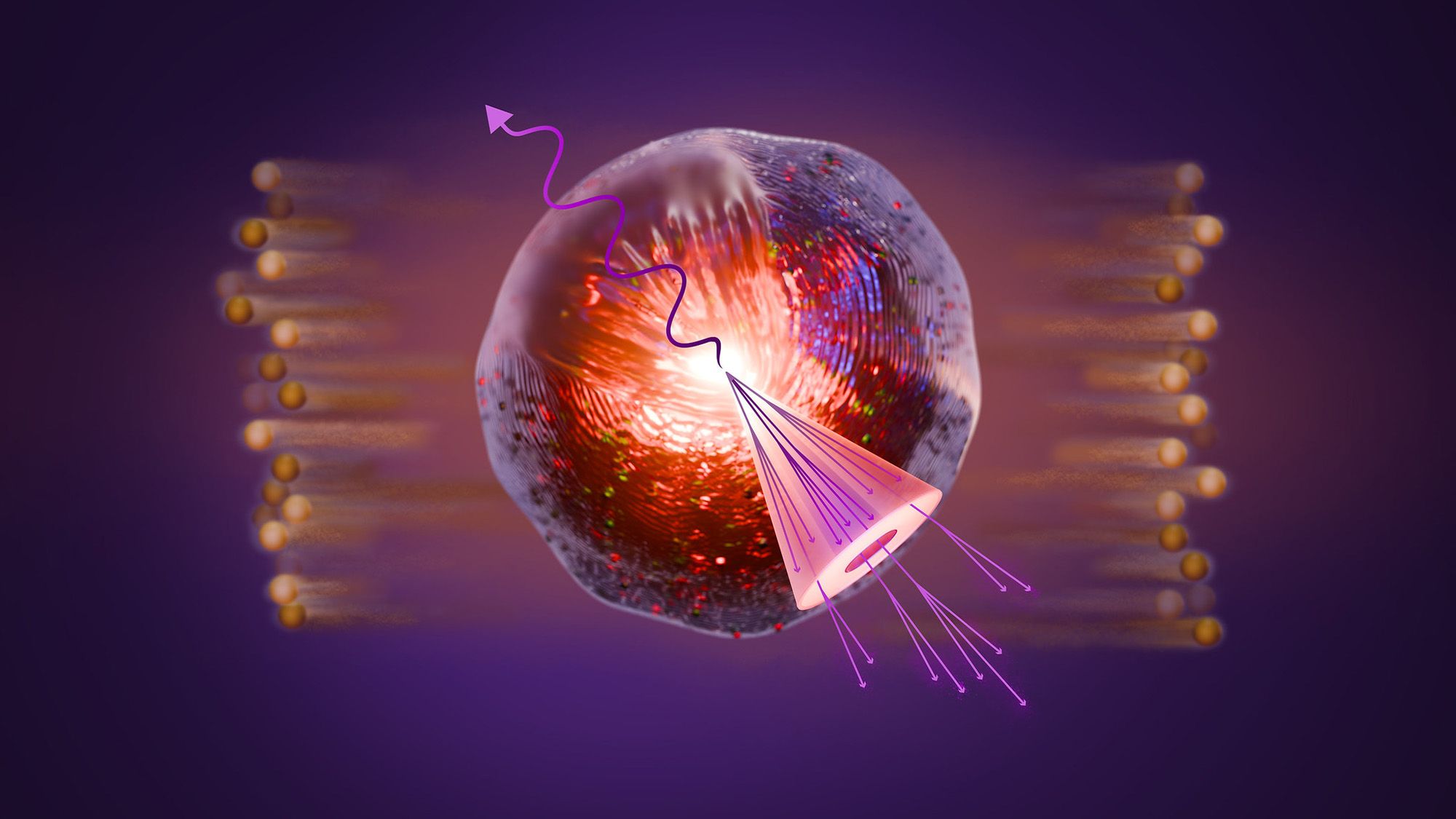
Particle physicists colliding gold nuclei at nearly the speed of light at Brookhaven National Laboratory have detected an unexpected dip in the sideways momentum of particles flung out of the resulting fireballs, a pattern that may point toward a long-sought critical point in nuclear matter. The findings, published Sept. 22 in Physical Review Letters and covered by livescience.com, offer a fresh probe into the quark-gluon plasma that filled the universe in the first microseconds after the Big Bang.
-
The Tech TL;DR:
- Physicists at the Relativistic Heavy Ion Collider analyzed roughly 1 billion gold-on-gold collisions at energies between 3 and 7.7 GeV per pair.
- Instead of a smooth shift in particle collision variations, detectors recorded an unexpected dip that could mark a nuclear critical point.
- The data helps researchers map the equation of state for extreme nuclear matter, providing empirical benchmarks for early universe models and neutron star cores.
Colliding Gold Nuclei at the Relativistic Heavy Ion Collider
Operating the Relativistic Heavy Ion Collider (RHIC) in New York, researchers focused on the lowest end of the facility’s energy range to compress nuclear matter into extreme densities. At these collision energies—ranging from 3 to 7.7 giga electron volts per pair of colliding protons or neutrons—protons and neutrons melt into a free soup of quarks and gluons. According to livescience.com, the STAR experiment utilized a fixed-target setup where a beam of gold nuclei struck a thin gold foil inside the detector rather than an oncoming beam.
In every collision, charged particles are flung sideways out of the fireball. Physicists measure how hard these particles are flung, a value known as transverse momentum, and look for correlations between them. While researchers expected the size of these collision variations to change smoothly as energy levels adjusted, the measured variations instead dipped, shrinking before growing again. Rutik Manikandhan, a postdoctoral physics scholar at The Ohio State University, noted to livescience.com that this dip could signal a critical point where nuclear matter changes how it transforms from one form to another.

Collider Measurements Highlight Unknowns About the Early Universe
The convergence of these collider measurements and cosmological simulations shows how much is still unknown about the universe's infancy. Although the RHIC signal is strong enough to rule out a statistical accident, researchers emphasized that the observed dip remains a tantalizing hint rather than definitive proof of a nuclear critical transition. Pinning down the exact equation of state requires continuous collaboration between experimentalists and theorists running advanced numerical simulations.
# Conceptual parameter check for heavy-ion collision energy scans
energy_range_gev = [3.0, 7.7, 200.0]
target_type = "gold_foil_fixed_target"
detected_phenomenon = "transverse_momentum_dip"
if energy_range_gev[0] <= 7.7 and detected_phenomenon:
    print("Critical point signature detected in low-energy RHIC scan.")
Researchers mapping these extreme nuclear states continue to refine their datasets across different collision thresholds.
Mapping the Evolution of Early Cosmic Matter
Understanding how quark-gluon plasma cools into ordinary matter gives astrophysicists a baseline for modeling the interiors of neutron stars, where matter exists under similarly extreme conditions. The equation of state serves as the fundamental rulebook for these environments, dictating how pressure, temperature, and density link together. As teams at Brookhaven continue processing the multi-billion collision logs, subsequent analysis runs will determine if the observed momentum variations hold steady under expanded statistical checks.
The STAR experiment operated at RHIC up to its maximum energy of 200 GeV, but the crucial lower-tier runs at 3 to 7.7 GeV provide the high densities required to approach the conjectured critical point.