
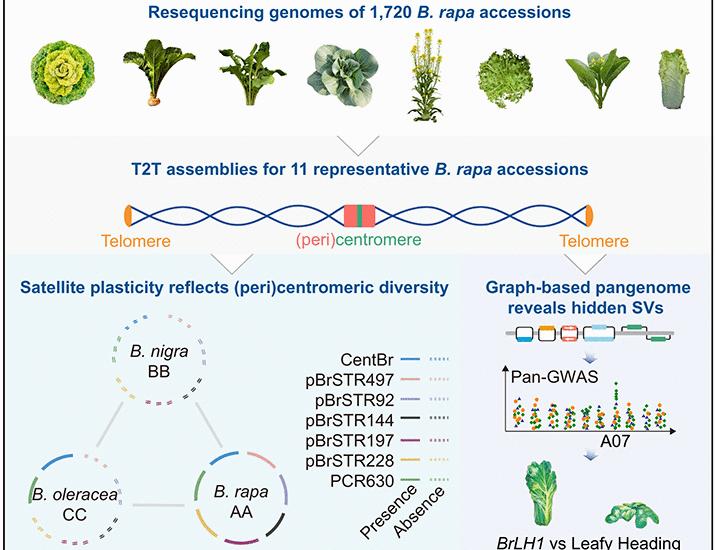
Researchers have created gapless genome assemblies for eleven subspecies of Brassica rapa, a globally important crop species, revealing new insights into its rapid diversification and offering valuable resources for future breeding programs.
The study, detailed in recent publications including perform in Science and Nature, involved resequencing the genomes of 1720 B. Rapa accessions. This extensive genomic analysis identified 6992 previously unknown genes and 110 complete (peri)centromeres, along with five new satellite sequences associated with different B. Rapa morphotypes and subspecies, and broader implications for the Brassica genus.
Brassica rapa, encompassing a wide range of varieties, serves as a key model for understanding plant diversification and the development of distinct subspecies. The newly assembled genomes are “telomere-to-telomere gapless,” meaning they represent complete sequences of the plant’s genetic material, a significant improvement over previous assemblies published in 2011 and subsequent updates.
Researchers utilized both de novo assembly techniques and resequencing to achieve this comprehensive genomic picture. Pangenome-wide association studies pinpointed the gene BrLH1 as controlling leaf-head formation, a crucial trait in certain B. Rapa varieties. The analysis demonstrates that structural changes within satellites, (peri)centromeres, and genes have played a significant role in the species’ rapid subspeciation and morphotypification during cultivation.
The genomes of three Brassica oleracea accessions, including a wild type, were also assembled at the chromosome level, alongside improvements to the genomes of two Brassica rapa genotypes. RNA-Seq data from flower buds, leaves, roots, and stems were generated to aid in gene annotation, with 94.97 to 99.49% of predicted genes anchored to pseudomolecules. The research also predicted resistance gene analogs, including those unique to each assembly, representing a crucial resource for expanding the known reservoir of disease resistance genes.
These findings provide invaluable resources for Brassica breeding, offering a deeper understanding of the genetic basis of important agronomic traits. The completed genomes and identified genetic markers will facilitate more precise and efficient crop improvement strategies.
