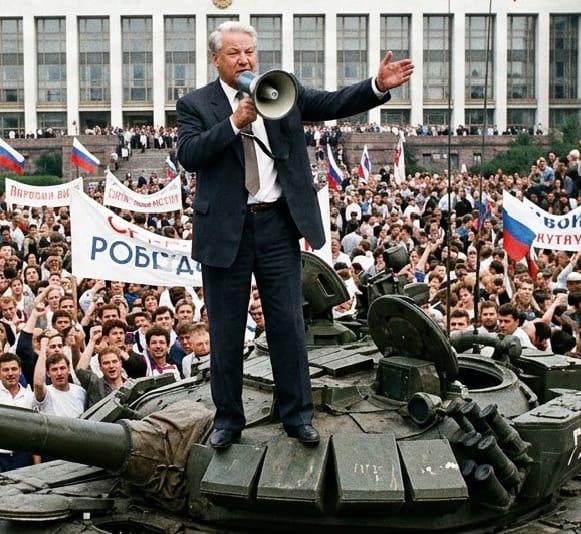
Boris Yeltsin led resistance against 1991 Soviet coup attempt
The 1991 Soviet coup d’état attempt remains a defining geopolitical pivot, where the collapse of the USSR was accelerated by the failed resistance of hardline communist factions against reformists led by Mikhail Gorbachev and Boris Yeltsin.
The 1991 Coup and the Collapse of the Soviet Power Structure
In August 1991, the Soviet political landscape fractured when hardline members of the Communist Party of the Soviet Union (PCUS), including high-ranking military officials and the KGB, attempted to seize power. The coup leaders, led by Vice President Gennady Yanayev and KGB chief Vladimir Kryuchkov, detained Mikhail Gorbachev at his residence in Crimea. The conspirators sought to arrest the transition process, which had been characterized by Gorbachev’s twin pillars of reform: Perestroika (economic and institutional restructuring) and Glasnost (freedom of expression).
The attempt to reassert control failed as Boris Yeltsin, then a prominent political rival to Gorbachev, emerged as the central figure of the resistance. Yeltsin defied the military blockade at the Soviet parliament building, known as the “White House.” By standing atop a tank to address the military and the public, Yeltsin stripped the coup organizers of their perceived legitimacy. This confrontation effectively neutralized the hardline attempt to reverse the democratic shifts initiated between 1985 and 1991.
Vladimir Putin’s Role in the Leningrad Transition
The 1991 crisis also marked a significant moment for Vladimir Putin, then an advisor to the reformist mayor of Leningrad, Anatoli Sobchak. According to his account in First Person, Putin utilized his background within the KGB to prevent the deployment of heavy weaponry against thousands of protesters in Leningrad. His decision to support the democratic transition over the security apparatus he was trained in served as a foundation for his political rise, eventually leading to his presidency in 2000 with the backing of both Sobchak and Yeltsin.
Global Alliances and the End of the Cold War
The transition away from communism was not an isolated internal event but was bolstered by a coalition of international leaders. Figures such as Ronald Reagan, Pope John Paul II, Margaret Thatcher, Helmut Kohl, and François Mitterrand provided critical external support for the reforms. Pope John Paul II, in particular, maintained a strategic alignment with Lech Wałęsa’s Solidarity movement in Poland, which pressured the Soviet bloc from within.
The cohesion of this international response contrasted sharply with the internal dissent of the Soviet old guard, represented by figures like Yegor Ligachev and Nina Andreyeva, who characterized the reforms as a betrayal of communist doctrine. While these internal factions sought to preserve the status quo, the momentum of the Yeltsin-Gorbachev period proved irreversible. The failed coup did not just collapse the emergency committee; it signaled the imminent dissolution of the Soviet Union itself.